
BOSCH SPS4IMW00X Dishwasher












Dishwasher
SPS4IMW00X
[en]
Information for Use


| General | Details |
|---|---|
| Name | BOSCH SPS4IMW00X Dishwasher |
| Make | Bosch |
| Language | English |
| Filetype | PDF (Download) |
| File size | 1.7 MB |
 (1 votes, average: 5.00 out of 5)
 Loading...

BOSCH SMV6ZCX49E-39 Dishwasher

BOSCH SMI4HVS33E Dishwasher

BOSCH SRV2HKX39G Dishwasher

BOSCH SGS4HAW40G Dishwasher

BOSCH SGH4HVX32G Dishwasher

BOSCH SMS4ECI26E Dishwasher

BOSCH SMS6EDI02G Free-Standing Dishwasher

BOSCH SMS6EDW02G Free-Standing Dishwasher

BOSCH SMV4HTX27G Dishwasher

BOSCH SMV4HCX48E Dishwasher

BOSCH SPS4IMW00X Dishwasher Overview
Summary of Contents
- Page 1: Dishwasher SPS4IMW00X Information for use
- Page 2: Further information and explanations are available online. Table of contents. Safety. General information. Intended use. Restriction on user group. Safe installation. Safe use. Risk to children. Environmental protection and saving energy. Installation and connection. Familiarising yourself with your appliance. Suitable detergents. Adding detergent. Tableware. Damage to glass and tableware.
- Page 3: Customer service Product number (E-Nr.), production number (FD) Basic operation Opening appliance door Switching on the appliance Setting a programme Activating button lock Cleaning and servicing Troubleshooting Transportation, storage and disposal
- Page 4: Safety Observe the following safety instructions. Read this instruction manual carefully. Keep the instruction manual and the product information safe for future reference or for the next owner. Do not connect the appliance if it has been damaged in transit. Only use this appliance for cleaning household tableware. This appliance may be used by children aged 8 or over and by people who have reduced physical, sensory or mental abilities or inadequate experience and/or knowledge, provided that they are supervised or have been instructed on how to use the appliance safely. Do not let children play with the appliance. Cleaning and user maintenance must not be performed by children unless they are being supervised. Keep children under the age of 8 years away from the appliance and power cable.
- Page 5: Safety The legal communications means radio communications operated in compliance with the Telecommunications Act. Low power radio-frequency devices must be susceptible to interference from legal communications or ISM radio wave radiated devices. Improper installation may cause injury. When installing and connecting the appliance, follow the instructions in the manual and installation instructions. Incorrect installation is dangerous. Connect and operate the appliance only in accordance with the specifications on the rating plate. Always use the supplied power cable for the new appliance. Connect the appliance to a power supply with alternating current only via a properly installed socket with earthing. The protective conductor system of the domestic electrical installation must be properly installed. Never immerse the plastic housing in water.
- Page 6: Safety Warning - Risk of fire! It is dangerous to use an extended power cord and non-approved adapters. Do not use extension cables or multiple socket strips. Only use adapters and power cords approved by the manufacturer. If the power cord is too short and a longer one is not available, please contact an electrician to have the domestic installation adapted. Check that there is a distance of at least 5 cm between the appliance and installation lines. Warning - Risk of burns! If the appliance is not installed properly, this may result in burns. With free-standing appliances, ensure that they are installed with the back panel against a wall. Warning - Risk of serious harm to health! Failure to comply with safety instructions and directions for use on packagings of detergent and rinse aid products may cause serious harm to health. Warning - Risk of explosion! Never add solvents to the interior of the appliance.
- Page 7: Safety Highly caustic alkaline or highly acidic cleaning agents in conjunction with aluminium parts may cause explosions. Never use highly caustic alkaline or highly acidic cleaning agents with aluminium parts. Leaving the appliance door open may result in injury. Only open the appliance door to load or unload tableware to prevent accidents. Do not sit or stand on the appliance door when open. Arrange knives and utensils with sharp points in the cutlery basket with the points downwards. If you open the appliance door while the programme is running, hot water may splash out. Open the appliance door carefully if the programme is still running. Overfilling the baskets may cause the appliance to tip up. Never use steam- or high-pressure cleaners to clean the appliance.
- Page 8: Safety Never let the power cord come into contact with sharp points or edges. Never kink, crush or modify the power cord. If the appliance or the power cord is damaged, this is dangerous. Never operate a damaged appliance. Never operate an appliance with a cracked or fractured surface. Repairs to the appliance should only be carried out by trained specialist staff. Only use genuine spare parts when repairing the appliance. Children may put packaging material over their heads or wrap themselves up in it and suffocate. Keep packaging material away from children. Use the childproof lock if fitted.
- Page 9: Safety Never let children play with or operate the appliance. Children can lock themselves in the appliance, thereby putting their lives at risk. With redundant appliances, unplug the power cord and damage the lock on the appliance door beyond repair. With higher-level appliances, children can become crushed between the appliance door and cabinet doors underneath. Keep an eye on children when opening and closing the appliance door. Rinse aid and detergent may cause chemical burns to the mouth, throat, and eyes. Keep children away from detergent and rinse aid products. The water in the interior of the dishwasher is not drinking water and may contain residues of detergents and rinse aid. Children may get their fingers caught in the slots of the tablet collecting tray and injure themselves. The appliance is equipped with a childproof lock.
- Page 10: Preventing material damage Modified or damaged water hoses may result in material damage and damage to the appliance. Never kink, crush, modify or cut through water hoses. Only use the water hoses supplied with the appliance or genuine spare hoses. Never re-use water hoses that have been used before. Safe installation Improper installation of the appliance may cause damage. If the dishwasher is installed above or below other domestic appliances, follow the information on installation in combination with a dishwasher. Make sure that the water pressure in the water supply system is min. 50 kPa (0.5 bar) and max. 1000 kPa (10 bar). Do not install the dishwasher under a hob. Escaping water vapour can damage fitted units.
- Page 11: Childproof lock The childproof lock lets you protect children from possible hazards resulting from the appliance. The appliance is equipped with a door lock. The door lock is a mechanical safety system and makes it more difficult to open the appliance door. You can activate or deactivate the door lock. Risk of suffocation! Children may become trapped in the appliance and thus suffocate. Activate the door lock and close the appliance door. The door lock remains activated until it is deactivated manually. The packaging materials are environmentally compatible and can be recycled. Sort the individual components by type and dispose of them separately.
- Page 12: Installation and connection If you follow these instructions, your appliance will use less electricity and less water. You can position your built-under or integrable appliance in a fitted kitchen between wooden and plastic walls. Use the Eco 50° programme, which is energy-efficient and environmentally friendly. Follow the safety instructions. To ensure proper operation, connect the appliance to the power and water supply correctly. Check the scope of supply and the condition of the appliance. Make the appliance level using the height-adjustable feet. Install the drainage connection to discharge dirty water via the wash cycle. The delivery consists of the dishwasher, operating instructions, installation instructions, and other documents. Connect the wastewater hose to the outlet connection of the siphon using the enclosed parts.
- Page 13: Installation and connection Check that the wastewater hose is not kinked, crushed, or twisted. Insert the mains plug of the appliance's power cable in a socket nearby. Check that there is no cover in the drainage system preventing the wastewater from being discharged. The connection data of the appliance can be found on the rating plate. Check the mains plug is inserted properly. Connect your appliance to a drinking water connection. If you are replacing the appliance, you must use a new water supply hose. Consult the installation instructions supplied for the steps required. When doing so, check that the drinking water connection is not kinked, crushed, or twisted. Follow the safety instructions.
- Page 14: Familiarising yourself with your appliance Add detergent to the detergent dispenser. Add special salt to the dispenser for special salt. During the wash cycle tablets automatically fall out of the detergent dispenser into the tablet collecting tray where they can fully dissolve. The upper spray arms wash the tableware in the top basket. If the tableware has not been washed properly, clean the spray arms. The lower spray arm washes the tableware in the bottom basket. Add rinse aid to the dispenser for rinse aid.
- Page 15: Familiarising yourself with your appliance You can use the control panel to configure all functions of your appliance and to obtain information about the operating status. With some buttons you can perform different functions. ON/OFF button and reset button Switching on the appliance Switching off the appliance Terminating the programme Programme buttons Special salt refill indicator Rinse aid refill indicator
- Page 16: Familiarising yourself with your appliance Programme buttons and additional functions The display shows information about the remaining running time or the basic settings. You can change the basic settings via the display and the setting buttons. Open the appliance door. The display shows the following symbols depending on the model. If the appliance is connected to a wireless WLAN home network, the symbol lights up on the display. If the rinse aid refill indicator lights up on the display, top up with rinse aid. If you have activated the button lock, the symbol lights up on the display. If the water inflow or drainage malfunctions, the symbol lights up or flashes on the display. If the special salt refill indicator lights up on the display, add special salt to the dispenser for special salt just before the programme starts.
- Page 17: You can find an overview of the programmes that can be selected here. Different programmes are available depending on the appliance configuration. The running time may vary depending on the programme selected. The consumption values can be found in the quick reference guide. Programme sequence includes various cleaning processes for different types of tableware. Intensive programme is suitable for pots, pans, and non-fragile tableware. Sensor-controlled programme optimizes cleaning based on the level of soiling. The most economical programme is designed for mixed tableware and cutlery. Particularly gentle programme is intended for delicate tableware and temperature-sensitive plastics. The level of soiling affects the choice of programme and cleaning effectiveness.
- Page 18: Programmes Programme sequence Time-optimised: Delicate tableware, cutlery, temperature-sensitive plastics and glasses Cleaning 45 °C Express 45° Level of soiling: Lightly adhering fresh food remnants Cold rinsing: Pre-Rinse All types of dishes Note: The relatively long running time in the Eco 50 ° programme is due to longer soaking and drying times. Information for test institutes: Test institutes are provided with information for comparability tests, e.g. according to EN60436.
- Page 19: Additional functions You can find an overview of the additional functions that can be selected here. Different additional functions, which can be found on the control panel of your appliance, are available depending on the appliance configuration. ExtraDry: For a better drying result the final rinse temperature is increased and the drying phase extended. Especially suitable for drying plastic parts. There is a slight increase in energy consumption and the running time is extended. Hygiene+: To ensure a higher hygiene status for the appliance and tableware, the temperature is raised and maintained for an extra-long period. Especially suitable for cleaning chopping boards or baby bottles. Continuous use of this function increases the hygiene status. This will increase the running time and energy consumption. IntensiveZone: Switch on with mixed loads containing tableware with different soiling levels. The spray pressure in the bottom basket is increased and the maximum programme temperature maintained longer. This will increase the running time and energy consumption. SpeedPerfect: The run time is shortened by 15% to 75% depending on the rinse programme. The additional function can be activated before the start of the programme and at any time when the programme is running. Energy and water consumption are increased.
- Page 20: Features You can find an overview of the possible features of your appliance and how to use them here. These features depend on the model of your appliance. Arrange cups, glasses and small items of tableware in the top basket. You can adjust the height of the top basket to make room for larger items of tableware. Check that the basket is level on both sides. To wash large items of tableware in the baskets, adjust the shelf position of the top basket. The basket clicks into position. Pull out the top basket. To prevent the basket from suddenly dropping down, hold the side of the basket by the top edge.
- Page 21: Features Use the cutlery shelf and space underneath for small cups and glasses or for large items of cutlery, e.g. cooking spoons or serving cutlery. Arrange pans and plates in the bottom basket. If you do not need the cutlery shelf, you can fold it up. Use the small items holder to position small items of tableware, e.g. light plastic parts. Large plates up to a diameter of 31 cm can be arranged in the bottom basket as shown.
- Page 22: Features Use the folding prongs to position tableware securely, e.g. plates. Arrange cutlery in the cutlery basket, always without sorting it and with the sharp points downwards. You can fold the prongs down to position pans, bowls and glasses better. Arrange cutlery in the cutlery drawer. If you do not need the prongs, fold them down. Push the lever forwards and fold down the prongs. Arrange cutlery with the points and sharp edges downwards. To use the prongs again, fold them back up. The prongs audibly click into position.
- Page 23: Before using for the first time, add detergent and start the programme with the highest cleaning temperature without tableware. To remove any marks from water or other residues, operate the appliance without tableware before using it for the first time. On initial start-up or after a reset to the factory settings, you will need to make settings. You can change these settings and other basic settings at any time. Connect your appliance to a mobile device to conveniently change all settings via the Home Connect app. Hard water leaves limescale on the tableware and parts of the appliance may become blocked. To ensure good dishwashing results, treat the water with special salt and the water softening system. Water with a hardness above 9 °E must be softened to avoid damage to the appliance. You can find an overview of the water hardness values that can be selected here. Find out how hard your water is from your local water company or by using a water hardness tester.
- Page 24: Water softening system Water hardness Set the water hardness determined on your appliance. The higher the water hardness, the greater the consumption of special salt. Detergent may damage the water softening system. With a water hardness of 0 - 8 °E you can dispense with special salt for dishwashers and switch off the water softening system. Only fill the dispenser of the water softening system with special dishwasher salt. To make sure that any special salt that escapes is washed out of the tub, add the special salt to the dispenser for special salt immediately before the programme starts. Set the water hardness on your appliance. Only use special salt for dishwashers. The value H04 is set at the factory.
- Page 25: Rinse aid system For optimum drying results, use rinse aid. Only use rinse aid for domestic dishwashers. If the rinse aid refill indicator lights up, top up with rinse aid. To avoid damage to the appliance, only switch off the water softening system in specific cases. The water hardness is max. 26 °E and you are using a combined detergent with salt replacement substances. The water hardness is 0 - 8 °E. You do not need to use special salt. If rinse aid spills out, remove it from the tub. Spilled rinse aid can cause excessive frothing during the wash cycle. Adding rinse aid involves pressing the catch on the lid of the dispenser.
- Page 26: Detergent The display shows Hxx. To open the basic settings, press for 3 seconds. Only use detergents that are suitable for dishwashers. For optimum washing and drying results, use separate detergent. Modern, powerful detergents mainly use a low-alkaline formulation with enzymes. A low setting adds less rinse aid during the wash cycle and reduces streaking on tableware. A higher setting adds more rinse aid during the wash cycle, reduces water marks, and improves the drying result. Follow the manufacturer's instructions for each detergent. The function of rinse aid is limited with combined detergents. Tabs are suitable for all cleaning functions and do not need to be measured out.
- Page 27: Detergent Combined detergents generally only function up to a water hardness of 26 °E. With a water hardness above 26 °E, you will need to add special salt and rinse aid. For the best washing and drying results, we recommend using special salt and rinse aid from a water hardness of 17 °E. Powder detergent is recommended for shorter programmes. Liquid detergent works faster and is recommended for shorter programmes without PreRinse. Do not use detergent which could cause damage to the appliance or present a risk to health. Hand washing-up liquid can cause increased frothing and damage the appliance. Chlorine residue on tableware may present a risk to health. Detergents marked as organic or ecological generally contain lower levels of active agents. Combined detergents with salt replacement substances can only be used up to a certain water hardness.
- Page 28: Tableware Only put glasses and china in the dishwasher if it is marked as dishwasher-safe by the manufacturer. Avoid damage to glass and tableware. The following tableware is not dishwasher-safe: Items of cutlery and tableware made from wood. Decorated glassware, antique and hand-crafted tableware. Plastic parts not resistant to heat. Tableware made from copper or tin. Tableware soiled with ash, wax, lubricating grease or paint. Only clean tableware that is suitable for dishwashers. Decorated glassware and parts made of aluminium or silver may fade or discolour with dishwashing. Delicate types of glass may turn cloudy after a few washing cycles.
- Page 29: Tableware Allowing steam to escape and water to leak out around the door could damage your kitchen units. Highly caustic alkaline or highly acidic cleaning agents, particularly commercial or industrial cleaners, are not safe to use in the dishwasher with aluminium. The water temperature of the programme is too high. Select a programme with lower temperatures. After the programme has ended, take glassware and cutlery out of the appliance without delay. Using the appliance allows you to save energy and water compared to washing-up by hand. To save energy and water, load the machine with the number of place settings specified. For better washing and drying results, position items with curves or recesses at an angle so water can run off. Arrange tableware correctly to optimise the dishwashing result and prevent damage to both the appliance and tableware. Load the baskets so that no projecting items of tableware interfere with closing of the door. Remove large remnants of food from tableware.
- Page 30: Basic operation To save resources, do not pre-rinse tableware under running water. WARNING: Hot tableware can cause burns to the skin. When the programme has ended, do not empty the appliance until the tableware has cooled down for a while. Put heavily soiled tableware in the bottom basket, e.g. pans. Arrange cutlery with the points and sharp edges facing down to prevent injury. Position containers with the openings facing down so no water can collect in them. To prevent water dripping on the tableware, unload it starting at the bottom and working up. Check the washing tank and accessories for soiling and clean if necessary. Do not block the spray arms - make sure that they can turn freely. If the childproof lock is activated, press the catch of the lock to the right to open the appliance door.
- Page 31: Basic operation Switching on the appliance Setting timer programming You can delay the start of the programme by up to 24 hours. The Eco 50° programme is set by default. If you do not perform any actions on the appliance for 10 minutes, the appliance will automatically switch off. Setting a programme To adjust the washing programme to the soiling level of the tableware, select a suitable programme. Starting the programme Requirement: The appliance door is closed. The programme has ended when the display shows 0h:00m. Setting additional functions You can set additional functions to complete the washing programme selected.
- Page 32: Basic operation The button lock is activated and will be automatically deactivated at the end of the programme. If you press during the wash cycle, the programme currently running will be interrupted. When the appliance is operated, flashes on the display. The button lock remains activated with a power failure. To deactivate the button lock, press for approx. 3 seconds. When you open the appliance door once heated up, leave it slightly ajar for a few minutes. To resume the programme, press to continue. To end a programme early, you will need to cancel it first. Press for approx. 4 seconds to cancel the programme. The programme is cancelled and ends after approx. 1 minute.
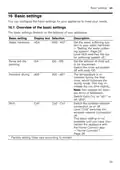
- Page 33: Basic settings can be configured to meet your needs. The basic settings depend on the features of your appliance. Set the water softening system to your water hardness. Level H00 switches the water softening system off. Set the amount of rinse aid to be dispensed. Switch the rinse aid system off with level r00. The temperature is increased during the final rinse, which improves the drying result. Switch Extra Dry on d01 or off d00. Switch the wireless network connection on or off. This basic setting is not available until you have connected the appliance with the Home Connect app.
- Page 34: Home Connect Basic setting Remote Start The following settings are possible: With the setting rc0, the function is permanently deactivated. With the setting rc1, the function can be selected via the button. With the setting rc2, the function is permanently activated. This basic setting is not available until after you have connected the device with the Home Connect app. Restore changed settings to the factory settings. You can change several settings. To save the settings, press for 3 seconds. Connect your appliance to a mobile device to control its functions via the Home Connect app.
- Page 35: Home Connect services in your country can be found at www.home-connect.com. To use Home Connect, set up the connection to the WLAN home network and the Home Connect app. Open the Home Connect app and scan the QR code. The Home Connect app guides you through the entire login process. Please note the safety precautions in this instruction manual when operating the appliance via the Home Connect app. You can use the Home Connect app to start the appliance with your mobile device. If you select rc2 in the basic settings, the function is permanently activated. Install the Home Connect app on your mobile device. The appliance must be connected to your WLAN home network and the Home Connect app. The appliance door must be closed for the function to remain activated.
- Page 36: Cleaning and servicing Data protection To keep your appliance working efficiently for a long time, it is important to clean and maintain it carefully. The first time your appliance is registered on a home network connected to the Internet, your appliance will transmit certain types of data to the Home Connect server. This initial registration prepares the Home Connect functions for use and is only required when you want to use the Home Connect functions for the first time. Using detergents containing chlorine may result in harm to health. Never use detergents containing chlorine. Only use suitable cleaning products to clean your appliance. Home Connect functions can only be utilized with the Home Connect app. Information on data protection can be retrieved in the Home Connect app. Follow the tips on appliance care to make sure your appliance functions properly at all times.
- Page 37: Cleaning and servicing Turn the coarse filter anticlockwise and remove the filter system. If the appliance is not going to be used for a while, leave the door slightly ajar. This will prevent unpleasant odours. Check that no foreign objects fall into the sump. The filter system removes coarse soiling from the dishwashing cycle. Soiling in the dishwashing water may block the filters. After each wash check the filters for residue. Press the locking catches together and lift the coarse filter out. Clean the filter elements under running water.
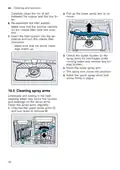
- Page 38: Cleaning and servicing Carefully clean the rim of dirt between the coarse and the fine filter. Pull up the lower spray arm to remove. Re-assemble the filter system. Make sure that the locking catches on the coarse filter click into position. Insert the filter system into the appliance and turn the coarse filter clockwise. Make sure that the arrow markings match up. Check the outlet nozzles on the spray arms for blockages under running water and remove any foreign bodies. Insert the lower spray arm. The spray arm clicks into position. Insert the upper spray arms and screw firmly in place. Cleaning spray arms Limescale and soiling in the dishwashing water may block the nozzles and bearings on the spray arms. Clean the spray arms regularly. Unscrew the upper spray arms and pull down to remove.
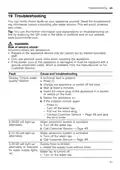
- Page 39: Troubleshooting You can rectify minor faults on your appliance yourself. Read the troubleshooting information before contacting after-sales service. Repairs to the appliance should only be carried out by trained specialist staff. Only use genuine spare parts when repairing the appliance. If the power cord of this appliance is damaged, it must be replaced with a special connection cable. Display Check water supply flashes indicates a technical fault is present. If the problem occurs again, contact Customer Service and provide the error code. E:30-00 indicates the water protection system is activated. E:31-00 indicates the water protection system is activated. E:32-00 indicates the supply hose is kinked or the water supply is turned off. Install the supply hose without kinks and ensure the water tap is turned on.
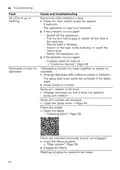
- Page 40: Troubleshooting Fault Cause and troubleshooting E:32-00 will light up alternately or indicator for water supply lights up. Water tap is jammed or furred up. The flow rate must be at least 10 l/min when the water supply is open. The filters in the water connection of the supply or AquaStop hose are blocked. E:34-00 will light up alternately. Water is continuously running into the appliance. E:61-02 will light up alternately. Not an appliance fault. Wastewater pump is blocked or the cover of the wastewater pump is loose.
- Page 41: Troubleshooting E:61-03 will light up alternately. Water is not drained. Not an appliance fault. Siphon connection is still closed or the wastewater hose is kinked or blocked. Check the connection to the siphon and open if necessary. Install wastewater hose without kinks. Remove residues. Not an appliance fault. Wastewater pump is blocked or the cover of the wastewater pump is loose. Clean the wastewater pump. Secure the cover of the wastewater pump so it clicks into position. E:92-40 will light up alternately. Filters are soiled or blocked. Clean the filters.
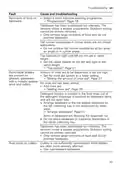
- Page 42: Troubleshooting All LEDs lit up or flashing indicates a fault detected by electronics. To reset the appliance, press the main switch button for approximately 4 seconds. If the problem recurs, switch off the appliance and disconnect the mains plug or fuse. Wait at least 2 minutes before reconnecting and switching the appliance back on. If the issue persists, contact customer service. Remnants of food on tableware may be due to items being placed too close together or an overfilled basket. Arrange tableware with sufficient space to ensure spray jets reach all surfaces. Ensure that the spray arm rotation is not obstructed by properly arranging tableware. Clean the spray arms and filters if they are blocked or soiled. Make sure filters are inserted correctly and engaged properly.
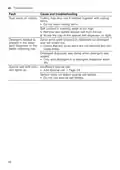
- Page 43: Troubleshooting Fault Remnants of food on tableware. Select a more intensive washing programme. Tall narrow receptacles in corner areas are not rinsed adequately. Do not position tall narrow receptacles at too great an angle or in corner areas. Top baskets on right and left are not set to the same height. Set the upper basket on the left and right to the same height. Removable streaks are present on glasses, glassware with a metallic appearance and cutlery. Set the rinse aid system to a lower setting. No rinse aid has been added. Add rinse aid. Detergent residue is present in the final rinse. Arrange tableware in the top basket so the tab collecting tray is not obstructed by tableware. Items of tableware are blocking the dispenser lid. Do not place tableware or fragrance dispensers in the tablet collecting tray. Rust spots on cutlery. Use rust-resistant tableware.
- Page 44: Troubleshooting Rust spots on cutlery may occur if washed with rusting items. Do not wash rusting items. High salt content in washing water can cause issues. Remove any spilled special salt from the tub. Ensure the cap of the special salt dispenser is screwed on tight. Detergent residue may be present in the detergent dispenser or tablet collecting tray. Check that the spray arms are not blocked and can rotate freely. Only add detergent to a detergent dispenser when dry. Insufficient special salt can trigger the refill indicator. Do not use special salt tablets.
- Page 45: Transportation, storage and disposal Insert the pump cover down and press. Clean wastewater pump. Large remnants of food or foreign bodies can block the wastewater pump. As soon as the rinsing water no longer drains properly, the wastewater pump must be cleaned. Warning: Risk of injury! Sharp and pointed objects or fragments of glass may block the wastewater pump and cause injury. Remove any foreign bodies carefully. Install the filter system. Disconnect the appliance from the power supply. Scoop out any water. Use a sponge if necessary. Removing the appliance: Disconnect the appliance from the mains power supply. Detach the drainage connection and the drinking water connection.
- Page 46: Transportation, storage and disposal Protect appliance from frost If there is a risk of frost where the appliance will be standing, empty the appliance completely. Valuable raw materials can be reused by recycling. Risk of harm to health! Children can lock themselves in the appliance, thereby putting their lives at risk. To avoid damage to the appliance, empty it before transporting. Always transport the dishwasher upright to prevent residual water getting into the machine's controls. Dispose of the appliance in an environmentally friendly manner. This appliance is labelled in accordance with European Directive 2012/19/EU concerning used electrical and electronic appliances. The guideline determines the framework for the return and recycling of used appliances as applicable throughout the EU.
- Page 47: Customer service information is available from after-sales service, retailers, or the website. You will need the product number (E-Nr.), production number (FD), and consecutive numbering (Z-Nr.) to contact customer service. The liability guarantee is valid for the service life of the appliance. A claim under the guarantee requires correct installation and connection with Aqua-Stop. The guarantee does not cover defective supply lines or fittings up to the Aqua-Stop connection. If fitted with Aqua-Stop, the appliance can be left unattended during operation. The product number, production number, and consecutive numbering can be found on the appliance's rating plate. The rating plate is located inside the appliance door. Make a note of your appliance's details and customer service contact information. Compensation is offered for water damage caused by a defective Aqua-Stop system.
- Page 48: Technical specifications Weight: Max. 45 kg Voltage: 110 V, 60 Hz Power rating: 1100 W Fuse: 15 A Water pressure: Min. 50 kPa (0.5 bar), Max. 1000 kPa (10 bar) Inlet rate: Min. 10 l/min Water temperature: Cold water; Hot water max.: 60 °C Capacity: 10 place settings Information regarding free and open source software This product includes software components that are licensed as free or open source software.
- Page 49: Declaration of Conformity 2.4 GHz band (2400–2483.5 MHz): Max. 100 mW 5-GHz band (5150–5350 MHz + 5470–5725 MHz): max. 150 mW 5 GHz WLAN (Wi-Fi): For indoor use only.
- Page 50: Thank you for buying a Bosch home appliance. Register your new device on MyBosch now and profit directly from expert tips and tricks for your appliance, warranty extension options, discounts for accessories and spare parts, digital manual and all appliance data at hand, and easy access to Bosch Home Appliances Service. Free and easy registration – also on mobile phones. Looking for help? You'll find it here. Expert advice for your Bosch home appliances, help with problems or a repair from Bosch experts. Find out everything about the many ways Bosch can support you.

Whirlpool W11703656 Dishwasher

SIEMENS SN27ZI04CZ Dishwasher

SIEMENS SN93HX60CG Dishwasher

FISHER PAYKEL baseDD24SHTI9 N Single DishDrawer Dishwasher

BOSCH SMS4EVW02E Dishwasher

FISHER and PAYKEL DW24UNT4X2 Dishwasher

SAMSUNG DW60R2014 Wide 12 Place Dishwasher

BOSCH SMV2HTX02G Fully Integrated Dishwasher

SIEMENS SN43HW32US Dishwasher

BOSCH SPS6ZMI29E Free Standing Dishwasher