
ZLINE 65286411 Monument Dishwasher














| General | Details |
|---|---|
| Name | ZLINE 65286411 Monument Dishwasher |
| Make | Zline |
| Language | English |
| Filetype | PDF (Download) |
| File size | 1.61 MB |
 (1 votes, average: 5.00 out of 5)
 Loading...

ZLINE Monument Top Touch Dishwasher

ZLINE Monument Series 24 Red Matte Dishwasher

ZLINE 65286410 Monument Dishwasher

ZLINE Classic Dishwasher

ZLINE DWV-18 Tallac Dishwasher

ZLINE 65286411 Monument Dishwasher Overview
Summary of Contents
- Page 1: Page 1
- Page 2: ZLINE Kitchen and Bath provides attainable luxury. The kitchen and bath of your dreams is never out of reach. Unique designs and unparalleled quality are our focus. We are dedicated to providing an elevated experience in your home. An endless selection of features and finishes is available. Your inspiration becomes reality with our products.
- Page 3: ZLINE is fueled by a passion for innovation. A relentless pursuit of bringing the highest end luxury designs and professional features into everyone’s homes. We may change specifications and designs without prior notice. WARNING: This product can expose you to chemicals including nickel, which is known to the State of California to cause cancer.
- Page 4: Important safety instructions Operation Filter system Control panel Preparing dishes Adjusting racks Loading racks Using detergent Using rinse aid Maintenance and cleaning Troubleshooting Warranty
- Page 5: Important safety instructions should be observed, including all governing codes and ordinances. Installers must leave the installation manual instructions for the consumer and local inspector's use. Consumers should keep the installation manual instructions with the user manual for future reference. Basic mechanical and electrical skills are required for the installation of the dishwasher. Improper installation is not covered under the appliance warranty. Installation completion time can range from one to three hours, with new installations typically requiring more time. The dishwasher must be installed to allow for easy future removal for service. Do not install the dishwasher if it has missing or broken parts. Cautions and warnings should be read and observed throughout the installation instructions. Safety gear, such as gloves and safety glasses or goggles, should be worn during installation.
- Page 6: Important safety instructions should be read and observed. Gloves and safety glasses or goggles should be worn during installations. This installation manual does not cover every possible condition and situation. Use the dishwasher only for its intended functions as described. Rinse off large pieces of food from dishes before washing. Load sharp items and knives carefully to avoid damage and injury. Do not wash plastic items unless they are marked dishwasher-safe. Ensure the garbage disposal is empty if the dishwasher drains into it. Do not tamper with the control panel or operate the dishwasher without all enclosure panels in place. Keep detergents and rinse agents out of reach of children and pets.
- Page 7: Important safety instructions Some dishwasher detergents are strongly alkaline and can be extremely dangerous if swallowed. Avoid contact with the skin and eyes and keep children away from the dishwasher when the door is open. Under certain conditions, hydrogen gas may be produced in a hot water system that has not been used for two weeks or more. If your home’s hot water system has not been used for a period of time, let the water flow for several minutes before using the dishwasher again. Keep young children and infants away from the dishwasher when it is operating. Do not use the dishwasher if it has a damaged power line or plug, and do not plug it into a damaged outlet. Remove the door to the washing compartment when removing an old dishwasher from service or discarding it. To reduce the risk of injury, do not allow children to play in or on a dishwasher. This dishwasher is intended for residential use only and should not be used in commercial establishments. The manufacturer disclaims responsibility for damage or injury caused by improper use of this appliance.
- Page 8: Important safety instructions Specifications: 23 7/8 W x 24 1/2 D x 33 3/4 (min) - 35 (max) H Panel ready dimensions: 606 mm W x 622 mm D x 832 mm (min) - 889 mm (max) H Top light Top rack Door latch Basket handle Cup shelf Adjustable upper rack Tub gasket
- Page 9: Operation Important notes Water supply temperature should be between 120°F - 150°F (49°C - 66°C). Dispose of the discarded appliance and packing material properly. The dishwasher must be grounded to avoid the risk of electric shock. If there is any damage to the dishwasher, please contact customer service. For information on installing and setting up your dishwasher, refer to the Installation Manual. Before using your dishwasher, remove the interior packing. Clean the interior surface with lukewarm water using a soft cloth. This dishwasher is designed to be built-in. Check your local power source; this dishwasher requires a 120VAC, 60Hz power supply. The dishwasher fills with water, covering the filter area at the bottom, and sprays a mixture of hot water and detergent against soiled surfaces.
- Page 10: Your dishwasher has a multiple filter system that includes four separate filter meshes. The multiple filter system helps your dishwasher operate with better performance by using less water and less energy. Your dishwasher has a smart wash system under the normal wash program that selects the wash cycle based on how large and soiled the load is. A short wash cycle is automatically selected for a partial load of lightly soiled dishes. A heavy wash cycle is automatically selected for a full load of heavily soiled dishes. The upper rack of your dishwasher can be raised or lowered to accommodate loading dishes of varying heights. After removing the third rack, the upper rack clearance height can be adjusted from 8 to 10. The lower rack clearance height can be adjusted from 11 to 13. See “Adjusting the Upper Rack” on page 12 for more details.
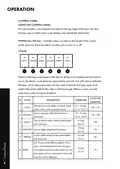
- Page 11: Operation Control panel Using the control panel Your dishwasher’s control panel is located on the top edge of the door. The door must be open to select wash cycle settings and operate the dishwasher. Power on/off - Hold this button down for three seconds to turn the unit’s power on or off. Select a cleaning cycle based on the type of dishes to be washed and the level of soil on the dishes. Cycle times are approximate and will vary with options selected. Auto - Auto sensing wash, lightly, or heavily soiled dishes, with or without dried-on food. Normal - Use for regularly soiled dinner dishes or silverware. Heavy - Use for hard-to-clean, heavily soiled dishes, pots, and pans. Delicate - Use for lightly soiled dishes and glass. Express - Use for pre-rinsing dishes or glasses. Rinse - This is only a rinse that keeps food from drying on your dishes and reduces odor buildup in your dishwasher until you are ready to wash a full load.
- Page 12: Operation Controls and indicators display the remaining hours and minutes of the current cycle, delay hours remaining, and error codes. Rinse aid indicator turns on when you need to add rinse aid. Sanitized indicator turns on when a sanitized cycle is finished and turns off after 30 seconds when the door is opened. Clean indicator turns on after a cycle is finished and turns off after 30 seconds when the door is opened. Delay function allows you to delay the start of the selected wash cycle from 1 to 24 hours. Heated dry option is used to heat-dry dishes and is not available for rinse-only cycles. Sanitize option is used to sanitize dishes and glassware, maintaining a maximum water temperature of 158°F (70°C). Certified residential dishwashers are not intended for licensed food establishments. The sanitize cycle is NSF certified.
- Page 13: HI TEMP WASH - Use to maintain the water temperature at 140°F (60°C) max. This option is available with the AUTO, NORMAL, and HEAVY cycles. START/CANCEL - Press to start the dishwasher after you have selected a cycle and function. Close the door. The cycle indicator begins to blink and the function indicator turns on. If you don’t close the door within four seconds of pressing START/CANCEL, the dishwasher pauses. Press START/CANCEL again to continue with the cycle. To cancel a running cycle, open the door, then press and hold START/CANCEL for three seconds. The dishwasher will return to standby status. To avoid injury, open the door slowly and carefully. There is a possibility of hot steam from inside the dishwasher. You can add more dishes before the main wash cycle has started. Check the detergent dispenser in the door. BASIC OPERATION - Load the dishwasher, add detergent, add rinse aid if needed, select the cycle, select the function, press START/CANCEL, and close the door within four seconds to begin the wash cycle.
- Page 14: Operation Preparing and loading dishes Preparing dishes for washing Scrape away large pieces of food, bones, pits, toothpicks, and similar items. The continuous filtered wash system will remove the remaining food particles. Burned-on foods should be loosened before loading into the dishwasher. Empty liquids from glasses and cups. Foods such as mustard, mayonnaise, vinegar, lemon juice, and tomato-based products may cause discoloration of stainless steel and plastics if allowed to sit for a long period of time. Unless the dishwasher is to be operated at once, it is best to rinse off these types of foods. If the dishwasher drains into a garbage disposal, be sure the disposal is completely empty before starting dishwasher.
- Page 15: Operation Adjusting racks Adjusting the upper rack This dishwasher has a convenient top rack for silverware, cutlery, and small items. This rack can be adjusted to accommodate varying loads.
- Page 16: Operation Adjusting the upper rack The height of the upper rack can be adjusted to accommodate loading taller dishes. Loading the upper rack The upper rack is designed for cups, glasses, small plates, bowls, and plastic items marked dishwasher-safe. For best results, place the items with the soiled surface facing down or toward the center. Tilt them slightly for better drainage. Make sure the loaded dishes do not interfere with the rotation of the middle spray arm. You can check this by rotating the middle spray arm by hand.
- Page 17: Operation Loading racks Loading the top rack You can place the items in the top rack randomly or in an orderly fashion. The image below shows how to load the top rack for 16 place settings. Loading suggestions are shown below.
- Page 18: Operation Loading the bottom rack The bottom rack is designed to accommodate plates, bowls, saucers, and cookware. The adjustable rack lets you load items up to 13 (330 mm) high. Large items should be placed along the edge, with the inside faces down. The fold-down tines on the bottom rack are provided to support extra large and hard-to-fit items. The tines may be left up for normal use or folded down for more flexible loading of larger items. Loading suggestions are shown below.
- Page 19: Operation Loading the silverware basket The silverware basket is divided into three separate sections, which can be placed in either the upper or lower racks. Caution: Make sure nothing protrudes through the bottom of the silverware basket that would block the lower spray arm from turning effectively. Adding a dish To avoid burn injury: Open the door slowly and wait until the spray arms and wash action stop. Hot water may splash out of the dishwasher. Before adding dishes, refer to “Preparing and Loading Dishes” for instructions on loading more dishes. To add or remove items after the wash cycle starts: Open the door slightly and wait a few seconds until wash action stops before completely opening. Press START/CANCEL on the control pad and close the door within four seconds. The cycle automatically resumes.
- Page 20: Operation Using detergent Filling the detergent dispenser Push the detergent dispenser cover latch downward to open the detergent cup. Add detergent (dry powder, liquid, or packet) to the cup. Close the detergent dispenser cover. The amount of detergent required depends on the cycle selected and the soil level on the dishes. Detergent pods are not designed to be used in this dispenser. They should be thrown into the bottom of the tub. Refer to the table for the recommended amount. Loading suggestions are shown below.
- Page 21: Operation Using rinse aid Filling the rinse aid dispenser Your dishwasher is designed to use a liquid rinse aid. The use of rinse aid greatly improves drying performance after the final rinse. Do not use a solid or bar-type rinse aid. Under normal conditions, the rinse aid will last approximately one month. Try to keep the dispenser full, but do not overfill it. Turn rinse aid dispenser cap 1/4 turn counterclockwise and lift it out. Add rinse aid until liquid touches the indicated fill level. Do not overfill since this can cause over sudsing. Wipe up any spills with a damp cloth. The dispenser holds enough for 35 to 140 washes, depending on the dial setting. Replace the cap and turn it 1/4 turn clockwise.
- Page 22: Operation Rinse aid greatly improves drying and reduces water spots and filming. Without rinse aid, your dishes and dishwasher interior will have excessive moisture. The rinse aid dispenser automatically releases a measured amount of rinse aid during the last rinse. If spotting and poor drying is a problem, increase the amount of rinse aid dispensed by rotating the dial to a higher number. Hot water is required for optimal dishwashing and drying results. Water entering the dishwasher should be at least 120° F (49°C) to achieve satisfactory results. To check water temperature, turn on the hot water faucet near the dishwasher and let it run for several minutes. To make sure that the water entering the dishwasher is hot, run hot water from the nearest hot water faucet before starting the cycle. The heat dry function, when used with a rinse aid, enhances drying performance. If you do not choose the heat dry function, items in your load may be wetter than anticipated at the end of the cycle. For optimal performance, the hot water supply line for your dishwasher must provide water pressure of at least 20 psi and not more than 120 psi. You may experience low water pressure during high-demand periods, such as when laundry or showers are in use while washing dishes.
- Page 23: Maintenance and cleaning are essential for optimal performance. Allow the heating element to cool before cleaning the interior of your dishwasher to avoid burn injury. Clean the stainless steel door and handle regularly with a soft cloth and standard household cleaner. Do not use appliance wax, polish, bleach, or products containing chlorine on the stainless steel door. Clean the control panel gently with a soft, lightly dampened cloth. The tub is made of stainless steel and will not rust or corrode. Clean spots on the steel inner door and tub with a damp non-abrasive cloth. The filters need to be cleaned monthly to maximize wash performance. Remove the bottom rack to access the filters.
- Page 24: Maintenance and cleaning Rotate the cylinder filter, then lift it out. Lift the fine filter from the bottom of the tub. Take out the fabric filter.
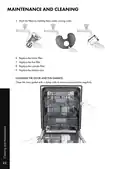
- Page 25: Maintenance and cleaning Flush the filters by holding them under running water. Replace the fabric filter. Replace the fine filter. Replace the cylinder filter. Replace the bottom rack. Clean the door gasket with a damp cloth to remove food particles regularly.
- Page 26: Maintenance and cleaning The inside of the dishwasher is self-cleaning under normal use. If needed, the tub gasket can be cleaned with a damp cloth. Use a brush to clean the opening in the end of the gasket.
- Page 27: Maintenance and cleaning Cleaning the air gap Ensure the air gap is clean for proper drainage. Turn off the dishwasher before cleaning the air gap and use a toothpick for cleaning. Disconnecting service Protect the dishwasher from freezing if left in an unheated place. A qualified person should disconnect service by turning off electrical power and water supply, draining the water line, and disconnecting the drain line. Restoring service Reconnect the water, drain, and electrical power. Turn on the water and electrical supply, fill the detergent and rinse aid cups, and run a heated wash cycle. Check all connections for leaks.
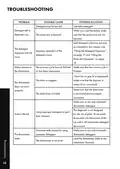
- Page 28: Troubleshooting Refer to this table to correct minor issues before calling for service. Slow fill time or fill time has exceeded time allotted. Water intake is restricted. Water pressure is too low. A leak in the dishwasher. The display board can’t receive or the main board can’t send a signal for over 20 seconds. Communication exception or issue. If a water overflow occurs, turn off the main water supply before calling for service. If there is water in the base pan because of an overfill or small leak, the water should be removed before restarting the dishwasher.
- Page 29: Troubleshooting The dishwasher won’t start. Make sure that the door is closed and latched. The power is off or not connected. The delay start option is selected. The dishwasher beeps at the end of the cycle. This is a normal occurrence that indicates the wash cycle is complete. The rinse aid light is on. The rinse aid level is low. Add rinse aid. The dishwasher runs too long. The cycle time varies, depending on the soil level of the dishes. The dishes are not drying enough. Dishes are loaded improperly. Choose a cycle with drying.
- Page 30: Troubleshooting The water pressure is too low. Make sure that the water pressure is above 20 psi. The inlet water temperature is too low. Make sure that the dishwasher is connected to a hot water supply. The dishes are not clean enough. Dishes are too close together. Improper use of detergent. The selected cycle is not suitable for the soil level on the dishes. The spray arms are blocked. Water hardness is too high. Spots and filming on dishes. Old or damp rinse aid power is used. Using too much detergent. Etching. The inlet water temperature exceeds 150°F (66°C).
- Page 31: Troubleshooting Use fresh detergent. Make sure that the spray arms are not blocked. Add detergent and rinse aid only as indicated in this manual. The detergent dispenser will not close due to improper operation of the detergent cover. Water remains in the dishwasher if the previous cycle has not finished. Check the air gap and ensure the disposer is empty. Make sure that the drain hose is not kinked and is properly connected. The dispenser is not designed for the use of pods. Excessive suds are caused by using improper detergent. Level the dishwasher as indicated in the Installation Manual.
- Page 32: Troubleshooting There are black or gray marks on the dishes. Make sure that the water inlet temperature is not less than 120°F (49°C). Aluminum utensils have rubbed against the dishes. Use a spot cleaner to remove the stains. Coffee or tea stains may cause reddish stains. The interior of the tub is stained. Some tomato-based products may cause this. The dishwasher won’t fill (the dishwasher will beep). The water valve is turned off. The door may not be closed completely.
- Page 33: Warranty coverage for ZLINE Kitchen and Bath dishwasher products lasts for one year from the original purchase date for the original purchaser. This warranty includes all parts and labor for necessary repairs if any part of the product is defective in materials or workmanship. Service must be performed by ZLINE approved and certified service during normal business hours. The warranty applies only to the original purchaser and is valid for products installed for normal residential use. Commercial settings are excluded from this warranty. The warranty is non-transferable and does not extend based on the installation date. It is only applicable to products installed in the continental United States and the District of Columbia. Failure to secure certified warranty service will result in forfeiture of the remaining warranty. Unapproved out of pocket payments for service will not be reimbursed. Warranty coverage will not apply for damage resulting from negligence, improper maintenance, misuse, abuse, or unauthorized service or repair.
- Page 34: Page 34

FISHER AND PAYKEL DD24ST4NX9 Dishwasher
ZLINE Monument Series 24 Red Matte Dishwasher

BOSCH SMV4HDX52Y-39 Fully Integrated Dishwasher

SHARP SDW6506JS 24 Front Dishwasher

LAURUS LSVS60-9 Dishwasher

BOSCH SMI6HAS00X-13 Dishwasher

FISHER PAYKEL DD24SCTB9_N Single DishDrawer Dishwasher

Thermador Dishwasher : for DWHD650W and More

Respekta GSP60IBAV Dishwasher

Siemens SN95YX02CG Dishwasher