
Haier HDW15V2 Dishwasher
















User Manual
Dishwasher
HDW15V2/ HDW15V3 Models
AA


| General | Details |
|---|---|
| Name | Haier HDW15V2 Dishwasher |
| Make | Haier |
| Language | English |
| Filetype | PDF (Download) |
| File size | 4.82 MB |
 (1 votes, average: 5.00 out of 5)
 Loading...

Haier HDW13V1S1 Dishwasher

Haier HDW15V3S1 Satina Dishwasher

Haier HDW10F1S1 300 Series Compact Dishwasher

Haier HDW15V2B2 Dishwasher

Haier HDW13G1W Dishwasher

Haier HDW15V2S1 Dishwasher

Haier HDW13G1X Dishwasher

Haier HDW10F1S1 Compact Dishwasher

Haier HDW13F0W1 Hygiene Dishwasher

Haier HDW13F0B1 Dishwasher

Haier HDW15V2 Dishwasher Overview
Summary of Contents
- Page 1: User manual for dishwasher HDW15V2/HDW15V3 models.
- Page 2: Thank you for purchasing a Haier product. Please read these instructions carefully before using this appliance. The instructions contain important information which will help you get the best out of the appliance and ensure safe and proper installation, use and maintenance. Keep this manual in a convenient place so you can always refer to it for the safe and proper use of the appliance. If you sell the appliance, give it away, or leave it behind when you move house, make sure you also pass on this manual. Help protect the environment and human health. Do not dispose appliances marked with this symbol with the household waste. Disconnect the appliance from the mains supply. Cut off the mains cable and dispose of it. Remove the door catch to prevent children and pets from getting closed in the appliance.
- Page 3: Safety Product description Control panel Programs Daily use Care and cleaning Troubleshooting Economic and environmental use Installation Technical data
- Page 4: Safety Intended use The appliance is designed for domestic use inside the house. It is not intended for commercial or industrial use. Standards and directives This product meets the requirements of all applicable EC directives with the corresponding harmonised standards, which provide for CE marking. Before switching on the appliance for the first time Make sure all packaging is removed and is kept out of children’s reach. Make sure that the electrical information on the rating plate agrees with the power supply. Use a separate earthed socket for the power supply. The appliance must be earthed. Make sure the plug is easily accessible. Make sure only the delivered electric cable and hose set are used. Hold the plug and not the electric cable when unplugging the power supply. Do not install or use the appliance where the temperature is below 5 °C. Do not use multi-plug adapters and extension cables.
- Page 5: Safety During daily use Do supervise children to prevent them playing with the appliance. Do put sharp pointed objects in a way that there is no danger of injury. Do not open the door while a programme operates. Do not keep the appliance door open without supervision to prevent tripping and falling. Do not let children or pets come close to the appliance when the door is open. Do not sit or place heavy items on the open door. Do not remove the dishes from the appliance until the programme is completed. Do not drink the water in the appliance as it may be contaminated with detergent residues. Do not cover any ventilation openings in the base by a carpet or similar object. WARNING: Some dishwasher detergents are strongly alkaline and can be extremely dangerous if swallowed.
- Page 6: Product description Thermo dry Upper spray arm Lower spray arm Filters Rating label Cutlery basket Lower basket Upper basket Knife rack Rinse aid dispenser Detergent dispenser Accessories
- Page 7: Control panel features ON / OFF button, START / PAUSE button, and PROGRAMME touch button. Time & Info display provides essential information. Option indication shows available features. Status indication reflects the current state of the device. The control panel layout is consistent across models HDW15V2W1/S1 and HDW15V3W1/S1. Both models include similar control functions and indicators. The design aims for user-friendly operation. Buttons are clearly labeled for easy identification. The interface is designed for straightforward interaction. Key functions are accessible for efficient use.
- Page 8: Control panel Time & info display Programme cycle time Error codes and service information Remaining time in hours of a delayed programme starts Indicator icon If the indicator lights up, rinse aid is empty Child lock Delay start Status indicators
- Page 9: Control panel You can delay the start of a programme in 1 hour steps up to 24 hours. Check the according paragraph under “Daily use”. To activate or cancel Child lock, press and hold until the Child lock indicator comes on or turn off. This option reduces spots on glassware and dinnerware. The option adds an extra intermediate rinse. Use this option if you have only a few items to wash. This will save water, energy and time. If you use powder detergent, use a little less detergent than for a full load. Activate this option only when you use the Tablet detergent tablets. This option decreases the flow of rinse aid and salt. Press this button when you want to increase washing time. Increase by 10 minutes at a time, increase to three times.
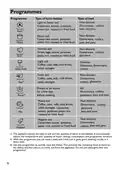
- Page 10: Programmes Non-delicate: Dinnerware, cutlery, pots and pans Light to heavy soil: Casseroles, sauces, pasta, rice, roasted or fried food Heavy soil: Potatoes, dinnerware, pots and pans Normal soil: Soups, eggs, sauces, potatoes, pasta, rice, roasted or fried food ECO: Light soil - Coffee, cake, milk, cold drinks, salad, sausages Delicate: Glassware, cutlery, dinnerware Fresh soil: Non-delicate - Dinnerware, cutlery, cold drinks, coffee, cake, milk, salad Dishes to be stored for a few days before washing Mixed soil: Coffee, cake, milk, cold drinks, salad, sausages Hygiene: The appliance senses the type of soil and adjusts the temperature and quantity of water.
- Page 11: Programmes on HDW15V3 models include options for saving. Light or fresh soil items include soups, eggs, sauces, potatoes, pasta, rice, and roasted or fried food. Non-delicate items consist of dinnerware and cutlery. Mixed soil items can include non-delicate options like coffee, cake, milk, and cold drinks, along with dinnerware, glassware, cutlery, salad, sausages, casseroles, sauces, potatoes, pasta, rice, and roasted or fried food. Pots and pans are also included in the mixed soil category. Pre-rinse is mentioned as a program option.
- Page 12: First steps Remove all packaging materials and dispose of them in an environmentally friendly manner. There could be water residue inside the appliance due to quality checks in the factory. Install the appliance. Adjust the rinse aid setting. Fill the rinse aid dispenser. Open the water tap. Start any wash programme with detergent but no load to remove possible manufacturing residues. An acoustic signal informs about the end of a programme. This signal can be switched off. Refer to section on how to adjust settings to change the signal.
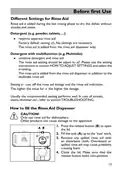
- Page 13: Different settings for rinse aid Rinse aid is added during the last rinsing phase to dry the dishes without streaks and stains. Detergent requires separate rinse aid. Factory default setting: No settings are necessary. The rinse aid is added from the rinse aid dispenser only. Detergent with multifunction combines detergent and rinse aid. The rinse aid setting should be adjusted according to the setting instructions. The rinse aid is added from the rinse aid dispenser in addition to the multitabs rinse aid. Only use rinse aid for dishwashers; other products can cause damage to the appliance. Fill the tank up to the ‘max’ mark. Remove any spilled rinse aid with an absorbent cloth.
- Page 14: How to adjust settings To adjust the rinse aid level, the appliance must be switched off. Press and hold for about 3 seconds until the display shows the current rinse aid setting. To change the rinse aid setting in steps between minimum dispense and maximum dispense, press accordingly. To exit the rinse aid menu, press and hold. Activate or deactivate the buzzer by switching the appliance off. Press and hold for about 3 seconds until the display shows the current rinse aid setting. Press to scroll to the buzzer menu, which will show buzzer off or buzzer on. To toggle between buzzer on and buzzer off, press accordingly. To exit, press and hold for 1 second. Child lock disables all buttons on the dishwasher, and the indicator will flash if other buttons are pressed. To activate child lock, press and hold for 3 seconds. To cancel child lock, press and hold for 3 seconds.
- Page 15: Daily use Not all sales models come with identical features and options. Load the baskets. Press the ON/OFF button to activate the appliance. If the rinse aid indicator is on, fill the rinse aid dispenser and reset the rinse aid indicator. Add the detergent. Close the door. Set the programme according to the type of load and how dirty the dishes are. Press the START/PAUSE button to start the programme. After programme end, the appliance changes to auto off. Unload the baskets. Always completely fill the rinse aid before starting the next wash cycle.
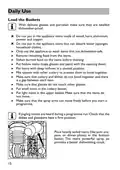
- Page 16: Daily use Load the baskets With delicate glasses and porcelain, make sure they are labelled dishwasher-proof. Do not put in the appliance items made of wood, horn, aluminium, pewter, and copper. Only use the appliance to wash items that are dishwasher-safe. Remove remaining food from the items. Soften burned food on the items before washing. Put hollow items (cups, glasses, and pans) with the opening down. Mix spoons with other cutlery to prevent them from bonding together. Make sure that cutlery and dishes do not bond together and there is a gap between each item. Place heavily soiled items (like pots and pans or dinner plates) in the bottom basket.
- Page 17: Daily use The lower basket has folding spikes. Fold down these spikes to improve arrangement of pots, pans, and bowls. Mix spoons with other cutlery to prevent them from bonding together. Use the grid element in order to separate the cutlery. Place cutlery with the handles down for better washing results. If long items may block the spray, place them in the upper basket. Put sharp and pointed items with the blade pointing downward to keep them out of harm’s way.
- Page 18: Daily use The upper basket is designed to hold items like glasses, cups, saucers, plates, small bowls, and shallow pans. Use the utensil tray to securely hold long or sharp items like knives, chopsticks, or ladles. Ensure that knife blades are facing down. Slide or remove the utensil tray if you need the space for other items below. You can adjust the height of the upper basket to create more space for tall items in the lower basket. For best washing results, place the table knives in the knife rack. Place small items on the foldable cup holder. Place sharp and pointed items with the blade pointing downward into the knife rack to keep them out of harm’s way.
- Page 19: Daily use Model with lever for easy height adjustment of the upper basket. Lift the basket Pull out the upper basket. Hold the basket on both sides on the edge above the lever. Lift the basket till you hear a click. Check the horizontal position and safe lock of the basket. Lower the basket Press the lever on both sides to lower the basket. Check the horizontal position and safe lock of the basket.
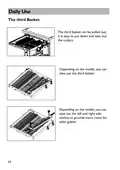
- Page 20: Daily use The third basket can be pulled out. It is easy to put down and take out the cutlery. Depending on the model, you can take out the third basket. You can take out the left and right side shelves to provide more room for taller goblets.
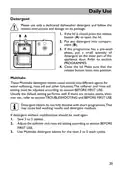
- Page 21: Daily use of detergent is essential for proper dishwasher operation. Use only dedicated dishwasher detergent and follow the instructions on its package. To add detergent, press the release button to open the lid and place detergent in the compartment. For programmes with a pre-wash phase, add a small quantity of detergent inside the appliance door. Close the lid and ensure the release button locks into position. Multitabs detergent tablets may include agents for water softening and rinse aid. Adjust the softener and rinse aid settings according to the instructions provided. Detergent tablets may not dissolve fully in short programmes, leading to poor washing results. If switching back to non-multifunction detergent, save 3 to 5 tablets and adjust settings accordingly. Use Multitabs detergent tablets for the next few wash cycles for optimal performance.
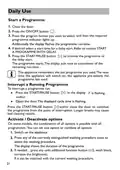
- Page 22: Daily use involves starting a programme by closing the door and pressing the ON/OFF button. Select the desired programme by pressing the programme button, which will light up the programme indicator. You can set a start time for a delay start by referring to the section on starting a programme with delay. Press the START/PAUSE button to activate the programme or the delay start. The display will show a countdown of the remaining run-time once the programme starts. The appliance remembers the last programme used and will pre-select it the next time it is switched on. To interrupt a running programme, press the START/PAUSE button; the display will flash. You can continue the programme from the point of interruption by pressing the START/PAUSE button again or closing the door. On some models, you can activate or deactivate options and combine them with all programmes. Select the washing procedure by pressing any extinguished washing procedure icon after switching on the appliance.
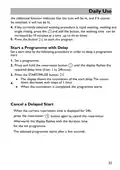
- Page 23: Daily use instructions are provided for the washing machine. The additional function indicates whether the icon will be lit based on matching criteria. If the rapid washing procedure is selected, the washing time can be increased by 10 minutes, up to three times. Press the button to start the program. To set a delayed start, first set a program. Press and hold the reservation button until the display shows the required delay time. The display will show a countdown of the start delay, decreasing in one-hour increments. When the countdown is completed, the program starts automatically. To cancel a delayed start, press the reservation button again when the current reservation time is displayed. The selected program will start after a few seconds once the reservation is canceled.
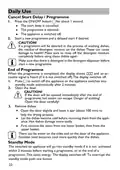
- Page 24: Daily use instructions include pressing the ON/OFF button for about 1 second to cancel the start delay and abort the programme. If a programme is aborted during washing, detergent residue may remain on the dishes, which can pose health risks. Ensure that detergent is in the dispenser before starting a new programme. At the end of the programme, an acoustic signal is heard, and the display shows completion. The appliance can be switched off manually or will enter standby mode automatically after 2 minutes. Caution is advised when opening the door immediately after the programme ends due to the risk of hot steam escaping. To aid drying, open the door slightly and let dishes cool before removal. Remove dishes starting from the lower basket to the upper basket. There may be water on the sides and door of the appliance after use. The appliance enters standby mode if not activated within 2 minutes, saving energy.
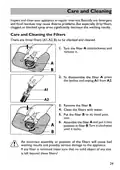
- Page 25: Care and cleaning your appliance at regular intervals is important. Inspect and clean the filters regularly. Remove the filter by turning it anticlockwise. Press the latches and unplug the appliance. Ensure no solid object is left beyond the filters after removal. Return the filter to its initial position. Turn the filter clockwise until it locks. Neglecting filter maintenance can lead to poor washing results. Serious damage to the appliance may occur if filters are not properly maintained. Regular maintenance is essential for optimal appliance performance.
- Page 26: Care and cleaning of the spray arms should be regularly inspected for dirt. Upper spray arm can be removed by turning the bayonet socket to the left. Flush the spray arms with water and check that all the holes are clear. The lower spray arm can be removed by pulling at the center. Never clean the appliance with a steam cleaner. Only use neutral detergents for cleaning. Do not use abrasive products, cleaning pads, or solvents. Clean the appliance with a damp soft cloth. Clean the door seal with a damp soft cloth.
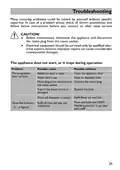
- Page 27: Troubleshooting In case of a problem, please check all shown possibilities and follow below instructions before you contact an after sales service. CAUTION! Before maintenance, deactivate the appliance and disconnect the mains plug from the mains socket. The appliance does not start, or it stops during operation. Possible causes and solutions include: The programme does not start due to the appliance door being open or delay start being set. Close the appliance door or refer to displayed time. The mains plug is not connected in the mains socket. Connect the mains plug. The fuse in the house circuit is damaged. Replace the fuse. The rinse aid dispenser is empty. Refill rinse aid until full and press and hold the START/PAUSE button for 3 seconds after the rinse aid indicator is lighted.
- Page 28: Troubleshooting Error codes on the display Possible causes and solutions for various problems are provided. Acoustic alarm indicates that the water tap is closed; open the water tap. If the error is solved, switch off the appliance and restart the program. Check the position of the water inlet hose if it has a kink or bend. If the aqua-stop system is triggered, the hose must be replaced. Clean the filter at the inlet hose connections if it is clogged. Ensure that the water flow from the tap is adequate and check water pressure. If filters are clogged, scoop out as much water as possible and continue the program. If the drainage is blocked, ensure that the drain water connection and piping are correct. In case of leaks, close the water tap, disconnect the appliance from power, and contact service.
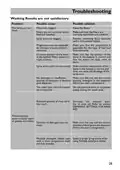
- Page 29: Troubleshooting Washing results are not satisfactory The dishes are not clean. Filters are clogged. Spray arms are clogged. Programme was not applicable for the type of load and food remnants. Incorrect position of the items in the baskets. Spray arms could not turn freely. No detergent or insufficient quantity of detergent in the dispenser. The wash cycle was interrupted by a long break. Whitish streaks, stains or bluish layers on glasses and dishes.
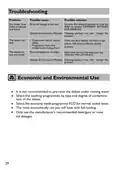
- Page 30: Troubleshooting Dry water drop stains on glasses and dishes may be caused by low rinse aid dosage. Increase the released quantity of rinse aid. Quality of rinse aid or Multitab may be an issue. Cleaning product too old; change the product. Dishes may be wet due to the programme having no drying phase or a low temperature drying phase. Open the door slightly to help the drying process. Wet and matte dishes may indicate an empty rinse aid dispenser. Refill rinse aid and reset the rinse aid indicator. It is not recommended to pre-rinse the dishes under running water. Select washing programmes by type and degree of contamination of the dishes. Select the economy mode programme ECO for normally soiled items. The most economical use occurs with full loading. Only use the manufacturer’s recommended detergent or rinse aid dosages.
- Page 31: Installation WARNING! Free standing installation Install the appliance on solid ground. Adjust accurately all feet. Only with a correct level the appliance door closes and seals correctly. Installation under worktop The dimensions of the recess should at least agree with the dimensions in the manual. Put the appliance adjacent to the slot. Make sure that all connections (water, drain water, power) are neatly positioned and connected. Optional: Remove the worktop of the appliance. Install the appliance carefully into the recess. WARNING! If used as free standing appliance again, the worktop must be remounted.
- Page 32: Installation The appliance should be connected to the water main using the new water inlet hose supplied. Old hoses should not be used. Do not shorten the inlet hose. The dishwasher has a single valve water connection. We recommend a cold water connection for best performance and energy efficiency. The incoming water temperature should not exceed 25°C. Lowest water pressure: 0.3 bar = 3 N/cm² = 30kPa. Where pressure is below 1 bar, contact a qualified plumber. Highest water pressure: 10 bar = 100 N/cm² = 1MPa. Where pressure is above 10 bar, a pressure reduction valve must be installed. Contact a qualified plumber. Connect the water inlet hose to an accessible water tap with a 3/4” BSP connector. Ensure that there is no kink in the inlet hose that could restrict the flow of water. Ensure incoming water is clear. If the water pipes have not been used for a long period of time, let the water run to make sure it is clear with no impurities. If required, use a filter insert to filter out deposits from the piping. Tighten the hose coupling a further half turn after seal contact. Check that the connection does not leak.
- Page 33: Installation Some models are fitted with an “Aquastop” water supply hose. The dishwasher is equipped with a system that stops the supply of water in the event of a problem with the water supply hose or leaks within the unit. This feature is designed to prevent damage to your home. If the box containing the electrical components gets damaged, turn off the power supply and remove the plug from the socket immediately. To ensure the anti-flooding feature operates properly, the water supply hose must be attached to the water supply tap as shown in the manual. No other type of connection is acceptable. The water supply hose must not be cut, as it contains live electrical parts. If the hose is not long enough, it must be replaced with a longer one. Replacement hoses are available from specialized retailers and Authorized Service Centers.
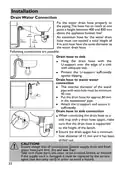
- Page 34: Installation Fix the water drain hose properly to the piping. The hose has to reach at one point a height between 400 and 850 mm above the appliance bottom line. An extension hose for the water drain hose must not exceed a total length of 4 m and must have the same diameter as the water drain hose. Drain hose to sink: Hang the drain hose with the U-support over the edge of a sink with adequate size. The internal diameter of the stand pipe with vent-hole must be minimum 40 mm. Put the drain hose for approx 80 mm in the wastewater pipe. When connecting the drain hose to a sink trap with a drain hose spigot, make sure that the drain hose is supported to the height of the bench. Ensure the drain spigot has a minimum hole diameter of 15 mm and it has been drilled out. Ensure always that all connections (power supply, drain and fresh water hose) are firm, dry and leak free. Take care these parts are never to be crushed, kinked, or twisted. If the supply cord is damaged, it must be replaced by the service agent in order to avoid a hazard.
- Page 35: Technical data includes the electrical specifications of the dishwasher. Check the electrical data on the rating label located on the left-hand side of the dishwasher’s stainless steel inner door. Consider the data on the rating label as correct if it differs from the specified values. Supplier's name is Haier. The model identifiers are HDW15V2 and HDW15V3. Rated capacity is in standard place settings. Mains water pressure ranges from 0.03-1 MPa (0.3-10 bar). Power voltage is 220-240 V (50Hz). Total absorbed power is between 1720-2050 W. Maximum current intensity is 10 A.
- Page 36: Customer service is recommended along with the use of original spare parts. Troubleshooting can be done through your local dealer or the Service & Support area on the Haier website. To contact service, ensure you have the model and serial number available. This information can be found on the rating plate at the door.
- Page 37: Standards test Eco Wash programme When the programme is finished, open the door 100mm to help with drying Powdered detergent quantities Rinse aid dosage level Maximum number of place settings Height adjustment of upper basket Recommended loading patterns Cutlery basket
- Page 38: Standards test Wash programme When the programme is finished, open the door 100mm to help with drying Powdered detergent quantities Rinse aid dosage level Maximum number of place settings Height adjustment of upper basket Ensure the upper basket is in its lower most position Recommended loading patterns Upper basket

COOKOLOGY 45cm Dishwasher

FISHER PAYKEL DD60ST4HNB9 Built Under Dishwasher

FISHER PAYKEL DD24STI9N Dishwasher

BOMANN GSP 7409 Household Dishwasher

architecto SPV5939st Dishwasher

Honeywell HDS18SS Dishwasher

BOSCH SMV4HBX19E Dishwasher
FISHER AND PAYKEL DD60SCTX9 7 Contemporary Tall Dishwasher

SILVERCREST SGW 860 A1 Table Top Dishwasher

INSIGNIA NS-DWRF2SS3 Front Dishwasher