
Hisense HV643D90UK Dishwasher










HV643D90
HV643D90UK


| General | Details |
|---|---|
| Name | Hisense HV643D90UK Dishwasher |
| Make | Hisense |
| Language | English |
| Filetype | PDF (Download) |
| File size | 3.4 MB |
 (1 votes, average: 5.00 out of 5)
 Loading...

Hisense HFI663BXXL Dishwasher

Hisense HS673A60X Dishwasher

Hisense HV642C65UK Dishwasher

Hisense HSCE14FS Dishwasher

Hisense HV642E90UK Fully Dishwasher

Hisense HV642C60 Dishwasher

Hisense HV693C60UK Dishwasher

Hisense HS693C60XAD Dishwasher

Hisense HS622E90BUK Dishwasher

Hisense HS643D60WUK Dishwasher

Hisense HV643D90UK Dishwasher Overview
Summary of Contents
- Page 1: Page 1
- Page 2: Your dishwasher Safety instructions Installation Overflow guard function Winter storage/transport Before washing for the first time Water hardness Basic settings Greener dishwashing Loading the dishwasher Using the dishwasher Care and cleaning Troubleshooting
- Page 3: Safety instructions Read the operating instructions and keep them in a safe place. Number of standard place settings: 16. Never use the dishwasher for any purpose other than that specified in these operating instructions. Do not load the dishwasher door or dishwasher baskets with anything other than dishes. Never leave the dishwasher door open as someone may trip on it. Use only dishwasher detergent. This appliance can be used by children aged from 8 years and above with supervision. Children shall not play with the appliance. Damaged supply cord must only be replaced by a qualified professional. Only use the dishwasher in household-type environments for dishwashing household dishes.
- Page 4: Before washing for the first time Water hardness is essential for achieving good dishwashing results. Hard water leaves a white coating on dishes and the dishwasher. Water hardness is specified using various degrees of measurement. A water supply with hardness over 2.8°dH must be softened. The built-in water softener requires adjustment to the local water hardness. Add detergent and rinse aid suitable for soft water after adjusting settings. Contact local waterworks to check the water hardness in your area. If water hardness exceeds 36.4°dH, consider connecting an external water softener. Regeneration of the water softener increases energy and water consumption. Select the right setting for the water softener to avoid hard water issues.
- Page 5: Basic settings The first time the dishwasher is switched on, it is important that you choose the right settings to ensure good dishwashing results. Set up: Rinse aid, Water hardness, TAB Drying is faster and a better result is achieved if you use rinse aid. Top up the rinse aid compartment with rinse aid if you have selected Rinse aid 01 - 05. Top up with salt if you have selected Water hardness 01 - 07. Add salt to the salt compartment by turning the lid anticlockwise. Use special dishwasher salt and fill the salt compartment to a maximum of 750 grams. Wipe up any excess salt so that the lid can be screwed on firmly. In order to avoid rust stains, a dishwashing program must be started immediately after adding salt.
- Page 6: Greener dishwashing Save energy and water when using a dishwasher in a residential setting. Do not rinse the dishes under running water as this will lead to increased energy and water consumption. Choose a green detergent and read the environmental declaration on the packaging. Run a fully loaded dishwasher to save energy and water. Run programs at a lower temperature if the dishes are only slightly dirty. Select the Eco 55° dishwashing program for normally soiled dishes. The Eco program is designed for an effective wash using as little energy and water as possible. Activate the Auto Dry setting for better drying results. Connect the dishwasher to the cold water supply if the building is heated using oil, electricity, or gas. Connect the dishwasher to the hot water supply if the building is heated using energy-efficient means.
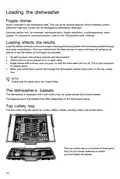
- Page 7: Loading the dishwasher Some cookware is not dishwasher safe due to high heat or damage from detergent. Exercise caution with handmade items, fragile decoration, crystal/glassware, silver, copper, tin, aluminium, wood, and plastic. Load the dishes carefully for the best washing and drying results with minimal energy and water consumption. All dirty surfaces should face inwards and downwards. Dishes should not be placed in or on each other. Angle dishes with hollows so that rinse water will run off. Ensure small items cannot fall through the dishwasher basket; place them in the top cutlery tray. Check that the spray arms can rotate freely. The dishwasher is equipped with a top cutlery tray, an upper basket, and a lower basket. The top cutlery tray has space for cutlery and similar items and can be adjusted to accommodate dishes.
- Page 8: Upper basket Place glasses, cups, bowls, side plates, and saucers in the upper basket. All dirty surfaces should face inwards and downwards. Wine glasses are placed on the wine glass shelf and knives are placed in the knife stand on the right. Raising and lowering the upper basket Pull out the upper basket. Grab the sides of the upper basket with both hands and lift it up. If the upper basket is raised while in the top position, it will drop to the bottom position. Note that both sides of the basket must always be set to the same height.
- Page 9: Place plates, side plates, serving dishes, and pots in the lower basket. Cutlery can be placed in the cutlery holder. Fit the cutlery holder to achieve maximum loading capacity. The adjustable plate supports can be folded down to make it easier to load pots and bowls.
- Page 10: Using the dishwasher Add detergent Follow the instructions on the detergent packaging. This dishwasher is fitted with a water softener, so use detergent and rinse aid doses suitable for soft water. Too much detergent can result in less effective dishwashing and also entails greater environmental impact. The detergent compartment must be dry when adding detergent. Use only dishwasher detergent! Washing up liquid must not be used as the foam that forms prevents the dishwasher from operating effectively. There are many types of all-in-one detergents on the market. Read through the directions for these products carefully. Activate the TAB setting and deactivate the Rinse aid setting when using an all-in-one detergent that contains rinse aid. Dishwasher tablets are not recommended for short programs (less than 75 minutes). Use powder or liquid dishwasher detergent instead. Optimal washing and drying results are achieved by using normal detergent together with separately dispensed rinse aid and salt.
- Page 11: On/Off The control panel only reacts to use when the door is open. Select a program to suit the type of dishes and how dirty they are. Eco 55° is always pre-selected. Eco 55° is suitable for washing normally soiled dishes and is the most effective program in terms of combined energy and water consumption. For heavily soiled dishes with a lot of grease, a program with higher temperatures should be used. The dishwasher can measure how dirty the dishes are and adjust water consumption and temperature accordingly. A quick program for slightly dried leftovers is available, but it is not intended for burnt food. The Auto Dry option is important for ensuring the best drying results. A program with a high temperature is available for dissolving grease on very dirty dishes. When newly installed, the program needs to be run five times before it is fully adapted.
- Page 12: Glass 40° A gentle dishwashing program with a low temperature for washing fragile items made of crystal/glass. Hygiene 70° This program is ideal to use where demands on hygiene are extra high, e.g. for baby bottles and cutting boards. Self-clean Self-cleaning program for hygienic cleaning of the dishwasher tub, spray arms, and spray pipes. Delayed start When you select Delayed start, the dishwasher will start 1-24 hours after you have pressed closed the door. Speed wash This option shortens the program time, but uses more energy and water. Start/Stop The display will start to flash, indicating that the dishwasher is ready to start. Close the door properly, otherwise the dishwasher will not start.
- Page 13: Stopping or changing a program involves opening the door and pressing and holding a button for five seconds. You can top up with new detergent if the lid of the detergent dispenser has opened. Once a program and options are selected, the total time is displayed. To load more dishes, open the door; the dishwasher stops automatically and resumes after closing the door. In case of a power failure, the program continues when power is restored, except during drying when it is interrupted. You can check washing times by pressing and holding a specific button. Once the program has finished, End appears on the display, and the dishwasher turns off after a buzzer sound. For the best drying results, fully load the dishwasher and angle dishes with hollows. Top up with rinse aid or increase the rinse aid dosage setting for better results. Allow dishes to cool before unloading, starting with the lower basket to avoid water drops from the upper basket.
- Page 14: Program chart Consumption values vary depending on the temperature of the incoming water, room temperature, load size, selected additional functions and more. The values for the Eco 55° program are accurate, others are indicative only. This program is suitable for washing normally soiled dishes and is the most effective program in terms of combined energy and water consumption. This program is used to assess compliance with EU legislation on ecodesign.
- Page 15: Press to open the dishwasher's settings menu. Press to step through the settings menu. Confirm the selected setting by pressing. A beep confirms that the control panel has been pressed. Setting for rinse aid dosage can be adjusted between 00 (Off) and 05 (High dosage). Increase the rinse aid dosage if the dishes have water marks. Adjusting the water softener is important for the hardness of the water supply. For water hardness below 2.8°dH, select 00 to deactivate the water softener. Activate the TAB setting when using an all-in-one detergent that contains rinse aid. This setting reduces the rinse aid dosage and affects the regeneration of the dishwasher's built-in softener.
- Page 16: Settings Auto Dry option improves drying results by automatically opening the dishwasher door. Wait for the program to end and dishes to cool before unloading. Surrounding furnishings must resist condensation if the dishwasher is built-in. Auto Dry is not available for Hygiene 70°, Self-clean, Intensive 70°, and Glass 40° programs. Error readout displays any error messages. Provide recent error messages when contacting the service department. Restoring factory defaults resets all settings. Select rSt to restore factory defaults. To exit the settings menu, select End and press or wait for three seconds.
- Page 17: Care and cleaning Top up with rinse aid When the rinse aid needs topping up, the symbol lights on the display. Open the rinse aid compartment lid. Carefully top up with rinse aid to the level marked MAX. Wipe up any splashes of rinse aid around the compartment. Close the lid firmly. Top up with salt When the salt needs topping up, the symbol lights on the display. Add enough salt to fill the salt compartment (max. 750 gram). Use special dishwasher salt. In order to avoid rust stains, a dishwashing program must be started immediately after adding salt.
- Page 18: Clean filter The filter traps larger food particles, which cannot get past the drainage pump. Empty the filter when necessary. It should be cleaned at regular intervals depending on how often the dishwasher is used. Turn the locking ring anticlockwise and lift the filter straight up. Empty and clean the filter. Refit the filter and turn the locking ring clockwise to its stop position. Check that the edges seal properly. Dishwashing results may be affected if the filter is fitted incorrectly. The dishwasher must not be used without the filter in place! Check that the yellow drainage pump stop on the right in the bottom drain is in place. Cleaning the spray arms Holes and bearings can sometimes become blocked. Remove any debris using a pin or the like. The spray arms also have holes underneath. To facilitate cleaning you can remove the spray arms. Remember to fit them firmly back into place afterwards. Top spray arm Pull out the top cutlery tray. Push up on the top spray arm while turning it anticlockwise to release it.
- Page 19: Upper spray arm: Pull out the upper basket. Unscrew the spray arm bearings anticlockwise to remove the spray arm from the upper basket. Lower spray arm: Pull the lower spray arm straight up to release it. Clean the outside of the dishwasher: Open the door. Clean the sides of the door and the door seal regularly with a slightly damp cloth. Clean the door seal at the lower front edge of the dishwasher with a washing-up brush. Control panel: Keep the control panel clean. If necessary, wipe it with a dry or slightly damp cloth. Never use cleaning products – they may scratch the surface. Dishwasher tub: The dishwasher tub is made of stainless steel and is kept clean through normal use. If you have hard water, limescale deposits may build up in the dishwasher. Run Self-clean with two tablespoons of citric acid in the detergent compartment. Special dishwasher cleaners are also available on the market.
- Page 20: Remove blockages Unblocking the drainage pump If the dishwasher still contains water after the program has finished, something may be blocking the drainage pump, which results in the water outlet fault error message. Turn off the machine and remove the plug from the wall socket. Remove the filter. Scoop out the water from the dishwasher tub. Inspect the drainage pump by removing the yellow drainage pump stop. Turn the pump wheel located behind the drainage pump stop by hand. Unblocking the inlet hose filter If the water supply contains small particles, the outer filter on the inlet hose may become blocked, resulting in the water inlet fault error message. Turn off the machine and remove the plug from the wall socket. Unscrew the inlet hose and carefully remove the outer filter from the inlet hose and clean it. Check that the gasket is correctly positioned before re-fitting the filter.
- Page 21: Troubleshooting Error messages F11 - Water outlet fault: See Water remains in the dishwasher in the table Problem below. If the problem persists, contact your nearest service centre. F12 - Water inlet fault: Check that the water tap is on. Check that the outer filter on the inlet hose is not blocked. If the problem persists, contact your nearest service centre. F18 - Diverter fault: Turn off the water tap and contact your nearest service centre. F40 - Inlet valve leakage: Turn off the water tap and contact your nearest service centre. F41 - Heater fault: Turn off the water tap. Remove the plug from the wall socket and contact your nearest service centre. F54 - Overfilling water: Turn off the water tap and contact your nearest service centre. To avoid water leakage outside the dishwasher, do not remove the plug from the wall socket until the water tap on the supply line has been turned off. The control panel does not react: Wait a moment then try again when pressed. Cannot close door: Check that the baskets are correctly positioned horizontally. Check that the dishes are not blocking the baskets from sliding properly into place.
- Page 22: The dishwasher does not start. The door is not properly closed. Close the door and wait. Check whether the Delayed start option has been selected. The plug is not plugged into the wall socket. A fuse/circuit breaker has been tripped. The dishes are not clean. The spray arms do not rotate. Clean the spray arms. Select a program with a high temperature to dissolve grease on very dirty dishes.
- Page 23: Problem: Dishes loaded incorrectly. Action: Do not cover porcelain with large bowls or the like. Avoid placing very tall glasses in the corners of the baskets. Problem: Glasses and cups have toppled over during the program. Action: Place dishes to sit steady. Problem: The filter is clogged. Action: Clean the filter. Problem: The filter is not fitted correctly. Action: Check that the filter is fitted correctly. Problem: Drainage pump stop missing. Action: Check that the yellow drainage pump stop on the right in the bottom drain is in place. Problem: Spots on stainless steel or silver. Action: Rinse off certain foodstuffs if not starting the dishwasher immediately. Problem: Spots or films on the dishes. Action: See the chapter Settings. Problem: Salt compartment empty. Action: Top up with salt. Problem: Incorrect water softener setting. Action: See Water hardness in the chapter Settings. Problem: The water softener is leaking salt. Action: Check that the salt compartment lid is properly tightened.
- Page 24: Problem: The dishes have a sticky white/blue film. Possible cause: Rinse aid dosage setting too high. Action: Reduce the dosage. Problem: Spots left after washing. Possible cause: Lipstick and tea can be difficult to wash off. Action: Use a detergent with a bleaching agent. Problem: Detergent residue in the detergent compartment after dishwashing. Possible cause: The detergent compartment was damp when adding detergent. Action: The detergent compartment must be dry when adding detergent. Problem: Rattling sound when dishwashing. Possible cause: The dishes are not correctly placed or the spray arms are not rotating. Action: Check that the dishes are placed securely. Problem: Water remains in the dishwasher. Possible cause: The filter is clogged. Action: Clean the filter. Problem: The filter is not fitted correctly. Action: Check that the filter is fitted correctly. Problem: Debris in the drainage pump. Action: Clean the drainage pump. Problem: Kink in drainage hose. Possible cause: Blocked drainage hose. Action: Check that the hose is free from kinks and sharp bends. Problem: Bad odour in dishwasher. Possible cause: Dirt around the seals and in corners. Action: Clean with washing-up brush and low foaming cleaner. Problem: Low temperature programs have been selected for a prolonged period. Action: Run a program with a high temperature once or twice a month.
- Page 25: Problem Possible causes Action Grease deposits in the dishwasher. Low temperature programs have been selected for a prolonged period. Select a program with a high temperature to dissolve grease on very dirty dishes, such as Intensive 70°. The dishes are not dry enough. The Auto Dry setting has not been activated. Activate the Auto Dry setting. The dishwasher is not fully loaded. Fully load the dishwasher. Rinse aid needs topping up or dosage is set too low. Top up with rinse aid or increase the rinse aid dosage setting.
- Page 26: Installation instructions must be followed carefully. Connections to electricity, water, and drainage should be performed by a qualified professional. Always adhere to applicable regulations for water, drainage, and electricity. Wear protective gloves during installation to avoid injury from sharp edges. A drip tray should be placed beneath the dishwasher to prevent water damage. Test the dishwasher by running a program before securing it in place. Turn off the water supply during installation. Ensure the area for installation is firm and level. Check that all dimensions are correct before starting the installation. The height of the cover door can be adjusted to match other fittings.
- Page 27: If the dishwasher is built-in, the surrounding furnishings must be resistant to any condensation from the dishwasher. Mount the protective film beneath the worktop and up around the edge to protect the worktop from moisture. Check that the machine is installed such that the door opens freely; otherwise, door lock functionality may be disrupted. The dishwasher is suitable for installing in a raised recess to attain an ergonomic working height. The drainage hose can be connected to a connection nipple on the sink unit's water trap, which must have an internal diameter of at least 14 mm. The drainage hose may be extended by a maximum of 3 m, and any joins must have an internal diameter of at least 14 mm. Use only the inlet hose supplied with the dishwasher; do not re-use old or other spare hoses. The water tap must be easily accessible to shut off the water if the dishwasher has to be moved. Connect the dishwasher to the cold water supply if the building is heated using oil, electricity, or gas. Connect the dishwasher to the hot water supply (max. 60 °C) if the building is heated using energy-efficient means.
- Page 28: The electric wall socket must be placed outside of the installation area to be easily accessible after installing the dishwasher. Do not use an extension cord!
- Page 29: Technical data includes height, width, depth, weight, number of standard place settings, water pressure, rated voltage, and rated power. Height is 816-885 mm, width is 598 mm, depth is 555 mm, and weight is 32 kg. The number of standard place settings is 16. Water pressure ranges from 0.03-1.0 MPa. Rated voltage is 220-240V~ 50Hz and rated power is 1900 W. Weight can vary due to different specifications. Information for consumers can be found at global.hisense.com, including a link to the European Product Database for Energy Labelling. For comparability tests, capacity is 16 place settings, and the position of the upper basket is in the lower position. The program used is Eco, with a rinse aid setting of 05. Powdered detergent quantities are 4g for prewash and 20g for the main wash.
- Page 30: Lower baskets include various items such as dinner plates, dessert plates, melamine bowls, soup plates, small pots, oven pots, oval platters, and dessert spoons. The top cutlery tray contains tea spoons, dessert spoons, soup spoons, forks, knives, and a serving fork. Each item is listed with a corresponding number for identification.
- Page 31: Page 31

BOSCH SHX5AEM2N Dishwasher

BOSCH SMS67NI10M Dishwasher

inDeSIT DSIO3M24CS Dishwasher

BOSCH SHV53CM3N 300 Series Full Dishwasher

NEFF S187ECX23G Dishwasher

BLACK PLUS DECKER BDW200MW Dishwasher

FISHER PAYKEL DD60STI9 Integrated Single Dishwasher

FOTILE BD2B-G5 Dishwasher

Westinghouse WSF6604WB Dishwasher

GAGGENAU DF271101F Dishwasher