
aspes AJI12600E Dishwasher




EN Dishwasher / User Manual
AJI12600E


| General | Details |
|---|---|
| Name | aspes AJI12600E Dishwasher |
| Make | aspes |
| Language | English |
| Filetype | PDF (Download) |
| File size | 0.66 MB |
 (1 votes, average: 5.00 out of 5)
 Loading...

aspes AJ14600BD Dishwasher

aspes ALV1047 Dishwasher

aspes AJI12600E Dishwasher Overview
Summary of Contents
- Page 1: Dishwasher user manual. Model AJI12600E.
- Page 2: Thank you for choosing this product. This user manual contains important information on safety and instructions intended to assist you in the operation and maintenance of your appliance. Please take the time to read this user manual before using your appliance and keep this book for future reference. WARNING: Serious injury or death risk. RISK OF ELECTRIC SHOCK: Dangerous voltage risk. Warning: Risk of fire / flammable materials. Injury or property damage risk. CAUTION: Important operating instructions.
- Page 3: Safety instructions include general safety warnings, installation warnings, and usage precautions. Installation covers machine positioning, water connection, water inlet hose, drain hose, and electrical connection. Technical specifications provide details on general appearance and technical specifications. Before using the appliance, prepare the dishwasher for first use, manage salt usage, fill the salt, and understand the water hardness table. Loading your dishwasher includes recommendations and alternative basket loads. The document includes a programme table and details about the control panel. Cleaning and maintenance focus on filters, spray arms, and the drain pump. Troubleshooting offers guidance for resolving common issues.
- Page 4: There may be some residue left in the machine after washing. Keep children away from the machine when it is open. Choose a suitable and safe place to install your machine. Only original spare parts should be used with the machine. Unplug the machine before installation. Your machine must only be installed by an authorised service agent. Installation by anyone other than an authorised agent may cause your warranty to be void. Check that the indoor electrical fuse system is connected in line with safety regulations. All electrical connections must match the values on the plate. Ensure the machine does not stand on the electrical supply cable. Never use an extension cord or a multiple socket connection. The plug should be accessible after the machine is installed.
- Page 5: Always use the coated plug supplied with your machine. If the electrical cable is damaged, it should only be replaced by a qualified electrician. Connect the hose directly to the water inlet tap. The pressure supplied by the tap should be a minimum of 0.03 MPa and a maximum of 1 MPa. This machine is for domestic use only; do not use it for other purposes. Do not stand, sit or place loads on the open door of the dishwasher. Only use detergents and rinse aids produced specifically for dishwashers. Do not drink water from the machine. Due to the danger of explosion, do not place any chemical dissolving agents into the machine’s washing section. Check the heat-resistance of plastic items before washing them in the machine. Only put items in the machine which are suitable for dishwashing, and take care not to overfill the baskets.
- Page 6: Do not open the door while the machine is in operation, hot water may spill out. Safety devices ensure the machine stops if the door is opened. The machine door should not be left open. Place knives and other sharp objects in the cutlery basket in a blade-down position. For models with the automatic door-opening system, when the EnergySave option is active, the door will open at the end of a program. To prevent damage to your dishwasher, do not attempt to close the door for one minute after it has opened. For effective drying, keep the door open for 30 minutes after a programme has ended. In the case of a malfunction, repair should only be performed by an authorised service company. Before repair work, the machine should be disconnected from the mains. For safety, disconnect the plug once a program has finished.
- Page 7: Pull the plug to disconnect the machine from the mains, never pull on the cord.
- Page 8: Note printing on the water inlet hose. When positioning the machine, place it in an area where dishes can be easily loaded and unloaded. Do not put the machine in an area where the ambient temperature falls below 0°C. For all other models, cold water is preferred; hot water max. temperature is 60 °C. Read all warnings located on the packaging before removing the packaging and positioning the machine. Ensure the water inlet and outlet hoses are not squeezed or trapped. Adjust the feet so the machine is level and balanced. Use the new water inlet hose supplied with your machine, do not use an old machine’s hose. Connect the hose directly to the water inlet tap. We recommend fitting a filter to your water inlet supply to prevent damage to your machine.
- Page 9: Electrical connection requires an Aquastop water spout with some models. The machine operates at 220-240 V; use a transformer if the supply is 110 V. Connect to a grounded outlet protected by a fuse according to the technical specifications. The earthed plug must be connected to an earthed outlet with suitable voltage and current. An authorized electrician should perform any necessary earthing installation. Connect the water drain hose directly to the drain hole or sink outlet spigot. The drain hose should be between 50 cm and 110 cm from the floor. Using a drain hose longer than 4 m may result in improper washing. The appliance plug may include a 13A fuse depending on the target country.
- Page 10: Technical specifications Capacity settings Dimensions: 820-870 mm height, 598 mm width, 570 mm depth Net weight: 33.9 kg Operating voltage/frequency: 220-240V, 50 Hz Total current: 10(A) Total power: 1900(W) Water supply pressure: Maximum 1 (Mpa), Minimum 0.03 (Mpa) General appearance includes upper basket with racks, upper spray arm, lower basket, lower spray arm, filters, rating plate, control panel, detergent and rinse-aid dispenser, cutlery basket, salt dispenser, and upper basket track latch. Mini active drying unit provides better drying performance for your dishes.
- Page 11: Recycling Some machine components and packaging consist of recyclable materials. Plastics are marked with the international abbreviations. The cardboard parts consist of recycled paper. They can be put into waste paper containers for recycling. Material unsuitable for domestic waste must be disposed of at recycling centres. Packaging and the environment Packaging materials protect your machine from damage during transportation. The packaging materials are environmentally friendly as they are recyclable. The use of recycled material reduces raw material consumption and decreases waste production. Disposal of your old machine The symbol on the product indicates that this product may not be treated as household waste. It shall be taken to the applicable collection point for the recycling of electrical and electronic equipment. Ensuring this product is disposed of correctly helps prevent potential negative consequences for the environment and human health.
- Page 12: Fill the salt compartment cap by turning it counterclockwise. At first use, fill the compartment with 1 kg salt and water until it is almost overflowing. After every 20-30 cycles, add salt into your machine until it fills up (approx. 1 kg). Make sure the electricity and supply water specifications match the values indicated in the installation instructions. Remove all packaging material inside the machine. Set the water softener level. For a good washing function, the dishwasher needs soft, less calcareous water. Using softener salt specifically produced for use in dishwashers is essential. Do not use any small grained or powdered type of salts which can easily dissolve. If the softener salt has overflowed and you do not start the machine immediately, run a short washing program to protect your machine against corrosion.
- Page 13: Test strip instructions include running water through the tap for one minute and keeping the strip in the water for one second. The factory hardness level setting is “3”. If the water is well water or has a hardness level above 90 dF, it is recommended to use filter and refinement devices. The water hardness table provides levels in German dH, French dF, and British dE. The dishwasher is equipped with a water softener that reduces the hardness in the mains water supply. To find out the hardness level of tap water, contact the water company or use a test strip. To change the salt level, open the door of the machine and turn it on. Press the Programme button as soon as the machine is turned on and hold it until all LEDs blink once. The machine will display the last setting, and the level can be set by pressing the Programme button. Switch off the machine to save the setting.
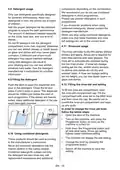
- Page 14: Detergent usage components depend on the combination. It is recommended not to use combined detergents in short programmes. Powder detergents should be used in such programmes. Problems with combined detergents should be directed to the detergent manufacturer. Ensure water hardness and rinse aid settings are correct when stopping the use of combined detergents. Only use detergents specifically designed for domestic dishwashers and keep them out of reach of children. The proper amount of detergent depends on the cycle, load size, and soil level of dishes. Rinse aid helps to dry dishes without streaks and prevents glass corrosion. Too much detergent can cause machine damage, while too little can result in poor cleaning. Rinse aid is required for stain-free utensils and clear glasses, and it is automatically released during the hot rinse phase. Adjusting the rinse aid dosage setting is crucial to avoid whitish stains or bluish layers on dishes. To fill the detergent dispenser, push the latch to open and pour in the detergent before starting each programme. For heavily soiled dishes, additional detergent can be placed in the pre-wash chamber. To fill the rinse aid compartment, open the cap, fill to the MAX level, and close it carefully to avoid spills. Adjusting the rinse aid level involves following specific steps with the machine's controls.
- Page 15: The factory rinse aid level setting is “4”. If the dishes are not drying properly or are spotted, increase the level. If blue stains form on your dishes, decrease the level. Rinse-aid not dispensed indicators show different LED patterns for various doses dispensed. 1 dose is dispensed when P2-9h LEDs are on. 2 doses are dispensed when 1/2-9h LEDs are on. 3 doses are dispensed when 3h-9h LEDs are on. 4 doses are dispensed when 6h-9h LEDs are on. P1-9h LEDs indicate no rinse-aid dispensed. Different LED indicators correspond to the amount of rinse-aid dispensed.
- Page 16: Recommendations for loading your dishwasher include removing coarse residue from dishes before placing them in the machine. Start the machine with a full load for best results. Loading the dishwasher to the manufacturer's indicated capacity contributes to energy and water savings. Manual pre-rinsing of tableware is not recommended as it increases water and energy consumption. Place cups, glasses, and small plates in the upper basket, ensuring long glasses do not lean against one another to avoid damage. Do not overload the drawers or place dishes in the wrong basket. Place long-handle and sharp-pointed knives with their sharp points facing down or horizontally to avoid injuries. Ensure all containers are placed with the opening facing downwards to prevent water collection. Use the cutlery grid if available for best results. Place large and very dirty items in the lower rack, and ensure dishes and cutlery are not stacked above each other. Take care not to obstruct the rotation of spray arms and ensure dishes do not prevent the opening of the detergent dispenser.
- Page 17: Upper basket Height adjustable rack (peg type) Height adjustment Turn the rail stop clips to open them, then pull out and remove the basket. Change the position of the wheels, then reinstall the basket. Make sure to close the rail stop clips. When the upper basket is in the higher position, large items such as pans can be placed on the lower basket. The height adjustable racks enable glasses and cups to be placed on or under the racks. The racks can be adjusted to 2 different heights. Cutlery and utensils can also be placed on the racks horizontally.
- Page 18: Alternative basket loads Unsuitable items for dishwashing Lower basket - Cigarette ashes, candle leftovers, polish, paint, chemical substances, iron-alloy materials. - Forks, spoons and knives with wooden, bone, ivory or nacre-coated handles; glued items, items soiled with abrasive, acidic or base chemicals. - Temperature-sensitive plastics, copper or tin-coated containers. - Aluminium and silver objects. Upper basket - Some delicate glasses, ornamental printed porcelains; some crystal items, adhered cutlery, lead crystal glasses, cutting boards, synthetic fibred items. - Absorbent items such as sponges or kitchen rugs. Important: In future, purchase dishwasher-proof kitchenware. Incorrect loads Incorrect loading can cause poor washing and drying performance. Please follow the manufacturer’s recommendations for a good performance result.
- Page 19: Program names include Intensive 65°C, Hygiene 70°C, Super 50’, Quick 30’, Prewash, Eco, and Standard. The eco program is suitable for normally soiled tableware and is the most efficient in terms of energy and water consumption. Washing tableware in a household dishwasher typically consumes less energy and water than hand dishwashing when used according to the manufacturer's instructions. Only use powder detergent for short programs, which do not include drying. To assist drying, it is recommended to slightly open the door after a cycle is complete. The program duration may change based on the amount of dishes, water temperature, ambient temperature, and selected additional functions. Values for programs other than the eco program are indicative only. You can access the product database by reading the QR code on the energy label. According to regulations, eco program energy consumption values may differ. This table complies with regulations 2019/2022 and 2017/2022.
- Page 20: The control panel includes various buttons for operation. The on/off button switches the machine on and off. The programme selection button allows you to choose a suitable programme for your dishes. The half load button reduces the duration of the selected programme to save energy and water. The delay button enables you to delay the start time of a programme for 3, 6, or 9 hours. Indicators show the status of the salt chamber and rinse aid chamber. If the salt chamber needs filling, the salt lack warning indicator will illuminate. If the rinse aid chamber needs filling, the rinse aid lack warning indicator will illuminate. To change a programme while in operation, open the door and select a new programme. The new programme will resume the course of the old programme after closing the door.
- Page 21: Buzzer sound control allows you to change the buzzer sound level. To cancel a programme while in operation, open the door and press Programme and Half Load buttons simultaneously for 3 seconds. When the sound setting is recognized, the buzzer gives a long sound and displays the last set level from “S0” to “S3”. To decrease or increase the sound level, press the Programme or Half Load button respectively. The End Of Programme Indicator will flash when the programme is cancelled, and a buzzer will sound 5 times. To save the selected sound level, turn off the machine. The factory setting for sound level is “S3”, while “S0” means all voices are off. To activate or deactivate save power mode, press Half Load and Delay buttons simultaneously for 3 seconds. When Save Power Mode is activated, interior lights will turn off after 4 minutes and the machine will turn off after 15 minutes of inactivity. If the door is opened or power is cut off during operation, the programme will continue when the door is closed or power returns.
- Page 22: The machine will always be on unless it is turned off by the user. To save the selected setting, turn off the machine. In factory setting, Save Power Mode is active. The machine is running a program. A program is cancelled. The machine has a fault. Refer to section Automatic fault warnings and what to do. A program is finished.
- Page 23: Cleaning and maintenance are essential for the dishwasher's service life. To clean the filter combination, turn it counterclockwise and lift it upwards. Rinse the filter with plenty of water until free of residue and reassemble the filters. Ensure the water softening setting is correct to prevent limescale accumulation. Refill the salt compartment when the salt sensor light comes on. Never use the dishwasher without a filter, as it reduces washing effectiveness. Clean filters are necessary for the proper running of the machine. To extend the life of your dishwasher, clean it regularly. Check that the spray holes are not clogged and clean the spray arms if necessary. Wipe the door seals regularly with a damp cloth to remove residue.
- Page 24: Drain pump Large food residues or foreign objects may block the waste water pump. The rinsing water will then be above the filter. Warning: Risk of cuts! When cleaning the waste water pump, ensure that you do not injure yourself on pieces of broken glass or pointed implements. First, always disconnect the appliance from the power supply. Take out baskets. Remove the filters. Scoop out water, use a sponge if required. Check the area and remove any foreign objects. Install filters.
- Page 25: Troubleshooting Possible causes for issues with the dishwasher include being unplugged or switched off. Check indoor fuses if the fuse is blown. Ensure the water inlet tap is turned on. Close the dishwasher door to start the program. If the program does not start, check for a closed water inlet tap or an open door. Clogged water inlet hose and machine filters can prevent operation. Water remaining inside the machine may indicate clogged filters or an unfinished program. If the machine stops during washing, check for water inlet failure. Shaking and hitting noises may occur if the spray arm is blocked by dishes. Ensure dishes are placed correctly and do not overload the baskets.
- Page 26: Fault possible causes troubleshooting Use the correct amount of detergent, as instructed in the programme table. Not enough detergent used. Increase rinse aid and/or water softener setting. Whitish stains remain on dishes. High water hardness level. Increase water softener level and add salt. Salt compartment cap not closed properly. Check that the salt compartment cap is closed properly. Dishes do not dry. Use only dishwasher-proof sets.
- Page 27: Automatic fault warnings and what to do Trouble code Possible fault What to do Water inlet system failure Make sure the water inlet tap is open and water is flowing. Separate the inlet hose from the tap and clean the filter of the hose. Pressure system failure Close the tap and contact for service. Inability to discharge water Cancel the programme. Faulty heater Unplug the machine and close the tap. Overheating Faulty electronic card Contact for service.
- Page 28: The installation and repairing procedures should always be carried out by the authorised service agent to avoid possible risks. The manufacturer shall not be held liable for damages that may arise from procedures carried out by unauthorised persons. Repairs may be carried out by technicians only. If a component has to be replaced, ensure that only original spare parts are used. Improper repairs or use of non-original spare parts may cause considerable damage and put the user at considerable risk. Function-relevant genuine spare parts according to the corresponding Ecodesign order can be obtained from customer service for a period of at least 10 years from the date on which your appliance was placed on the market within the European Economic Area.

GE JGP3036 36 Inch Gas Cooktop with Dishwasher

Hotpoint H2F HL626 X UK Dishwasher

Fisher and Paykel DW60FC2X2 Dishwasher

FISHER and PAYKEL DD24SCTB9 N Dishwasher

SAMSUNG DW60M6055FG-SA Free Standing Dishwasher

FISHER AND PAYKEL DD24DTI9 N Integrated Dishwasher

Kaiser S 60 I 69 XL Empire Dishwasher

Bosch SPU6ZMS35E Dishwasher

FISHER AND PAYKEL DD24SHTI9N Integrated Single Dishwasher

InDeSIT DFE 1B19 X Dishwasher