
bellini BDW96W, BDW96X Series 45cm Dishwasher
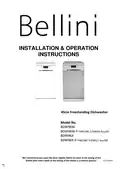






INSTALLATION & OPERATION
INSTRUCTIONS
45cm Freestanding Dishwasher
Model No.
BDW96W
BDW96W-F FINELINE: 5104010 Aus/NZ
BDW96X
BDW96X-F FINELINE: 5104011 Aus/NZ
'We recommend you open the door slightly 50mm to assist in the drying of the
dishes after every wash as the drying of the dishes is a natural process'
V13 July22


| General | Details |
|---|---|
| Name | bellini BDW96W, BDW96X Series 45cm Dishwasher |
| Make | Bellini |
| Language | English |
| Filetype | PDF (Download) |
| File size | 0.97 MB |
 (1 votes, average: 5.00 out of 5)
 Loading...

Bellini BDW504 Series 45cm and Dishwasher

Bellini BDWM48B Dishwasher

bellini BDW96W, BDW96X Series 45cm Dishwasher Overview
Summary of Contents
- Page 1: Installation and operation instructions for the 45cm freestanding dishwasher are provided. Model numbers include BDW96W, BDW96W-F, BDW96X, and BDW96X-F. It is recommended to open the door slightly (50mm) to assist in the drying of the dishes after every wash. The drying of the dishes is a natural process.
- Page 2: Thank you for choosing Bellini Appliances. Bellini prides itself on ‘affordable living’ making sure there is no compromise in your favourite room … The Kitchen. All Bellini appliances carry a 3 year In Home warranty. Be sure to retain your installation and user manual and receipt.
- Page 3: Safety instructions Operation description Start using your appliance Maintenance Warranty
- Page 4: Only authorised personnel should carry out servicing. Never use soap, laundry detergent, or hand washing detergent in your dishwasher. Always ensure the appliance is switched off before cleaning or replacing parts. Dishwasher detergents are strongly alkaline and can be extremely dangerous if swallowed. The door should not be left in the open position since this could present a tripping hazard. This appliance must be earthed. The appliance is to be connected to the water mains using new hose sets, and the old hose-sets should not be reused. Never use a spray cleaner to clean the door panel, as it could damage the door lock and electrical components. Do not operate your dishwasher unless all enclosure panels are properly in place. This product must not be disposed together with domestic waste.
- Page 5: Operation instruction Control panel Power switch: To turn on/off the power supply. Program button: Press the button to scroll through the wash cycles. Delay button: The DELAY START will allow you to delay the start time of any cycle automatically up to 24 hours. Dry+ button: Press this button to choose or cancel the Dry+ function. 3 in 1 button: Press this button to choose or cancel the “3 in 1 function. Start/Pause button: The appliance will start or pause the expected washing cycle. Child lock button: Press the two buttons for 3 seconds to lock or unlock the appliance. Program indicator light: The corresponding light will display when you select a washing programme. Rinse aid refill indicator: The indicator lights up when the dispenser needs to be refilled. Digital display: To display the running time remaining, malfunction codes, and delay timer.
- Page 6: Dishwasher features include various components such as the upper basket, spray arms, lower basket, filters, detergent dispenser, rinse aid dispenser, and cutlery basket. The user manual outlines the accessories, including a drain hose hanger and hose hook. The document also mentions the inlet pipe connector and drain pipe connector.
- Page 7: Before using your dishwasher for the first time, fill the rinse aid dispenser. Rinse aid is automatically added during the last rinse, ensuring thorough rinsing, spot and streak-free drying. Only use branded rinse aid for the dishwasher. Never fill the rinse aid dispenser with any other substances, as this would damage the appliance. You can judge the amount of rinse aid by the color of the optical level indicator located next to the cap. When the rinse aid container is full, the whole indicator will be dark. You should never let the rinse aid get below 1/4 full. As the rinse aid diminishes, the size of the black dot on the rinse aid level indicator changes. Refill the rinse aid to eliminate spotting when it reaches 1/4 full.
- Page 8: Rinse aid dispenser To open the dispenser, turn the cap to the open (left) arrow and lift it out. Pour the rinse aid into the dispenser, being careful not to overfill. The rinse aid is released during the final rinse to prevent water from forming droplets on your dishes. Your dishwashers are designed to use liquid rinse aids. To fill the dispenser, open the cap and pour the rinse aid until the level indicator turns completely black. Be careful not to overfill the dispenser, as this could cause over sudsing. The rinse aid dispenser has four or six settings. Always start with the dispenser set on 4. Increase the amount of rinse aid dispensed if spots and poor drying are problems. Detergents are necessary to remove dirt and transport it out of the dishwasher.
- Page 9: Concentrated detergent can be split into two basic types: conventional, alkaline detergents and low alkaline concentrated detergents with natural enzymes. Using a normal washing programme with concentrated detergents reduces pollution and is effective for cleaning dishes. Normal washing programmes are matched to the dirt-dissolving properties of concentrated detergents, achieving results similar to intensive programmes. Detergent tablets dissolve at different speeds, so long programmes are recommended to ensure complete removal of detergent residues. The detergent dispenser must be refilled before each washing cycle according to the provided instructions. Generally, only one tablespoon of detergent is needed for a normal wash load, with more heavily soiled items requiring additional detergent. Always add detergent just before starting the dishwasher to ensure proper dissolution. Dishwasher detergent is corrosive and should be kept out of reach of children. Use only detergent specifically made for dishwashers and keep it fresh and dry. Do not put powder detergent into the dispenser until ready to wash dishes.
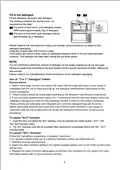
- Page 10: Fill the detergent dispenser with detergent. The marking indicates the dosing levels. The place of main wash cycle detergent placed, MIN means approximately 20g of detergent. The place of pre-wash cycle detergent placed, approximately 5g of detergent. Please observe the manufacturer's dosing and storage recommendations as stated on the detergent packaging. If the dishes are heavily soiled, place an additional detergent dose in the pre-wash detergent chamber. You find information about the amount of detergent for the single programme on the last page. Before using 3 in 1 products, check that the water hardness in your supply is compatible. These products should be strictly used according to the detergent manufacturers instructions. To cancel 3in1 function, follow the 'Cancelling a programme in progress' instructions.
- Page 11: Loading the dishwasher baskets requires following specific guidelines for optimal performance. Scrape off large amounts of leftover food; rinsing is not necessary. Items should be placed upside down to allow water to run off. Ensure items are stacked securely and do not obstruct the spray arms. Very small items should not be washed in the dishwasher. Only one basket can be pulled out at a time to prevent dumping. To avoid water dripping, empty the lower basket first. The upper basket is designed for delicate and lighter dishware. Position dishes so they are not moved by the spray of water. The height of the upper basket can be adjusted for larger utensils.
- Page 12: Upper basket height adjustment allows you to adjust the height of the upper basket upwards or downwards without removing it from the machine when full. The basket is set to a lower position in factory settings. To lower the upper basket, press the levers located at the left and right sides and push the basket downwards slightly. To raise the upper basket, pull it upwards without operating any levers. Ensure both sides are in the same position when adjusting the loaded basket. Upper basket can be adjusted for height by putting wheels of different height into the rails. Long items should be placed on the shelf to avoid obstructing the rotation of the spray arms. Folding racks on the upper and lower baskets help place larger items like pots and pans more easily. Each part of the folding racks can be folded separately or all can be folded for larger space. You can use folding racks by raising them upwards or by folding.
- Page 13: Cutlery tray Arrange the cutlery in the tray as shown. Cutlery should be placed to ensure that water runs off freely. Cutlery basket For washing in the dishwasher, the following cutlery/dishes are not suitable: - Cutlery with wooden, horn china or mother-of-pearl handles - Some types of glasses can become dull after a large number of washes - Plastic items that are not heat resistant - Older cutlery with glued parts that is not temperature resistant - Bonded cutlery items or dishes - Pewter or copper items - Lead crystal glass - Silver and aluminium parts have a tendency to discolour during washing - Steel items subject to rusting - Wooden platters - Items made from synthetic fibre - Glazed patterns may fade if machine washed frequently Note: Do not put in items that are dirty of cigarette ash, candle wax, lacquer or paint. If you buy new dishes, please make sure that they are suitable for dishwashers.
- Page 14: Note: Do not overload your dishwasher. There is only space for 9 standard dishes. Before loading the dishes, remove large leftovers and soften remnants of burnt food in pans. Dishes and cutlery must not impede the rotation of the spray arms. Load hollow items such as cups and glasses with the opening downwards. Dishes and items of cutlery must not lie inside one another or cover each other. To avoid damage to glasses, they must not touch. Load large items which are most difficult to clean into the lower basket. The upper basket is designed to hold more delicate and lighter dishware. Long bladed knives stored in an upright position are a potential hazard. When the working cycle has finished, the buzzer of the dishwasher will ring for 6 times, then stop.
- Page 15: Starting a washing programme Wash cycle table For the heaviest soiled loads, such as pots, pans, casserole dishes and dishes that have been sitting with dried food on them for a while. For heavy soiled loads, such as pots, plates, glasses and lightly soiled pans. For normally soiled loads, such as pots, plates, glasses and lightly soiled pans. For dishes that need to be rinsed and dried only. A shorter wash for lightly soiled loads that do not need drying. To rinse dishes that you plan to wash later that day. This programme is the test cycle. The information for comparability test in accordance with AS/NZS.2007.1. We recommend you open the door slightly 50mm to assist in drying of the dishes after every wash. Draw out the lower and upper basket, load the dishes and push them back.
- Page 16: Insert the plug into the socket. The power supply is 220-240V AC 50 Hz. Make sure that the water supply is turned on to full pressure. Press the Power button and select a desired Wash cycle. A click could be heard when the door is closed perfectly. When the washing is over, you can shut off the switch by pressing the Power button. A cycle that is underway can only be modified if it has only been running for a short time. If you open the door when washing, the machine pauses and a warning alarm rings. A forgotten dish can be added any time before the detergent cup opens. It is dangerous to open the door when washing, because the hot water may scald you. Open the dishwasher's door, leave it ajar and wait a few minutes before removing the dishes.
- Page 17: Maintenance and cleaning The filter is used to avoid big remnants and other sundries getting inside the pump. The filter system consists of a coarse filter, a flat (main filter), and a micro filter (fine filter). Food and debris will be trapped by a special jet on the lower spray arm. Big debris, such as bone and glass that could clog the drain, will be trapped in the coarse filter. Inspect the filters for obstructions every time the dishwasher has been used. Remove any food remnants and clean the filters under running water. For best performance and results, the filter assembly must be cleaned. The entire filter assembly should be cleaned once a week. Improper replacement of the filter may reduce the performance level of the appliance and damage dishes and utensils.
- Page 18: WARNING! Never run the dishwasher without the filters in place. When cleaning the filters, don't knock on them. It is necessary to clean the spray arms regularly for hard water chemicals will clog the spray arm jets and bearings. Wash the arms in soapy and warm water and use a soft brush to clean the jets. To clean the control panel, use a lightly dampened cloth then dry thoroughly. Never use sharp objects, scouring pads or harsh cleaners on any part of the dishwasher. If your dishwasher is left in an unheated place during the winter, ask a service technician to cut off electrical power to the dishwasher. To clean the edge around the door, use only a soft warm, damp rag. Never use a spray cleaner to clean the door panel for it could damage the door lock and electrical components. Never use abrasive cleaners or scouring pads on the outer surfaces because they will scratch the finish.
- Page 19: How to keep your dishwasher in shape After every wash, turn off the water supply to the appliance and leave the door slightly ajar to prevent moisture and odors. It is recommended to run a wash cycle with the dishwasher empty before removing the plug and turning off the water supply. Before cleaning or performing maintenance, always remove the plug from the socket. If the appliance must be moved, keep it in the vertical position; it can be positioned on its back if necessary. Do not use solvents or abrasive cleaning products on the exterior and rubber parts of the dishwasher. To remove spots or stains from the interior, use a cloth dampened with water and a little white vinegar. Periodic cleaning of the seals with a damp sponge will prevent odors from forming. Electrical shock hazard: installation of pipes and electrical equipment should be done by professionals. Keep this instruction manual in a safe place for future reference. Read this instruction manual carefully for important information regarding safe installation, use, and maintenance.
- Page 20: Position the dishwasher on a level and sturdy floor. If the floor is uneven, adjust the front feet of the appliance until it reaches a horizontal position. Connection to the water and electricity supplies should only be performed by a qualified technician. The appliance must be connected to the water supply network using new piping. Connect the cold water supply hose to a threaded 3/4 inch connector and ensure it is fastened tightly. Let the water run to ensure it is clear and free of impurities before connecting the water inlet. Fit the drainage hose of your machine to the drainage pipe without bending. The length of the drainage hose should not exceed 4 meters, even with an extension. Before inserting the plug into the electrical socket, ensure the socket is earthed and complies with current regulations. Do not use extension cables or multiple sockets.
- Page 21: Once the appliance has been installed, the power supply cable and the electrical socket should be easily accessible. If the power supply cable is damaged, it must be replaced by the manufacturer or its Technical Assistance Service. Advice regarding the first wash cycle: completely fill the dispenser of Rinse before running the first wash cycle. Position the appliance in the desired location, with the back against the wall and sides along adjacent cabinets or wall. Once the appliance is positioned, adjust the feet to make it level. If the sink is 1000mm higher from the floor, drain excess water from hoses into a bowl or suitable container. Connect the water drain hose correctly to avoid water leaks. Ensure that the water inlet hose is not kinked or squashed. If you need a drain hose extension, it must be no longer than 4 metres. The waste connection must be at a height of between 50cm (minimum) and 100cm (maximum) from the bottom of the dish.
- Page 22: Start of dishwasher The followings should be checked before starting the dishwasher: - Whether the dishwasher is level and fixed - Whether the inlet valve is opened - Whether there is leakage at the connections of the conducts - Whether the wires are tightly connected - Whether the power is switched on - Whether the inlet and drain hoses are knotted - All packing materials and printings should be taken out from the dishwasher After installation, please put this manual into the bags of printings. The content of this manual is very helpful to the users. When some malfunctions happen, the appliance will display error codes to warn you. If overflow occurs, turn off the main water supply before calling a service. If there is water in the base pan because of an overfill or small leak, the water should be removed before restarting the dishwasher. Technical information - W: 448mm - D: 600mm - H: 845mm - Voltage connected load: see rating label - Water pressure: 0.04--1.0MPa - Capacity: 9 place settings
- Page 23: Problem: Dishwasher doesn't run Possible causes: Power supply is not turned on, water pressure is low What to do: Replace fuse or reset circuit breaker, ensure the dishwasher is turned on and the door is closed securely, check power cord and water supply. Overflow: The system detects overflow and shuts off the circulation pump while turning on the drain pump. Noise: Some audible sounds are normal, ensure utensils are secure in the baskets. Suds in the tub: Use only special dishwasher detergent, wipe up rinse agent spills immediately. Dishes and flatware not clean: Check for improper program, improper loading, or blocked detergent dispenser and spray arms. Spots and filming on glasses and flatware: Use vinegar or citric acid crystals to remove spots. Cloudiness on glassware: Use less detergent if you have soft water and select a shorter cycle.
- Page 24: Using a solution of 1/2 cup of bleach and 3 cups of warm water to remove stains by hand. You have to wait for 20 minutes after a cycle to let the heating elements cool down before cleaning interior; otherwise, burns will happen. Iron deposits in water can cause an overall film. You have to call a water softener company for a special filter. To clean the interior, use a damp sponge with dishwasher detergent and wear rubber gloves. Never use any other cleaner than dishwasher detergent for the risk of foaming or suds. Clogged detergent residue is blocking the catch. Dishes block detergent cups. There is some steam coming through the vent by the door latch during drying and water draining. Make sure the dishwasher is in a horizontal position.
- Page 25: Warranty In this warranty, Australian Consumer Law refers to the law as set out in Schedule 2 of the Competition and Consumer Act 2010. The Company means GSM Retail Australia Pty Ltd. Consumer refers to the original purchaser of a Bellini product. Consumer Guarantees are the guarantees under the Australian Consumer Law. This warranty does not affect any person’s rights under the Australian Consumer Law. The Company warrants that the Bellini product will be free of manufacturing defects. The warranty commences on the date of purchase and lasts for three years. The warranty will not apply to any Bellini product installed by unqualified persons or subjected to misuse. The Australian Consumer Law guarantees that goods cannot be excluded from certain rights. To make a claim under this warranty, the consumer must contact the nearest authorized center.
- Page 26: You must provide proof of your purchase of the Bellini product and the date of purchase to obtain the benefit of this warranty. If you live outside the service area of the Company or one of its service agents, this warranty does not cover the cost of transport of the Bellini product for service. You must ensure the Bellini product is safely disconnected by a qualified tradesman and securely packed and insured for transport. The Company does not accept any responsibility for loss or damage of the Bellini product prior to it being received by the Company or its service agent. You will be responsible for all costs of returning a Bellini product to the Company and for redelivery of the Bellini product. The Company will examine any Bellini product and if it is determined to be defective through no fault of the Owner, it will repair or replace the product. Your purchase receipt/invoice is proof of date of purchase. If you are unable to establish the date of purchase, you will be required to bear all service call charges. GSM Retail Australia Pty Ltd reserves the right to discontinue items, modify designs and change specifications without incurring obligation. No warranty is given in respect of descriptions, specifications and other information in this publication, and the company shall not be liable for any errors therein.

Hotpoint H2F HL626 Dishwasher

SHARP QW-NA1BF47EI-EU Series Dishwasher

Mueller DW-1800 Series 18 Inch Dishwasher

BOSCH SMS2ITI04Y Dishwasher

FISHER AND PAYKEL DD24DCTX9 Contemporary Tall Dishwasher

FISHER AND PAYKEL DW60UT4HI2 Dishwasher

FISHER PAYKEL DD24DTI9N Dishwasher

kleenmaid DW6032 Semi Integrated Dishwasher

BOSCH SMV4HTX33E Dishwasher

SIEMENS SN23EC03AE Free Standing Dishwasher