
comfee CDC22P4AWW Portable Dishwasher




1
2
A
A
技术要求:
1.该手册印刷颜色均为黑色 :PANTONE BLACK C
2.纸张规格为A5
3.如果供应商的排版需要加空白页,请加在封底之前
B
B
C
C
用户手册
CDC22P4AWW(2501C-US)
Comfee美国
6720602730
D
标记处数 分区 更改文件号 签 名
校对
日 期
阶 段 标 记
比 例
D
80G双胶
01
REV.
1:1
编
制
数
审 核
审 定
批 准
性能
排版
日期
量
重
第
量
佛山市顺德区美的
1
洗涤电器制造有限公司
1 张
共 1 张
1
2


| General | Details |
|---|---|
| Name | comfee CDC22P4AWW Portable Dishwasher |
| Make | comfee |
| Language | English |
| Filetype | PDF (Download) |
| File size | 3.48 MB |
 (1 votes, average: 5.00 out of 5)
 Loading...

COMFEE CDC22P1ABB Dishwasher

COMFEE CDC22P Mini Dishwasher

comfee CDC22P4AWW Dishwasher

comfee CDC22P1AWW Compact Dishwasher

COMFEE KWH-TD602E-S Compact Dishwasher

comfee FD1201P-W Dishwasher

COMFEE TD802 Table Top Dishwasher

Comfee CDC22P2AWW Dishwasher

comfee CDC22P Dishwasher

COMFEE FD1435E-W Slimline Dishwasher

comfee CDC22P4AWW Portable Dishwasher Overview
Summary of Contents
- Page 1: 技术要求: 该手册印刷颜色均为黑色。 纸张规格为A5。 如果供应商的排版需要加空白页,请加在封底之前。 用户手册 CDC22P4AWW(2501C-US) Comfee美国 标记处数分区更改文件号 签名 校对日期 阶段标记 比例 编制数 审核 审定 批准 性能 排版 日期 量重
- Page 2: Model CDC22P4AWW The warranty extension is for the three months immediately following the completion of the product's original warranty period. Please read this manual carefully before using your dishwasher, and keep it for future reference.
- Page 3: Quick user guide Starting a wash Discard scraps Scrape large food particles off and remove any foreign objects. Load dishes carefully For better washing result, place the dishes properly avoiding any contact or overlapping between them. Add detergent Check spray arm Ensure there are no items blocking the spray arm from rotating. Start washing Set up program and function Choose the proper program and function.
- Page 4: Safety information Product description Part names Control panel Using your dishwasher Preparing and loading dishes Basket use tips Adding detergent Operating the appliance Maintenance and cleaning
- Page 5: Important safety instructions include following basic precautions when using the dishwasher. Read all instructions before using the dishwasher. Use the dishwasher only for its intended function. Use only recommended detergents or wetting agents and keep them out of the reach of children. Locate sharp items to avoid damaging the door seal. Load sharp knives with the handles up to reduce the risk of injuries. Do not wash plastic items unless they are marked as dishwasher safe. Check the manufacturer's recommendations for unmarked plastic items. Do not touch the heating element during or immediately after use. Do not operate the dishwasher unless all enclosure panels are properly in place.
- Page 6: Do not abuse, sit on, or stand on the door or dish rack of the dishwasher. To reduce the risk of injury, do not allow children to play in or on a dishwasher. Under certain conditions, hydrogen gas may be produced in a hot-water system that has not been used for two weeks or more. If the hot-water system has not been used for such a period, before using the dishwasher turn on all hot-water faucets and let the water flow from each for several minutes. As the gas is flammable, do not smoke or use an open flame during this time. Remove the door to the washing compartment when removing an old dishwasher from service or discarding it. This appliance can be used by children aged from 8 years and above and persons with reduced physical, sensory or mental capabilities if they have been given supervision or instruction. Children shall not play with the appliance. Cleaning and user maintenance shall not be made by children without supervision. Save these instructions.
- Page 7: Grounding instructions This appliance must be grounded to reduce the risk of electric shock. Grounding provides a path of least resistance for electric current. The appliance is equipped with a cord having an equipment-grounding conductor and a grounding plug. The plug must be plugged into an appropriate outlet that is installed and grounded according to local codes. Improper connection of the equipment-grounding conductor can result in a risk of electric shock. Check with a qualified electrician if you are in doubt about proper grounding. Do not modify the plug provided with the appliance. If the plug does not fit the outlet, have a proper outlet installed by a qualified electrician.
- Page 8: Disposal For disposing of the package and the appliance, please go to a recycling centre. Cut off the power supply cable and make the door closing device unusable. Cardboard packaging is manufactured from recycled paper and should be disposed of in the waste paper collection for recycling. By ensuring this product is disposed of correctly, you will help prevent potential negative consequences for the environment and human health. For more detailed information about recycling of this product, please contact your local city office and your household waste disposal service. Do not dispose of this product as unsorted municipal waste. Collection of such waste separately for special treatment is necessary.
- Page 9: Product description Important: To get the best performance from your dishwasher, read all operating instructions before using it for the first time. Part names Front Top of inner tank Middle spray arm Lower spray arms Filter Detergent adding receptacle Back Power cable Drain pipe Interface
- Page 10: Upper basket Lower basket List of accessories provided Inlet pipe Drain-pipe Bucket pipe Water supply bucket Suction cup
- Page 11: Control panel Press this button to turn on your dishwasher, the screen will light up. Press these buttons to select the appropriate washing program, the selected program icon will light up. Heavy: For hard-to-clean, heavily soiled dishes, pots and pans. Normal: For normally soiled dinner dishes and silverware. Hygiene: Use to sanitize your dishes and glassware. 58min wash: For lightly soiled loads that need quick wash. Rapid: A shorter wash for lightly soiled loads that do not need drying. Self cleaning: This program provides an effective cleaning of the dishwasher itself. Child lock: This option allows you to lock the buttons on the control panel, so children cannot accidentally start the dishwasher. To lock or unlock the buttons on the control panel, press and hold the button for 3 seconds.
- Page 12: Auto open feature improves drying performance by automatically opening the dishwasher door at the end of the program. Press the button for 3 seconds to select the auto open function. Delay start time can be increased by pressing the button, allowing a cycle to be delayed for up to 24 hours in one-hour increments. Press the start button to begin the dishwasher cycle; the lamp will remain lit while the dishwasher is running. To pause a cycle, slightly open the door and wait for a few seconds until the wash action stops, indicated by a blinking lamp. Press and hold the start/cancel button for 3 seconds to cancel a running cycle. The water faucet indicator lights up when the water faucet is closed. If using a self-priming pump, a blinking indicator means there is insufficient water in the bucket, pausing the machine until more water is added. The screen displays the remaining program time, delay time, and error codes.
- Page 13: Using your dishwasher Preparing and loading dishes Consider buying utensils which are identified as dishwasher-proof. For particular items, select a program with the lowest possible temperature. To prevent damage, do not take glass and cutlery out of the dishwasher immediately after the program has ended. Cutlery with wooden, horn china or mother-of-pearl handles are not suitable. Plastic items that are not heat resistant are not suitable. Some types of glasses can become dull after a large number of washes. Recommendations for loading the dishwasher include scraping off any large amounts of leftover food. For best performance, place objects in the dishwasher with items such as cups and glasses faced downwards. Load hollow items with the opening facing downwards to prevent water collection.
- Page 14: To avoid damage, glasses should not touch one another. Please do not overload your dishwasher. Very small items should not be washed in the dishwasher as they could easily fall through the basket. Items will be hot! To prevent damage, do not take glass and cutlery out of the dishwasher for around 15 minutes after the program has ended. The loading pattern in the illustration is recommended for the design of the basket. Cups and glasses face downwards. Plates face the back of each other, as do side plates, soup plates, and saucers. Upper basket loading recommendations include serving spoons, serving fork, dinner forks, salad forks, knives, tea spoons, and saucers.
- Page 15: Lower basket Bread butter plates Dinner plates Oval platter Dessert bowls Saucers Glasses Serving bowl Cups Basket use tips The spacing between the tines can be increased by folding them down. This will help the loading of large bowls and deep pots and pans.
- Page 16: Adding detergent is crucial for proper dishwasher operation. Only use detergent specifically for dishwashers to avoid damage. Dishwasher detergent is corrosive and should be kept out of children's reach. Detergent tablets dissolve at different speeds; use long programs for complete cleaning. Refill detergent before each wash cycle according to the Wash Cycle Table. Your dishwasher uses less detergent than conventional models. Generally, one tablespoon of detergent is sufficient for a normal wash load. More heavily soiled items require additional detergent. Always add detergent just before starting the dishwasher to ensure proper dissolution.
- Page 17: Adding detergent The place to add the detergent
- Page 18: Operating the appliance Wash cycle table The table shows which programs are best for the levels of food residue on them and how much detergent is needed. Description of cycle Water (Gal) Running time (min) Program Heavy Normal Hygiene Rapid
- Page 19: Description of cycle includes water usage and running time for various programs. Instructions for starting a cycle wash involve loading the baskets, pouring in detergent, and ensuring proper power and water supply. The recommended loading order is the lower basket first, followed by the upper basket. After closing the door, the power button must be pressed to switch on the machine. Choosing a program will activate the response light, and the Start/Cancel button initiates the cycle. Changing the program once started is possible only if the cycle has been running for a short time. If the detergent has been released, the dishwasher needs to be reset and the detergent dispenser refilled. To reset the dishwasher, hold the Start/Cancel button for more than 3 seconds to drain the machine. After draining, a new program can be selected and started. The dishwasher will enter standby state after the reset process.
- Page 20: Adding items while a wash is in progress You can add items after the wash program has begun. If it is no longer in the wash cycle, anything added may not be well washed. Check that it is not rinsing. Open the door a little to stop the washing. After the spray arms stop working, you can open the door completely. It is dangerous to open the drawer mid-cycle, as hot steam may scald you. If you open the door during washing, the machine will pause. When you press the Start/Pause button, the machine will keep on working. If the electric power to the dishwasher is interrupted during a wash program, it will continue to the end of the program when the power is restored.
- Page 21: Maintenance and cleaning External care Clean the door seals regularly with a soft damp cloth to remove food deposits. Food and drink residues may drip onto the sides of the dishwasher door. These surfaces are outside the wash cabinet and are not accessed by water from the spray arm. The control panel should be wiped with a soft damp cloth only. To avoid penetration of water into the door lock and electrical components, do not use a spray cleaner of any kind. Never use abrasive cleaners or scouring pads on the outer surfaces. The filtering system in the base of the wash cabinet retains coarse debris from the washing cycle. Check the condition of the filters regularly and clean them if necessary under running water. Pictures are only for reference; different models of the filtering system and spray arm may be different.
- Page 22: Filtering system Fine filter Main filter Lift fine filter up from main filter. Hold the coarse filter and rotate it anticlockwise to unlock the filter. Lift the filter upwards and out of the dishwasher. Larger food remnants can be cleaned by rinsing the filter under running water. Reassemble the filters in the reverse order of the disassembly. Replace the filter insert and rotate clockwise to the close arrow. For a more thorough clean, use a soft cleaning brush.
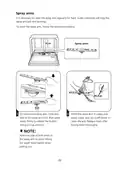
- Page 23: Spray arms need regular cleaning to prevent clogging from hard water chemicals. To clean the spray arm, hold one end and press down firmly to release the button. Wash the spray arm in soapy warm water and use a soft brush to clean the jets. Replace the spray arm after rinsing it thoroughly. Hold one side of both ends of the spray arm to avoid hitting the upper bowl basket when pulling it out.
- Page 24: Caring for the dishwasher involves taking precautions against frost damage. To prevent freezing, turn off the mains power and water supply, and disconnect the water inlet hose. Drain the water from the hose and reconnect it. Remove the coarse filters and soak up any remaining water with a sponge before reassembling. Use gentle cleaning products on the exterior, avoiding solvents and abrasive compounds. Products designed for stainless steel interiors can help restore brightness. For long-term storage, disconnect both the power and water supply. Soak up any water in the coarse filters to prevent odors in the tubs.
- Page 25: Installation instruction Product dimensions Height Width (W) Depth (D1) Depth (D2) Voltage connected load Water pressure Power supply Capacity
- Page 26: Inlet pipe connected There are two ways to connect the water. Connect inlet hose to the tap. Use the suction pipe and add water into the suction bucket. Take the existing aerator off your faucet. Screw the faucet adapter onto (or into) the faucet tap. Check for leaks. Attach the quick connect onto the faucet adapter by pulling down the locking collar. Slowly open the hot water line and check for any sign of water leaks at all hose connections. Please confirm whether the supplied adapter is suitable for your faucet tap.
- Page 27: Connect the inlet pipe to the dishwasher. Please keep the soft cover on the suction hose after you connect the inlet pipe to the dishwasher. A little water will flow out if the soft cover is pulled out. Connect the suction pipe and add water into the suction bucket. Please make sure the bucket is filled up over 12L (3.17 Gal) - tick mark. Otherwise, the dishwasher may show E1 code on the screen due to insufficient supply water, and it will not work properly.
- Page 28: Fill the bucket with water at the maximum water level. Power on, choose the program and run. Fix the drain pipe with the back pipe of the machine. The interface is fitted with clamps and tightened with a screwdriver. Put end of the drain pipe into a sink or bucket.
- Page 29: How to drain excess water from hoses Excess water in hoses cannot be drained directly into the sink if the drain hose or location is higher than the drain exit. It is necessary to drain excess water into a bowl or suitable container held outside and lower than the sink. Water outlet The drain hose must be correctly fitted to avoid water leaks. Ensure that the water drain hose is not kinked or squashed. Extension hose Use a similar drain hose for extensions. The extension must be no longer than 157.5 inches to maintain cleaning effectiveness. Electrical requirements Disconnect electrical power before installing the dishwasher to avoid electrical shock hazards. The installation of pipes and electrical equipment should be done by professionals.
- Page 30: About power connection For personal safety, do not use an extension cord or an adapter plug with this appliance. Do not, under any circumstances, cut or remove the earthing connection from the power cord. Please look at the rating label to know the rating voltage and connect the dishwasher to the appropriate power supply. Use the required fuse 10 amp, time delay fuse or circuit breaker recommended and provide separate circuit serving only this appliance. Ensure the voltage and frequency of the power being corresponds to those on the rating plate. Only insert the plug into an electrical socket which is grounded properly. If the electrical socket to which the appliance must be connected is not appropriate for the plug, replace the socket. Ensure that proper grounding exists before use. The power supply is 120V AC 60Hz, 10 Amp circuit.
- Page 31: Troubleshooting tips provide a checklist for common problems and solutions before calling for service. If the dishwasher doesn't start, check if the fuse is blown or the circuit breaker is tripped. Ensure the power supply is turned on and the dishwasher door is securely closed. A kink in the drain hose or a clogged filter can prevent water from being pumped from the dishwasher. Check the kitchen sink for clogs, as this may require a plumber. Using only special dishwasher detergent is important to avoid suds. If suds occur, let them evaporate and add cold water to the tub to drain it out. Hard water minerals can cause a white film on the inside surface of the dishwasher. To clean the interior, use a damp sponge with dishwasher detergent and wear rubber gloves. Never use any cleaner other than dishwasher detergent to avoid foaming or suds.
- Page 32: Problem Possible causes What to do There are rust stains on cutlery. Avoid washing items that are not corrosion resistant in the dishwasher. The spray arm is knocking against an item in a basket. Interrupt the program, and rearrange the items which are obstructing the spray arm. Rattling noise may occur if items of crockery are loose in the wash cabinet. Interrupt the program, and rearrange the items of crockery. Knocking noise in the water pipes may be caused by on-site installation or the cross-section of the piping. The dishes were not loaded correctly. Select a more intensive programme.
- Page 33: Problem: Cloudiness on glassware. Possible causes include a combination of soft water and too much detergent. What to do: Use less detergent if you have soft water and select a shorter cycle to wash the glassware. Problem: Black or grey marks on dishes. Possible causes include aluminium utensils rubbing against dishes. What to do: Use a mild abrasive cleaner to eliminate those marks. Problem: Dishes block detergent dispenser cups. What to do: Re-load the dishes properly to help shed water from the dishes. Problem: Detergent left in dispenser cups. What to do: Load the dishwasher as suggested in the directions. Problem: Dishes are not drying. Possible causes include improper loading and dishes being removed too soon. What to do: Open the door slightly after washing to let steam escape and unload only once the dishes are barely warm. Problem: Wrong program has been selected. What to do: Choose a program with a long washing time for better drying performance. Problem: High amount of plastic dishes. Note: Drying plastic dishes is more difficult than glass, ceramic, or metal objects.
- Page 34: Error codes indicate malfunctions in the dishwasher. The dishwasher displays error codes to identify symptoms. E1 indicates extended water inlet time due to possible leaks or obstructions. E4 signifies a leak detected in the system. Possible causes for E1 include over height items or internal plumbing failures. E4 may result from a failure of connection between the display unit and control system. For E4, contacting customer service is recommended. Water supply failure can be caused by a closed faucet or insufficient water pressure. Damaged components such as the self-priming pump, inlet valve, or flowmeter may also lead to issues. Understanding these error codes can help diagnose and resolve dishwasher problems.
- Page 35: 1 Year Limited Warranty This is the only express warranty for the product and in lieu of any other warranty or condition. This product is warranted to be free from defects in material and workmanship for a period of one year from the date of original purchase. During this period, your exclusive remedy is repair or replacement of this product or any component found to be defective. You are responsible for all costs associated with returning the product to us. This warranty does not cover wear from normal use, and operation that doesn’t conform to the instruction manual. This warranty extends only to the original consumer purchaser or gift recipient. Keep the original sales receipt, as proof of purchase is required to make a warranty claim. This warranty is void if the product is used for other than single-family household use. We exclude all claims for special, incidental, and consequential damages by breach of express or implied warranty. This warranty gives you specific legal rights, and you may have other legal rights that vary depending on where you live.

SIEMENS SX73HX10VE Dishwasher

Miele G 7960 C SCVi Dishwasher

FISHER PAYKEL DD24SCTX9 N Dishwasher

BOSCH SPS2HMW54Q Dishwasher

FISHER AND PAYKEL DD60D2NB9 Dishwasher

FISHER PAYKEL DD60DDFB9 Dishwasher

Westinghouse WSF6608KXB Sensor Wash Dishwasher

LG LDTH7972D Smart Dishwasher

FISHER AND PAYKEL DD24STI9N Dishwasher

GE APPLIANCES GD*650-670 Series Interior Dishwasher