
Home > Maidaid Halcyon > maidaid halcyon C612 Undercounter Tray Dishwasher
maidaid halcyon C612 Undercounter Tray Dishwasher


C612
PUMPED WASTE
User & Installation
Guide
JUNE.2021
REF:918753
All spares available from
The Engine Shed
Top Station Road
Brackley
NN13 7UG
Tel: 0845 1308060
Fax: 01280 845345
Copyright Notice: All rights reserved. No parts of this manual may be reproduced in any form without
express written permission of Maidaid-Halcyon (A trading name of Buttress Group Ltd)


| General | Details |
|---|---|
| Name | maidaid halcyon C612 Undercounter Tray Dishwasher |
| Make | Maidaid Halcyon |
| Language | English |
| Filetype | PDF (Download) |
| File size | 0.53 MB |
 (1 votes, average: 5.00 out of 5)
 Loading...

Maidaid Halcyon C652 Range Commercial Tray/Dishwasher
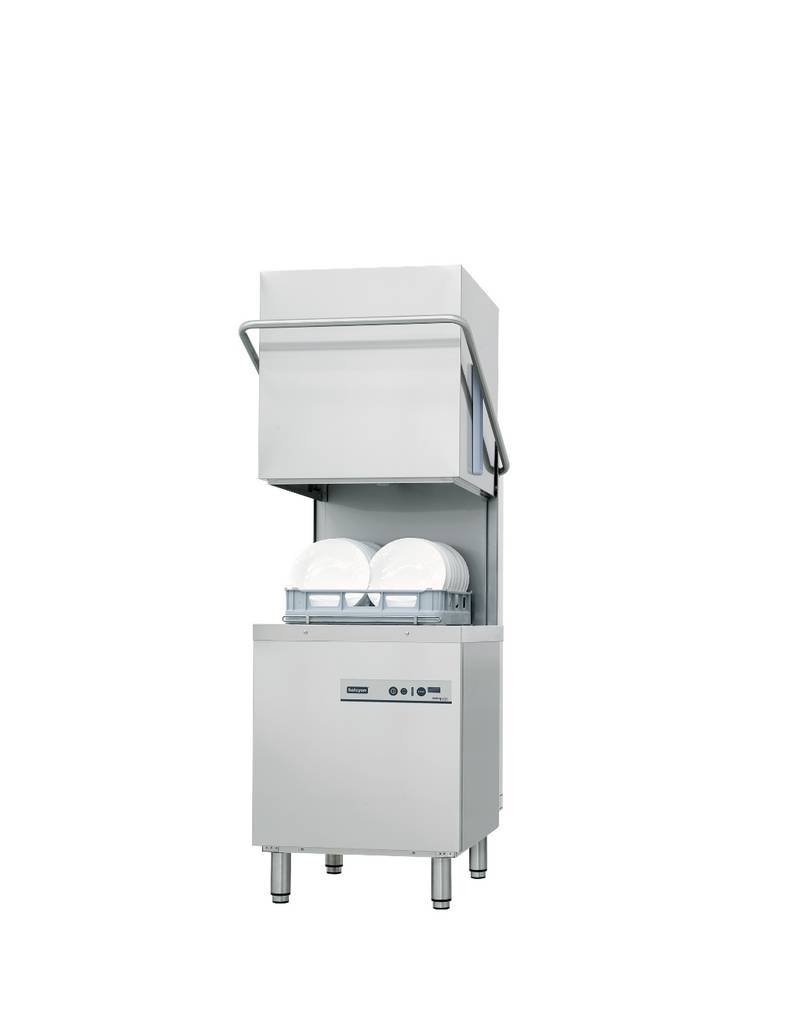
maidaid halcyon AMH91 Pass Through Gravity Drain Dishwasher

Maidaid Halcyon AMH80 Amika Pass Through Gravity Drain Dishwasher

maidaid halcyon EVO2160 Evolution Pass Through Dishwasher

maidaid halcyon AMH95WSD Water Softener Pass Through Dishwasher

Maidaid Halcyon AMH51 Amika Drain Pump Dishwasher

maidaid halcyon C612 Undercounter Tray Dishwasher Overview
Summary of Contents
- Page 1: User & Installation Guide Copyright Notice: All rights reserved. No parts of this manual may be reproduced in any form without express written permission of Maidaid-Halcyon.
- Page 2: Instruction manual for dishwashers Risks and important warnings Normal operating conditions Preface Installation Unpacking Positioning Electrical connection Water circuit hookup Connection to the drain line Rinse aid and detergent Using the machine Key and symbols Switching the dishwasher on Filling the rack Cycle selection and start-up Standard programmes Special programmes (optional) Automatic cycle start-up Removing the integral filter Emptying the dishwasher Maintenance General rules Cleaning Cleaning the filter unit Cleaning the arms Self diagnostics Settings Hardness settings for the incorporated water softener Environment
- Page 3: Instruction manual for dishwashers Read the instruction manual carefully before starting the machine. The warnings contained in the manual provide important information on safety and installation, use and maintenance. Risks and important warnings This appliance is intended solely for the use for which it was designed. Any other use is improper and therefore hazardous. The specialised technician responsible for installing the appliance must instruct the user on its operation and any attendant safety measures, including practical demonstrations. Only the manufacturer or an authorised service centre with qualified staff may work on the machine, even in case of malfunction, using only original spare parts. Always disconnect or isolate the machine from its power and water supplies before servicing, repairing or cleaning it. The machine may not be used by persons untrained in its use. Children must not play with the appliance. Cleaning and maintenance by the user must not be performed by unsupervised children. The machine must not be kept powered up when not in use. If the power cable is damaged, it must be replaced by the manufacturer or an authorised technical assistance service.
- Page 4: Instruction manual for dishwashers Never place your bare hands in the wash solution. If you notice any malfunction or fluid leak, immediately disconnect the power supply and shut off the water supply. Do not install the dishwasher in the vicinity of heat sources over 50°C. Never start a wash programme without the overflow in the tub, as applicable. The installer is responsible for checking that the grounding system is fully operational. At the end of testing, the installer must issue a written declaration stating that the machine has been installed and tested in accordance with established legislation and good practice. Do not clean the appliance with steam or water jets. Max inlet water temperature: 50°C. Max inlet water pressure: 4bar (400kPa). Appliance designed for permanent connection to the water supply.
- Page 5: instruction manual for dishwashers keep all documentation in the vicinity of the appliance and make it available to technicians and operators. the operator must read, understand and familiarize himself with the contents of this manual before working with the appliance. the appliance is intended solely for professional heavy duty dishwashing applications and must be installed, operated and serviced only by qualified persons. the manufacturer is not liable for any damage or injury resulting from failure to observe the instructions or improper use of the machine. failure to observe the instructions may compromise the safety of the appliance and void the warranty. proper installation is essential to the good operation of the appliance. the appliance may only be installed by qualified persons authorized to do so. check the condition of the packaging and report any damage to the reseller and shipping agent. ensure there are no objects in the installation area that may be damaged by steam emitted during operation. level the appliance with its four feet to ensure stability.
- Page 6: Instruction manual for dishwashers The appliance is intended for fixed installation only; any other approaches must be agreed with and approved by the manufacturer. Remove the protective film from its body panels before operating the dishwasher. The power supply must be fitted with an omnipolar circuit breaker to break all contacts including neutral. The master power switch must be fitted to the power line in the vicinity of the installation and may be connected to only one machine at a time. The mains voltage and frequency must match the nameplate ratings. The installation must include a grounding system conforming with established electrical safety legislation. This appliance conforms to EN/IEC 61000-3-11 certification if the system impedance is within specified limits. The power cable must be exclusively type H07RN-F with current capacity at 60°C. The appliance must also be connected to an equipotential system. Do not use multi-sockets, adapters, or cables of inadequate cross section or type.
- Page 7: Instruction manual for dishwashers The appliance must be connected to its water supply with a flexible hose. A shut off valve must be installed between the water supply line and the appliance's solenoid valve. The water supply, temperature, and pressure must be compatible with the ratings shown on the technical data plate on the machine. Make sure that the water supply flow rate is no less than 20 l/min. If the water hardness is greater than 14 °f (8 °dH), we recommend using an internal water softener. If the water has a very high residual concentration of high conductivity minerals, we recommend installing a demineralisation system. The drain line must consist of a free drain sump with siphon suited to the flow capacity of the drain hose supplied with the appliance. The tub drains under gravity, so the drain sump must be lower than the machine's base. If the drain is not lower than the base of the appliance, you can use the version with drain pump. The rinse aid and detergent are dispensed by the machine's integral dispenser. Never use chlorine or hypochlorite based detergents.
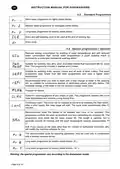
- Page 8: Instruction manual for dishwashers Using the machine Key and symbols Turn on the main power switch and open the external water tap. Press ON/OFF to start the machine. The CHECK BAR lights up to confirm the check. Loading begins automatically when the machine is switched on. Use a suitable rack, fill without overloading and without overlapping the dishes. Place the empty dishes in the rack facing downwards. Press the PROGRAMME SELECTION or SPECIAL PROGRAMME SELECTION button to select a wash cycle. To run the programme, press START; the STATUS BAR starts to flash orange. When the cycle is finished, the bar lights up in green. In hood versions, the automatic start is enabled after the first work cycle.
- Page 9: Instruction manual for dishwashers. Standard programmes include short, medium, and long wash cycles for varying soil levels. Drain and self-cleaning cycle should be used at the end of the working day. Special programmes are optional and reduce energy and water consumption while maintaining wash quality. A programme is suitable for very dirty dishes and includes multiple washes and rinses. There is a specific programme for cutlery that uses higher water temperatures. A complete change of water is recommended for greasy and dirty dishes, requiring a longer wash cycle. A programme for glasses uses low rinse temperatures and has a long drying time. Continuous wash cycle can be interrupted, with automatic rinsing resuming after a short pause. Sanitisation programme controls wash temperature and time based on the A0 value, typically around 20 minutes.
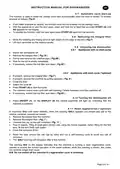
- Page 10: Instruction manual for dishwashers Automatic cycle start-up: This function is used to make the chosen cycle start automatically when the door is closed. Removing the integral filter: Move the washing and rinsing arms at right angles to the edge of the door. Lift each semi-filter by the relative handle. Emptying the dishwasher: Switch the dishwasher off. Remove the integral filter. Pull up and remove the overflow pipe. Wait for the tub to empty completely. Turning the dishwasher off: Press ON/OFF to power the machine. Resin regeneration: When the warning ‘SALt’ appears, add salt to the relative container. Remove the basket and integral filter. Unscrew the cap on the salt container and pour in approx. 700g of large-grain kitchen salt. Rinse the area around the salt cap and run a self-cleaning cycle. The warning ‘rEG’ indicates that the machine is running a resin regeneration cycle. Do not switch off the machine if a regeneration cycle is underway.
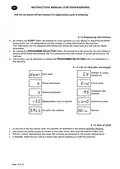
- Page 11: Instruction manual for dishwashers Do not switch off the machine if a regeneration cycle is underway. By holding the START button pressed for a few seconds, you can display the boiler temperature, tub temperature, and the number of cycles performed by the machine. This information can be displayed both before and during the wash cycle and will only be visible temporarily. By holding the PROGRAMME SELECTION button pressed for a few seconds, you can display the boiler temperature, tub temperature, and the number of cycles performed by the machine. At the end of the day, always drain the machine as described in the section on machine draining. Disconnect the power supply by means of the main switch and close the external water cock. Perform routine maintenance and clean the machine as described in the section on maintenance. If possible, leave the door ajar to prevent bad odours building up inside the machine.
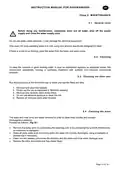
- Page 12: Instruction manual for dishwashers Maintenance Before doing any maintenance, completely drain out all water, shut off the power supply and close the water supply cock. Do not use water under pressure - it can damage the electrical equipment. Only wash the body panelling when it is cold, using only product specifically designed for steel. If there is a risk of ice forming, drain the water from the boiler and wash pump. To keep the machine in good working order, it must be maintained regularly. Run a sanitising treatment with suitable non-corrosive commercial products periodically. Remove and clean the baskets at the end of the day or when you see the filters are dirty. Do not use abrasive products to clean the tub. The wash and rinse arms are easily removed to clean their nozzles and prevent blockage/encrustations. Restore the arms and check that they rotate freely after cleaning.
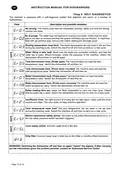
- Page 13: Instruction manual for dishwashers Self diagnostics The machine is equipped with a self-diagnosis system that registers and warns of a number of malfunctions. No rinsing: The rinsing cycle was not completed correctly. Make sure that the rinsing nozzles are clean. No drainage: The water was not drained or drained incorrectly. Check that the drain pipe is not bent or crushed. Rinsing temperature reset fault: The boiler temperature did not reset in the set time during the washing cycle. Water filling in tank fault: Make sure the pipes are connected correctly, and that the water tap is open. Tank thermometer fault (probe open): The machine does not read the tank temperature value. Boiler thermometer fault (probe open): The machine does not read the boiler temperature value. Boiler loading time out: Boiler not filled. Impossible to carry out rinse cycle. Insufficient rinse: The right amount of rinsing did not take place; make sure the rinse nozzles are clean. Electro-mechanical safety device: The boiler or tub safety thermostats have cut in. WARNING! Switching the dishwasher off and then on again resets the signals.
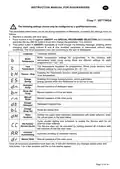
- Page 14: Instruction manual for dishwashers Settings The following settings should only be configured by a qualified technician. The parameters listed below can be set during installation or afterwards, accessing the settings menu. Machine in standby with door open. Press buttons 1 and 2 together for 5 seconds and enter the key CH 12. Language selection Boiler temperature settings for programmes. Tub temperature regulation for programmes. Enabling the Thermostop function, which guarantees the correct rinse temperature. Enabling the Energy Saving function, which guarantees energy savings when the dishwasher is on but not in use. Setting the supply water hardness (dishwashers with water softener). Cycle counter setting and activation to enable the Service alert for an external water softener. Once all necessary parameters have been set, to exit and memorise any changes simply press and hold button 1 for a few seconds.
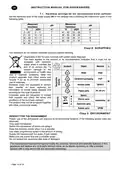
- Page 15: Instruction manual for dishwashers Set the hardness level of the water supply in the settings menu following the instructions given in the table. The mark applied to the product indicates that it must not be scrapped with domestic waste when it reaches the end of its service life. To prevent damage to the environment or health risks due to improper scrapping, keep this product separate from other waste and recycle it. Domestic users are requested to contact their reseller or local authority for information on sorted waste disposal and recycling. Proper use of the dishwasher can improve its environmental footprint if simple rules are observed. Only wash full baskets. Switch the dishwasher off when not using it. Keep the machine closed when it is in standby. Use wash programmes suited to the amount of soiling. Do not exceed the recommended dose of detergent.

Hotpoint HFC 3C26 WCUK Dishwasher

FISHER PAYKEL DD60D2HNX9 Built Under Dishwasher

BOSCH SMS4EMI06E-30 Dishwasher

Omega ODW300XN Slimline Dishwasher

Hotpoint HA3FC10BS7A0S Dishwasher

MONOGRAM CDT845P4NW2 Interior Dishwasher

FISHER PAYKEL DW60UC6B Built Under Dishwasher

FISHER and PAYKEL DD60SCW9 DishDrawer Dishwasher

Haier QDP555 Series Dishwasher

Whirlpool 859991663300 Dishwasher