
smeg LSPU8612S Silver Dishwasher






Contents
1
General safety instructions _______________________________2
2. Installation ___________________________________________9
3. Description of the controls ______________________________15
4. Operating instructions__________________________________19
5
6
Cleaning and maintenance______________________________20
Troubleshooting_______________________________________21
Thank you for choosing one of our products.
You are advised to read this manual carefully; it contains all the
information you need about the right conditions for the proper, safe use
of your dishwasher.
This manual contains only the basic information required to use the
appliance. The complete manual can be obtained from
by entering the product code shown on the plate attached to the inner
right hand edge of the dishwasher door.
The manual can be accessed quickly via the QR code using a device
with a QR reader application.
1


| General | Details |
|---|---|
| Name | smeg LSPU8612S Silver Dishwasher |
| Make | Smeg |
| Language | English |
| Filetype | PDF (Download) |
| File size | 0.28 MB |
 (1 votes, average: 5.00 out of 5)
 Loading...

smeg DWAU6224N4 Matte Black Underbench Dishwasher

smeg DWAFI6224-4 Dishwasher

smeg DWA6224X4 Dishwasher

smeg STU8633 Dishwasher

smeg DWAFI6214 Dishwasher

smeg LVS344PM 60 cm Free Standing Dishwasher

smeg LSPU8653X 24″ Fingerprint Resistant Dishwasher

Smeg DI362DQ Dishwasher

smeg DI323BL Dishwasher

smeg DWA6315X1 Dishwasher

smeg LSPU8612S Silver Dishwasher Overview
Summary of Contents
- Page 1: General safety instructions Installation Description of the controls Operating instructions Cleaning and maintenance Troubleshooting Thank you for choosing one of our products. You are advised to read this manual carefully; it contains all the information you need about the right conditions for the proper, safe use of your dishwasher. This manual contains only the basic information required to use the appliance.
- Page 2: Warnings Translation of the original instructions General safety instructions This manual is an integral part of the appliance and must always be kept intact together with the dishwasher for future reference. Before using the appliance, carefully read all the instructions contained in this manual. This appliance is intended for indoor use in a household environment and similar settings. The appliance is designed for washing and drying of dishes; any other use shall be considered improper. The manufacturer declines all responsibility for uses other than those described. Do not use appliances which have been damaged during transit. If in doubt, contact your dealer. The appliance must be installed and connected in accordance with the instructions provided by the manufacturer. Installation must be performed by qualified technicians in accordance with applicable regulations.
- Page 3: Warnings The installation and repair or servicing shall be carried out by qualified and authorised technical personnel. Interventions by unauthorised personnel can be dangerous and cause the warranty to lapse. The installation must comply with all the directives of the country where the dishwasher is installed, and in the absence of them, in the United States the National Electric Code; in Canada the Canadian Electric Code C22.1 - Latest edition/provincial and municipal codes and/or local codes. Never leave waste packaging unattended. Do not allow children to play with packaging materials. Separate waste packaging materials by type and consign them to the nearest recycling centre. The plate with the technical data, serial number and marking is in a visible position on the inside edge of the door. It must not be removed. The appliance must be earthed in compliance with electrical safety regulations. The manufacturer declines all responsibility for damage to persons or property resulting from failure to earth the appliance or from a defective earth connection. During the installation the appliance must be disconnected from the network. Do not install the appliance in a place subject to freezing. Do not install the appliance near equipment with high irradiation temperature (e.g. gas burners, fireplaces, etc.).
- Page 4: Warnings If the appliance is installed in a compartment above or below another equipment, read carefully the instructions provided by the manufacturer of the equipment. Building-in the appliance underneath a hob is absolutely forbidden. To ensure stability, install the appliance only under continuous worktop, securely fixed to adjacent cabinets. If the appliance is not built-in and is therefore accessible on one side, the door hinge area must be covered for safety reasons. Check that the voltage and the frequency of the mains match the ratings on the name plate of the appliance. The plug on the supply cord and the corresponding socket outlet must be of the same type and meet the regulations in force.
- Page 5: Warnings The plug of the appliance must be accessible after installation. Never disconnect the plug by pulling on the power supply lead. The appliance must be connected to the water supply by means of new hoses. Briefly test the appliance after installation. Run a wash cycle with a temperature of between 113°F and 158°F with the dishwasher empty and using a specific dishwasher detergent. If the dishwasher fails to operate correctly, disconnect it from the electrical power supply and call the nearest technical service centre. The dishwasher should only be used by adults. Use by children aged from eight years and persons with reduced physical, sensor or mental capabilities is only permitted under supervision. Do not allow children to play with the appliance. Keep children away from the dishwasher when the door is open.
- Page 6: Warnings Cleaning and regular maintenance of the appliance by children is only permitted under the supervision of a responsible person. Some detergents are strongly alkaline. Avoid contact with skin and eyes. Detergents can be extremely dangerous if swallowed, causing permanent damage and suffocation. Do not drink water residues present on dishes or the appliance at the end of the washing program. Never place solvents such as alcohol or turpentine inside the appliance. Never load dishes soiled with ash, wax, or paint. Never leave the dishwasher door open; it may cause tripping or damage. Switch off the dishwasher after use to avoid wasting electricity. Knives and other kitchen equipment with sharp edges must be placed with tips downwards or horizontally in the top basket.
- Page 7: Warnings The appliance satisfies all applicable safety regulations governing electrical equipment. Technical checks should be conducted exclusively by trained and authorised technicians. Repairs performed by unauthorised persons void the warranty and may put the user’s safety at risk. In the event of a fault, disconnect the dishwasher from the electrical power supply and shut off the water tap. Some components are live even with the on/off button in the off position. Do not clean the machine with a water jet machine, high-pressure or steam cleaners. Models with “acquastop” device prevent flooding in case of water leak. When the “acquastop” device is tripped, contact a qualified technician to identify and repair the fault. Do not cut the hose and do not allow the solenoid valve to drop into water. In case of damage to the water intake hose, disconnect the appliance from the electrical and water supply.
- Page 8: Warnings The device only works if the dishwasher is connected to the mains. The appliance does not contain substances in quantities sufficient to be considered hazardous to health and the environment. To dispose of the appliance, cut the power cable and make the lock unusable. The manufacturer declines any liability for damage or injury caused by failure to comply with the instructions. Tampering with any part of the appliance or using non-original spare parts may lead to liability issues.
- Page 9: Installation Technical characteristics Water supply pressure: min. 0.05 - max. 0.9 MPa (min. 0.5 – max. 9 bar) Water supply temperature: max. 60°C-140°F Capacity: 12-13 standard place settings Class of protection against moisture: IPX0 Protection against electric shock: class I Electrical data: see the data plate Appliance dimensions: Free standing and Integrated dimensions provided.
- Page 10: Installation General information This appliance may be placed up against walls or other furniture units. If the appliance is installed near a heat source, fit a special insulating panel to prevent overheating and malfunction. To facilitate the installation procedure, the intake and drain hoses can be positioned in any direction; make sure that the hoses are not kinked, crushed or pulled too tightly. A hole at least 8 cm (3 5/32) in diameter is required to allow the power supply cable and hoses to pass. At the end of the installation, perform a short test of the appliance: open the water tap and check that there are no leaks. To install the dishwasher against the back wall, the hoses should be passed through the lower area where there is a dedicated space for them. Level the appliance on the floor using the appropriate Allen key to regulate the adjustable feet. This operation is essential for ensuring correct operation of the dishwasher. Some models are equipped with only one adjustable foot at the rear, which can be adjusted by turning the screw on the lower front part of the appliance.
- Page 11: Installation Building-in a dishwasher underneath a hob is absolutely forbidden. Dishwashers may not be installed directly touching appliances which are not conventional built-in kitchen appliances. When installing the dishwasher in a compartment next to other appliances, it is essential to comply with all the recommendations provided by the appliance’s manufacturer. For free-standing models, installing a hob on top of a free-standing dishwasher is absolutely forbidden. If the appliance is accessible from one side, the door hinge area has to be covered for safety reasons. The covers for the door hinge area are available as an accessory and can be ordered through the Technical Assistance Service. The top surface of the dishwashers can be removed to allow installation under a worktop. The appropriate kit for installation should be purchased from authorised dealers or via the Technical Assistance Service. Installation must be carried out by authorised personnel.
- Page 12: Installation Water supply connection Connecting to the water supply Connect the intake hose to a cold water supply with ¾” gas thread, inserting the filter supplied with the dishwasher. Screw the hose firmly into place with your hands and then complete by tightening about ¼ of a turn with pliers. In dishwashers equipped with the AQUASTOP device, the filter is already fitted inside the threaded ring. The dishwasher can also be connected to a hot water supply not exceeding 60°C (140°F). Supplying the appliance with hot water cuts down the washing time by approximately 20 minutes, but slightly reduces its effectiveness. Make the connection to the domestic hot water supply using the same procedure described for connecting to the cold water supply.
- Page 13: Installation Drain connection Insert the dishwasher’s drain hose into a drain pipe having a diameter of at least 4 cm, or alternatively, place it inside the kitchen sink using the plastic support provided. Take care not to crush or excessively bend the hose. It is important to prevent the hose from coming loose and falling. The plastic support is equipped with a hole for tying it to the wall or water tap. The free end should be positioned at a height of between 30 and 100 cm and should never be submerged in water. If a horizontal drain extension hose is used, the drain hose can be placed at a maximum height of 85 cm from the ground.
- Page 14: Installation Check that the voltage and the frequency of the mains match the ratings on the name plate of the appliance positioned on the inner edge of the door. The plug on the supply cord and the corresponding socket outlet must be of the same type and meet the regulations in force. The plug must be accessible after installation. Never disconnect the plug by pulling on the power supply lead. After changing the supply cord, make sure that the bracket which secures the cord is fixed securely in place. Do not use adaptors or shunt connections in order to avoid the possibility of overheating or burning. The power cable must be replaced by the manufacturer or by an Authorized Service Centre.
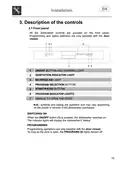
- Page 15: Installation Description of the controls All the dishwasher controls are grouped on the front panel. Programming and option selection are only possible with the door closed. ON/OFF button and warning light Sanitation indicator light No rinse aid light Program selection button Start/pause button Programming operations are only possible with the door closed.
- Page 16: User instructions Program selection involves pressing the program selection button until the light of the required program comes on. To start the dishwasher, press the start/pause button for a few seconds until the light of the selected program starts to flash. The light will flash as long as the program is in progress. At the end of the program, the beeper sounds briefly and the program lights marked end flash. To interrupt a program in progress, press the start/pause button; the light of the program in progress remains on. You may restart the program by pressing the button again or change or annul the program. To change the running program, interrupt the running program, select the new program, and start it. To annul the program, keep the start/pause button pressed until the program is interrupted. The water in the tank will be pumped out and the program will end at the point where it was interrupted. If the door is opened during operation, it is necessary to start the program again when the door is closed.
- Page 17: Installation Programs table Switching on Press the on/off button to start the dishwasher. Then wait for one of the program indicator lights to turn on. The door of the dishwasher must be closed within 4 seconds after use of the program selection button for all functions. If the door is not closed within 4 seconds, one or more program lights will flash at high speed to indicate that the operation must be confirmed. To confirm, simply press the program selection button once and the flashes will slow down. Close the door once to start/restart the dishwasher. If the dishwasher is opened with the program delay option set and the cycle not started, the program selection button must be pressed before the door is closed. If the door of the dishwasher has not been closed or has been incorrectly closed, the washing cycle will not begin.
- Page 18: The cycle times and electrical energy listed in the use and care manual are based on normal soil loads and 120°F (49°C) incoming water and will vary based on your actual conditions. Only the POTS & PANS program conforms to NSF std 184 and is certified by INTERTEK with the ETL SANITATION LISTED. When the Sanitized light shines, it means that the dishwasher and its contents have been sanitized according to the requirements of the National Sanitation Foundation (NSF). If the dishwasher door is open or not properly closed, the washing cycle will not start. Description of the programs includes: HALF LOAD: To wash just a few normally soiled dishes, washed immediately after use. NORMAL: Normally soiled dishes including dried-on residues, for daily use. DELICATE: Wash cycle for mixed loads such as wine glasses and lightly soiled dishes. MIX 65°: Normally soiled mixed loads such as dishes and pans, even with dried-on residues. POTS & PANS: Mixed dishes very dirty and pans dirty, including dried-on residues.
- Page 19: Installation After having installed the dishwasher, remove the basket retainers. The salt prevents the formation of scale deposits. Only for the first time, fill the container with a litre of water. Pour salt (approx. 1 kg) into the container using the funnel provided with the dishwasher. Only use regeneration salt specifically for domestic dishwashers. The rinse aid helps to dry the dishes more quickly. Top up again when the rinse aid indicator light turns on. Use a cloth to remove any spillage of rinse aid which might lead to the formation of excess foam. Open the detergent dispenser cover by lightly pressing the button. Add the detergent or tablet.
- Page 20: Cleaning and maintenance Before carrying out any work, always unplug the appliance from the electrical supply or switch off the omnipolar circuit breaker. Cleaning the water intake filter Close the water supply tap, unscrew the end of the water intake hose, remove the filter and clean it under running water. Cleaning the spray arms Remove the spray arms and wash them with a jet of water. Put them back in their seats, making sure that there is nothing to prevent them from rotating. To remove the upper spray arm, unscrew the locking ring. To remove the lower spray arm, simply lift it up, pulling by the central part. To remove the orbital spray arm assembly, take hold of the longer arm and pull the orbital unit upward. Cleaning the filter unit Remove the planetarium spray arm (only for the models on which it is fitted). Grip the tabs, turn them anticlockwise and lift upwards. Push the central filter from underneath to remove it from the micro-filter. Separate the two parts that make up the plastic filter by pressing the body of the filter in the zone indicated by the arrows.
- Page 21: Installation Troubleshooting The dishwasher can signal faults through the illumination of indicator lights. Acquastop failure indicates the anti-flooding system has been activated due to water leaks. The safety level system limits the water level inside the dishwasher and may require restarting the program. Water heating malfunction occurs when the water is not heated or the heating parameters are incorrect. Water temperature monitoring malfunction requires interrupting the program and restarting the dishwasher. Water intake malfunction indicates the appliance does not take in water correctly. Water pump-out malfunction occurs when the appliance does not pump out water correctly.
- Page 22: User instructions Turbine flow-regulator malfunction: The appliance is not able to measure the amount of water loaded accurately. Interrupt the program and switch off the dishwasher. If the problem persists, contact the after-sales service. Alternate washing system malfunction: Interrupt the program and switch off the dishwasher. If the problem persists, contact the after-sales service. Water intake system malfunction: Contact the after-sales service. Wash motor pump does not work. If an alarm occurs, the appliance interrupts the program in progress and signals a fault. Alarms E1, E2, E3, E4, E8, and E9 interrupt the current program immediately. The E5 and E6 alarms interrupt the running program once the cause is resolved. The alarm E7 is visualized at the end of the cycle, but the operation of the dishwasher is not harmed. To reset an alarm, open and close the door, or turn off and on the machine.

KINGFISHER KF1000DW Deluxe Passthrough Dishwasher

FISHER AND PAYKEL DD24SCTX9 N Tall Dishwasher

FISHER PAYKEL DD24SAX9 N Dishwasher

LG Electronics LDPS6762S 23.75 in. PrintProof Smart Dishwasher

Midea MDF24P2B Dishwasher

IKEA FROSLUNDA Dishwasher

FISHER PAYKEL DD60D4HZB9 Dishwasher

Miele PFD 102 APFD 102 Dishwasher

Whirlpool WDFS3L5PBSSG Free Standing Dishwasher

FISHER and PAYKEL DD60SDFTX9 Tall, Dishwasher