
AEG FSS64907Z 60 Cm Dishwasher





EN User Manual
FSS64907Z
Dishwasher
USER
MANUAL


| General | Details |
|---|---|
| Name | AEG FSS64907Z 60 Cm Dishwasher |
| Make | AEG |
| Language | English |
| Filetype | PDF (Download) |
| File size | 0.9 MB |
 (1 votes, average: 5.00 out of 5)
 Loading...

AEG FSK76748P Dishwasher

AEG FSK53617Za Dishwasher

AEG FSK74747P Dishwasher

AEG FSE73507P Dishwasher

AEG GS60AIM Dishwasher

AEG FSB73427Z Dishwasher

AEG FSE74737P Quickselect Dishwasher

AEG FFB73727PM Dishwasher

Smeg DI362DQ Dishwasher

AEG F8642FI Tall Tub Dishwasher

AEG FSS64907Z 60 Cm Dishwasher Overview
Summary of Contents
- Page 1: User manual for FSS64907Z dishwasher.
- Page 2: SAFETY INFORMATION Before the installation and use of the appliance, carefully read the supplied instructions. The manufacturer is not responsible for any injuries or damage that are the result of improper use. Thank you for choosing this AEG product. We have created it to give you impeccable performance for many years. Please spend a few minutes reading to get the very best from it. Always use original spare parts. When contacting our Authorised Service Centre, ensure that you have the following data available: Model, PNC, Serial Number. The information can be found on the rating plate. Warning / Caution - Safety information. General information and tips.
- Page 3: Children and vulnerable people safety This appliance can be used by children aged from 8 years and above and persons with reduced physical, sensory or mental capabilities if they have been given supervision or instruction concerning the use of the appliance. Children between 3 and 8 years of age and persons with very extensive and complex disabilities shall be kept away from the appliance unless continuously supervised. Children of less than 3 years of age should be kept away from the appliance unless continuously supervised. Children should be supervised to ensure that they do not play with the appliance. Keep detergents away from children. Keep children and pets away from the appliance when the door is open. Children shall not carry out cleaning and user maintenance of the appliance without supervision. General safety This appliance is for cleaning household-type dishes and tableware only. This appliance is designed for single household domestic use in an indoor environment.
- Page 4: Make sure that the parameters on the rating plate are compatible with the electrical ratings of the mains power supply. If the water inlet hose is damaged, immediately close the water tap and disconnect the mains plug from the mains socket. Always use a correctly installed shockproof socket. Do not use multi-plug adapters and extension cables. Do not drink and play with the water in the appliance. Do not remove the dishes from the appliance until the programme is complete. The appliance can release hot steam if you open the door while a programme operates. To repair the appliance contact the Authorised Service Centre. Ensure that there are no visible water leaks during and after the first use of the appliance. The water inlet hose has a safety valve and a sheath with an inner mains cable.
- Page 5: Disposal instructions include a warning about the risk of injury or suffocation. Disconnect the appliance from the mains supply before disposal. Cut off the mains cable and discard it. Remove the door catch to prevent children and pets from getting closed in the appliance. The product description includes various components such as the ceiling spray arm, upper spray arm, lower spray arm, filters, and rating plate. Additional components listed are the salt container, air vent, detergent dispenser, lower basket, upper basket, and cutlery drawer. The graphic provided is a general overview of the product. For more details, refer to other chapters or documents provided with the appliance. Lamps inside the product are intended to withstand extreme conditions in household appliances. Spare part lamps sold separately are not suitable for household room illumination.
- Page 6: Beam-on-Floor is a light displayed on the floor below the appliance door. Beam-on-Floor is off when the appliance is deactivated. When AirDry is activated during the drying phase, the projection on the floor may not be completely visible. When the programme starts, a red light comes on and stays on for the duration of the programme. When the programme is completed, a green light comes on. When the appliance has a malfunction, the red light flashes. The ECOMETER indicates how the programme selection impacts energy and water consumption. The more bars are on, the lower the consumption is. The ECOMETER indicates the most environmentally friendly programme selection for a normally soiled dishwashing load. The rinse aid indicator is on when the rinse aid dispenser needs refilling.
- Page 7: Salt indicator indicates when the salt container needs refilling. Machine Care indicator shows when internal cleaning is needed. Drying phase indicator signals when a drying phase is selected. My Time selection bar allows selection of a suitable dishwashing cycle based on duration. AUTO Sense programme automatically adjusts the cycle to the load type. Quick programme is suitable for lightly soiled loads and lasts 30 minutes. ExtraPower improves dishwashing results by increasing wash temperature and duration. GlassCare prevents damage to delicate glassware by controlling temperature changes. ECO programme is the longest and most efficient for normal soil, used for compliance testing.
- Page 8: Programmes overview Dishwasher programmes vary based on the degree of soil. Quick programme is for fresh crockery and cutlery. Fresh programme operates at 50 °C with intermediate and final rinses. ExtraPower and GlassCare options enhance cleaning performance. Normal programme is suitable for lightly dried-on items at 60 °C. Prewash is included in heavy soil programmes. ECO programme is designed for energy efficiency at 50 °C. AUTO Sense adjusts the wash based on load conditions. Machine care is essential for maintaining appliance cleanliness. Automatic door opening occurs during the drying phase.
- Page 9: Consumption values for water, energy, and duration are provided for various programmes. The pressure, temperature, mains supply variations, options, quantity of dishes, and degree of soil can affect these values. The values for programmes other than ECO are indicative only. For test institutes, include the product number code from the rating plate for performance tests. Basic settings can be configured according to user needs. Water hardness can be adjusted based on local water conditions. Rinse aid indicator can be activated or deactivated. The end sound can be turned on or off. Auto door open feature can be activated or deactivated. Key tones can be enabled or disabled.
- Page 10: Number settings allow you to enable or disable the automatic selection of the most recently used programme and options. You can change the basic settings in setting mode. To enter setting mode, press and hold the designated buttons for about 3 seconds. When in setting mode, the bars of the ECOMETER represent available settings, with a dedicated bar flashing for each setting. You cannot enter setting mode while a programme is running. To change a setting, ensure the appliance is in setting mode and select the desired setting using the Previous or Next buttons. Press OK to enter the setting, which will cause the current setting value to flash. You can navigate in setting mode using the MY TIME selection bar. After changing the value, press OK to confirm the setting, and the new setting will be saved. The saved settings remain valid until you change them again.
- Page 11: The water softener should be adjusted according to the hardness of the water in your area. Your local water authority can advise you on the hardness of the water in your area. Set the right level of the water softener to assure good washing results. The water softener removes minerals from the water supply, which would have a negative effect on the washing results and on the appliance. Water hardness is measured in equivalent scales. Multi-tabs containing salt are not effective enough to soften hard water. For the correct water softener operation, the resin of the softener device needs to be regenerated regularly. This regeneration process is automatic and is part of the normal dishwasher operation. A new regeneration process will be initiated between the final rinse and the programme end. Regardless of the type of detergent used, set the proper water hardness level to keep the salt refill indicator active.
- Page 12: Water softener level affects rinse aid usage. The rinse aid indicator activates when the chamber is empty. For optimal drying, always use rinse aid. Regeneration of the water softener may extend program duration. An acoustic signal can indicate program completion. Rinsing the water softener increases water and energy consumption. AirDry enhances drying results by automatically opening the door. All consumption values are based on standard laboratory conditions. AirDry is activated with all programs, affecting drying duration. The display shows remaining time when AirDry opens the door.
- Page 13: Key tones can be deactivated. Do not try to close the appliance door within 2 minutes after automatic opening. If children have access to the appliance, deactivate AirDry to avoid danger. The latest programme that was completed is saved and selected automatically after activation. When the latest programme selection is disabled, the default programme is ECO. Ensure the current level of the water softener matches the hardness of the water supply. Fill the salt container with 1 kg of salt after adding 1 litre of water for the first time. Start the Quick programme to remove any residuals from the manufacturing process without detergent or dishes. Use rough salt designed for dishwashers only to avoid corrosion. The salt is essential for recharging the resin in the water softener and ensuring good washing results.
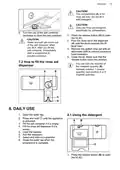
- Page 14: Caution: The compartment is for rinse aid only. Do not fill it with detergent. Only use rinse aid designed specifically for dishwashers. Turn the cap of the salt container clockwise to close it. Press the release button to open the lid. Pour the rinse aid in the dispenser until the liquid reaches the fill level 'max'. Water and salt can come out of the salt container when filling it. After filling the salt container, immediately start a programme to prevent corrosion. Remove spilled rinse aid with an absorbent cloth to prevent excessive foam formation. Close the lid and ensure that the release button locks into position. Open the water tap to activate the appliance.
- Page 15: Put the detergent, in powder or tablets, in the compartment (A). If the programme has a prewash phase, put a small quantity of detergent on the inner part of the appliance door. Close the lid. Make sure that the release button locks into position. It is not possible to activate or deactivate options while a programme is running. Activating options often increases the water and energy consumption as well as the programme duration. The appliance senses the type of load and adjusts a suitable wash cycle. During the cycle, the sensors operate several times and the initial program duration can decrease. Select a programme using MY TIME selection bar. Press the button dedicated to the option you want to activate. When the countdown is complete, the programme starts.
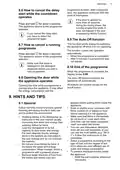
- Page 16: programme duration. After closing the door, the appliance continues from the point of interruption. If the door is opened for more than 30 seconds during the drying phase, the running programme ends. Press and hold for about 3 seconds. The appliance returns to the programme selection. This function saves energy by switching the appliance off when it is not operating. When the programme is completed, the display shows 0:00. Opening the door while a programme is running stops the appliance. Follow the hints below to ensure optimal cleaning and drying results in daily use and to protect the environment. Soak or slightly scour cookware with firmly cooked-on or baked-on food before washing it in the appliance. Washing dishes in the dishwasher as instructed in the user manual usually consumes less water and energy than washing dishes by hand. Select a programme according to the type of load and the degree of soil. ECO offers the most efficient use of water and energy consumption.
- Page 17: Use the recommended dosage of detergent and rinse aid. Make sure that the salt and rinse aid containers are full. Ensure that the current level of the water softener agrees with the hardness of the water supply. Start the Quick programme without adding detergent or dishes. Adjust the water softener according to the water hardness in your area after the programme is completed. Only use salt, rinse aid, and detergent designed for dishwashers. In areas with hard water, use basic dishwasher detergent, rinse aid, and salt separately for optimal results. Before starting a programme, ensure the filters are clean and correctly installed. Always use the whole space of the baskets and only wash dishwasher-safe items. Make sure that the water softener level is correct to prevent rust on cutlery.
- Page 18: External cleaning Clean the appliance with a moist soft cloth. Only use neutral detergents. Do not use abrasive products, abrasive cleaning pads or solvents. Cleaning the filters The filter system is made of 3 parts. Make sure that there are no residues of food or soil in or around the edge of the sump. Put back in place the flat filter. Turn the filter counterclockwise and remove it. Reassemble the filters. Put back the filter in the flat filter. Turn it clockwise until it locks.
- Page 19: Caution regarding the installation of the spray arm. An incorrect position of the filters can cause bad washing results and damage to the appliance. Regular cleaning of the lower spray arm is recommended to prevent soil from clogging the holes. Clogged holes can cause unsatisfactory washing results. To remove the lower spray arm, pull it upwards. Do not remove the upper spray arm; use a thin pointed object to clear clogged openings. Regular cleaning of the ceiling spray arm is recommended to prevent soil from clogging the holes. The ceiling spray arm is placed on the ceiling of the appliance. Use a thin pointed tool to remove particles of soil from the holes in the spray arm. The spray arm is installed in the delivery tube with the mounting element.
- Page 20: Wash the spray arm under running water. Use a thin pointed tool to remove particles of soil from the holes. Run the water through the holes to wash soil particles away from the inside. Release the stoppers on the sides of the sliding rails of the cutlery drawer and pull the drawer out. To install the spray arm back, insert the mounting element in the spray arm and fix it in the delivery tube by turning it clockwise. Make sure that the mounting element locks into place. Install the cutlery drawer on the sliding rails and block the stoppers. Move the upper basket to the lowest level to reach the spray arm more easily. To detach the spray arm from the delivery tube, turn the mounting element counterclockwise. Improper repair of the appliance may pose a danger to the safety of the user.
- Page 21: Problem and alarm code Possible cause and solution You cannot activate the appliance. Make sure that the mains plug is connected to the mains socket. Make sure that there is no damaged fuse in the fuse box. The programme does not start. Make sure that the appliance door is closed. If the delay start is set, cancel the setting or wait for the end of the countdown. The appliance does not fill with water. Make sure that the water tap is open. Make sure that the pressure of the water supply is not too low. Make sure that the water tap is not clogged. The appliance does not drain the water. Make sure that the sink spigot is not clogged. The anti-flood device is on. Close the water tap. Make sure that the appliance is correctly installed.
- Page 22: Problem and alarm code The level of water inside the appliance is too high. Switch the appliance off and on. Make sure that the filters are clean. The appliance stops and starts more times during operation. It is normal. It provides optimal cleaning results and energy savings. The programme lasts too long. If the delay start option is set, cancel the delay setting or wait for the end of the countdown. Small leak from the appliance door. The appliance is not levelled. Loosen or tighten the adjustable feet. The appliance trips the circuit-beaker.
- Page 23: The PNC can be found on the rating plate on the appliance door. Before checking the PNC, make sure the appliance is in the programme selection. We do not recommend using the appliance until the problem has been completely fixed. The product number code (PNC) is necessary when contacting an Authorised Service Centre. Poor washing results may be improved by using a more intensive washing programme. Activate the ExtraPower option to improve the washing results of a selected programme. To improve drying performance, activate the function AirDry to set the automatic opening of the door. Always use rinse aid, even with multi-tablets, to prevent poor drying results. Adjust the rinse aid dosage if there are whitish streaks or bluish layers on glasses and dishes. Humidity condenses on the appliance walls; this is not a defect of the appliance.
- Page 24: Problem: Unusual foam during washing. Possible cause and solution: Use the detergent designed specifically for dishwashers. Problem: Traces of rust on cutlery. Possible cause and solution: There is too much salt in the water used for washing. Problem: Residues of detergent in the dispenser at the end of the programme. Possible cause and solution: The detergent tablet was stuck in the dispenser and was not washed away by water. Problem: Odours inside the appliance. Possible cause and solution: Start the Machine Care programme with a descaler or a cleaning product designed for dishwashers. Problem: Limescale deposits on the tableware, on the tub and on the inside of the door. Possible cause and solution: The level of salt is low, check the refill indicator. Problem: Dull, discoloured or chipped tableware. Possible cause and solution: Make sure that only dishwasher-safe items are washed in the appliance. Problem: Load and unload the basket carefully. Possible cause and solution: Place delicate items in the upper basket. Problem: Activate the GlassCare option to ensure special care for glassware and delicate items. Refer to Before first use, Daily use, or Hints and tips for other possible causes.
- Page 25: Technical information includes dimensions, voltage, electrical connection, frequency, water supply pressure, and capacity. The dimensions are 596 mm width, 818 - 898 mm height, and 550 mm depth. The voltage is 220 - 240 V with a frequency of 50 Hz. The water supply pressure ranges from 0.5 to 10 MPa. The appliance has a capacity of 14 place settings. For other values, refer to the rating plate. If using hot water from an alternative energy source, it can help decrease energy consumption. The QR code on the energy label provides a link to the product information sheet. Appliances should not be disposed of with household waste and should be returned to a local recycling facility. Recycling helps protect the environment and human health.
- Page 26: Page 26

SAMSUNG DW80R9950 Dishwasher

KKT KOLBE DW616FS Dishwasher

euro appliances EED614KX S Steel 14 Place Dishwasher

nelson AD40 Commercial Dishwasher

Whirlpool D2I HD526 A Integrated Dishwasher

BOMANN GSP 7409 Household Dishwasher

BOSCH SMS6HVI01I 14 Place Settings Free-Standing Dishwasher

Bosch 041203 Active Water Dishwasher

Miele G 7765 SCVi XXL Auto Dos Obsidian Dishwasher

BLACK PLUS DECKER BDW200MW Dishwasher