
Home > Master Kitchen > Master Kitchen FI60514 Dishwasher
Master Kitchen FI60514 Dishwasher











Dishwasher
Instruction manual
PART I Generic version
Please read this manual carefully before using the dishwasher
Keep this manual for future reference.


| General | Details |
|---|---|
| Name | Master Kitchen FI60514 Dishwasher |
| Make | Master Kitchen |
| Language | English |
| Filetype | PDF (Download) |
| File size | 0.91 MB |
 (1 votes, average: 5.00 out of 5)
 Loading...

Master Kitchen 340965 Drawer Dishwasher

Master Kitchen FI60514 Dishwasher Overview
Summary of Contents
- Page 1: Dishwasher instruction manual. Please read this manual carefully before using the dishwasher. Keep this manual for future reference.
- Page 2: Safety information Product overview Using the dishwasher Salt insertion Maintenance and cleaning External cleaning Internal cleaning Installation instructions Water supply and drainage Troubleshooting tips Thank you for purchasing a Master Kitchen appliance.
- Page 3: Reviewing the troubleshooting tips section will help you solve some problems on your own. If you can't solve problems by yourself, please ask a professional technician for help. The manufacturer may make changes without prior notice. If the manual gets lost or is outdated, you may receive a new user manual from the manufacturer or the supplier. Read carefully the instructions provided before installing and using the equipment. The manufacturers are not liable for any injury or damage resulting from improper installation or use. Always keep the instructions in a safe and accessible place for future reference. Check the appliance after unpacking. Do not connect the appliance if it has been damaged during transport. This appliance is intended for domestic use only in private houses and closed spaces and not for professional use. The water working pressure (minimum and maximum) must be between 0.04 / 1.00 bar (MPa).
- Page 4: If the power cord is damaged, it must be replaced by the manufacturer or a qualified person to avoid dangerous situations. Place the cutlery inside the cutlery basket with the sharp ends pointing downwards. If you open the appliance door while it is in operation, hot water can be sprayed out. If overloaded, dish racks can cause the appliance to tip over. Do not leave the equipment with the door open unattended to prevent accidents. Before performing any maintenance work, turn off the equipment and pull the plug out of the socket. Do not use high-pressure water spray or steam to clean the appliance. The equipment must be correctly connected to the water system with new pipes supplied. In case of built-in installation, do not use the equipment before installation is completed. For disused devices, disconnect the power cord plug, then cut the power cord and destroy the door locking system.
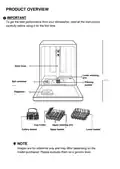
- Page 5: Product overview To get the best performance from your dishwasher, read all the instructions carefully before using it for the first time. Images are for reference only and may differ depending on the model purchased. Please evaluate them on a generic level.
- Page 6: Using the dishwasher Before using the dishwasher Setting the water softener Salt insertion Loading the rack Filling the dispenser Use only dishwasher-specific salt. Any other type of salt not specifically designed for use in dishwashers will damage the water softener. In case of damage caused by the use of unsuitable salt, the manufacturer does not provide any warranty. Fill the salt container first and perform a short washing cycle.
- Page 7: The salt container is located under the lower basket and must be filled as explained below. Remove the lower basket and unscrew the tank cap. Insert the end of the funnel into the hole and pour about 1.5 kg of dishwasher salt. Fill the salt container up to the maximum limit with water; it is normal for a small amount of water to come out of the salt container. After filling the container, tighten the cap firmly. The salt light will go out after the salt container is filled. Immediately after filling the salt container, a washing program should be started. The salt container must only be filled when the salt control light is lit on the control panel. If some salt escapes from the container, perform soaking or a quick program to remove it.
- Page 8: Tips for adjusting the upper basket. The height of the upper basket can be easily adjusted to accommodate taller dishes or pans. To adjust the height of the upper basket, follow the procedure below. Pull out the upper basket. Remove the upper basket. Reattach the upper basket to the upper or lower rollers. Push the upper basket inwards.
- Page 9: To lift the basket to the top position. To lower the basket, press down and release. The basket will lock into place. Clean the door seals regularly with a soft, damp cloth to remove food deposits. Food and drink residues can drip on the outside of the dishwasher door and should be removed before closing the door. Use only a soft, damp cloth to clean the control panel. To prevent water from penetrating the door lock and electrical control panel, do not use spray cleaners of any kind. Never use abrasive cleaners or abrasive pads on external surfaces because they can scratch. Even some paper towels can scratch or leave marks on the surface.
- Page 10: Internal cleaning The filter system at the base of the sink retains coarse debris from the washing cycle. Coarse debris collected may cause filter clogging. Check the condition of the filters regularly and clean them under running water if necessary. Follow the steps below to clean the filters. The images are for reference only, depending on the model purchased the filtering system and the lower wash arm may be different. The images are intended only as an example. Hold filter 1 and turn it counter-clockwise to unlock. Lift the filter up and pull it out of the dishwasher. Filter 3 can be removed from the bottom of the filter assembly. Filter 1 can be removed from filter 2 gently by pressing and turning it counter-clockwise and pulling it upwards.
- Page 11: Larger food residues can be cleaned by rinsing the filter under running water. For more thorough cleaning, use a soft brush suitable for cleaning. Refit the filters on the back in disassembly order, replace and insert the filter and turn clockwise as shown by the arrow. Don't overtighten the filters. Put the filters back in sequence safely, otherwise coarse debris could enter the system and cause a blockage. Never use the dishwasher without filters. Improper filter replacement can reduce the performance level of the appliance and create damage to dishes and tools that will not be covered under warranty.
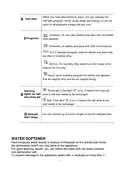
- Page 12: Washing arms must be cleaned regularly to prevent hard water chemicals from clogging the washing arm jets and bearings. To clean the spray arms, follow the instructions below: To remove the upper washing arm, hold the nut in the centre and turn the washing arm counter-clockwise to remove it. To remove the lower washing arm, pull it upwards. Wash your arms with soap and warm water and use a soft brush to clean the jets. Dry them after rinsing them thoroughly.
- Page 13: Folding the shelves allows for taller objects in the dishwasher basket. Lifting the grill enables placement of tall glasses. The grill can be removed when not in use. Racks hold trays and dishes. Racks can be lowered for more space. Pulling upwards and bending backwards adjusts the racks.
- Page 14: Installation instructions Connect the appliance to a drinking water system using the components provided. Make sure that the drinking water connection is not bent, crushed or wrapped around itself. If the water pipes are new or have not been used for a long period of time, let the water run to make sure it is clear. The safety water supply pipe consists of double walls. A hose attached to a sink can burst if installed on the same water line as the dishwasher. Connect the appliance to a water draining connection so that dirty water from the washing cycle can drain off. Make sure that the draining pipe is not bent, crushed or wrapped around itself. The height of the draining pipe must be less than 1000 mm. The end of the pipe must not be immersed in water to prevent backflow.
- Page 15: Fasten the draining pipe firmly in either position A or B. If the sink is higher than 1000 mm from the floor, excess water in the pipes cannot be discharged directly into the sink. You will need to drain excess water from the pipes into a suitable bowl or container that is held outside and lower than the sink. The draining pipe must be installed correctly to prevent water leaks. Make sure that the water draining pipe is not bent or crushed. If a draining pipe extension is required, be sure to use a similar draining pipe. It must be no longer than 4 metres; otherwise the cleaning effect of the dishwasher may be reduced. The connection to the siphon trap must be 100 cm below the bottom of the dish. Place the appliance in the desired position. The dishwasher is equipped with a water supply and the drainpipes can be positioned on the right or left side to facilitate correct installation.
- Page 16: Levelling the appliance can be adjusted by screwing in the feet. The height of the dishwasher is designed to fit between existing furniture in modern kitchens. The feet can be adjusted to reach the correct height. The laminate top is heat resistant, scratch-proof, and stain-resistant. For installation under a countertop, remove the dishwasher countertop by unscrewing the screws. Selecting the best installation position for the dishwasher is important for proximity to inlet and outlet pipes and the power cord. Refer to the figures of the cabinet dimensions and installation position for guidance.
- Page 17: There must be a distance of less than 5 mm between the top of the dishwasher and the cabinet. The outside door must be aligned with the cabinet. Space between the bottom of the cabinet should be 600 mm for a 60 cm model and 450 mm for a 45 cm model. If the dishwasher is installed in the corner of the cabinet, there should be some space when the door is open. Depending on where your electrical outlet is, you might need to cut a hole in the side opposite of the cabinet. Minimum space of 50 mm is required. The external wooden panel could be realized according to the installation drawings.
- Page 18: Install the hook on the aesthetic wooden panel and put the hook into the slot of the outer door of the dishwasher. After positioning the panel, press the top of the aesthetic wooden panel to ensure that the plastic hook is fastened. The door springs are factory set to the correct tension for the outer door. When installing the decorative panel, adjust the door spring tension by turning the adjusting screw. The spring tension of the door is correct when the door remains in the fully open horizontal position but is raised with slight pressure. Refer to the installation steps specified in the installation drawings. Fix the condensation strip under the countertop of the cabinet, ensuring it is level with the edge of the countertop. Connect the supply hose to the cold water source. Connect the draining pipe. Connect the power cord and place the dishwasher in the right position.
- Page 19: Level the dishwasher by adjusting the back from the front using a screwdriver. To adjust the front feet, use a flat screwdriver until the dishwasher is levelled. Install the cabinet door on the outer door of the dishwasher. Adjust the tension of the door springs with an Allen key, turning clockwise to tighten. Failure to adjust the door springs may cause damage to the dishwasher. The dishwasher must be fixed in place for proper operation. For a normal countertop, insert the installation hook and fasten it with wood screws. For marble or granite countertops, fix the side with a screw. Check that the dishwasher is levelled using a bubble level on the door and rack guide. Individually adjust the three levelling legs to ensure proper levelling.
- Page 20: When levelling the dishwasher, be careful not to tip the dishwasher over. Check the level from front to back. Check the level side by side. The maximum adjustment height of the feet is 50 mm.
- Page 21: Troubleshooting tips Before calling customer service, please consult the table below. The dishwasher does not start. Possible causes include a blown fuse or circuit breaker. Make sure the dishwasher is switched on and the door is closed properly. Water pressure is low. Check that the water supply is properly connected and open. Dishwasher door does not close properly. Dishwasher does not drain. Check the draining pipe and the filter. Kitchen sink clogged. Check the kitchen sink to ensure it can drain water properly. Foam inside the dishwasher. Use only specific detergents for dishwashers.
- Page 22: Problem Possible causes What to do Rinse aid spill Always clean up spills of rinse aid immediately. The detergent contains some dye Make sure the detergent has no dye. Hard water minerals To clean the inside, use a damp sponge with dishwasher detergent and wear rubber gloves. Avoid washing objects that are not corrosion-resistant in dishwashers. Always run a washing program without dishes after adding salt. Check that the softener cover is closed correctly. Stop the program and reorganize the objects that are obstructing the washing arm. The dishes were not loaded correctly.
- Page 23: Problem: Dishes are not dry. Possible causes: The selected program is wrong, and the temperature is lower, thus decreasing the drying performance. What to do: Choose a program with a longer washing time. Use of low quality cutlery: Water drainage is more difficult with these objects. Cutlery or dishes of this type are not suitable for washing in the dishwasher.
- Page 24: Loading the baskets according to standard EN60436. Upper basket includes small cups, saucers, glasses, large cups, pans, and small pots. Lower basket includes dessert dishes, flat dishes, bottoms plates, and plates. Cutlery basket is also mentioned.
- Page 25: Cutlery basket Warning: Please place only light objects on the top basket shelf, as the total weight is less than 1.5 kg. Capacity: 14 place settings Upper basket position: lower position Program: ECO Setting the rinse aid: Max Setting the softener: H3
- Page 26: Dishwasher MKDW FI60514 E instruction manual. Please read this manual carefully before using the dishwasher. Keep this manual for future reference.
- Page 27: Using the dishwasher Control panel Water softener Preparation and loading of dishes Detergent and rinse aid Filling the rinse aid tank Filling the detergent tank Washing cycles table Starting a washing cycle Error codes
- Page 28: Quick user guide Installation of the dishwasher Positioning of dishes Removal of food waste Loading baskets
- Page 29: Operating the dishwasher involves filling the dispenser with detergent and selecting the desired washing program before starting the appliance. The control panel includes a button to turn the dishwasher on, which lights up the panel. Selecting the appropriate washing program will illuminate the indicator for that program. There is an option for delayed start, which can be selected with a specific button.
- Page 30: When you have few dishes to wash, you can activate the half load program, which saves water and energy. Half load can be used for all programs except the fast one. Intensive is for very dirty dishes and pans with encrusted food residues. Universal is for dishes and pans with little food residues. ECO is the standard program ideal for dishes and pans that are little or normally dirty. 90 min. is for normally dirty loads that don’t need to be washed for too long. Quick is a quick washing program for dishes and glasses that are slightly dirty and do not require drying. If the rinse aid light is on, it means the rinse aid level is low and needs to be recharged. If the salt light is on, it means the salt level is low and needs to be recharged. Hard limescale water leaves a residue of limescale on the dishes and inside the dishwasher which can clog parts of the appliance.
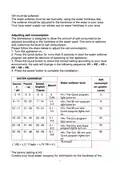
- Page 31: The water softener must be set manually using the water hardness dial. The softener should be adjusted to the hardness of the water in your area. Your local water supply can advise you on water hardness in your area. The dishwasher allows the amount of salt consumed to be adjusted according to the hardness of the water used. Please follow the steps below to adjust the salt consumption. Turn the appliance on and press the Quick button for more than 5 seconds to start the water softener program. Press the Quick button to select the correct setting according to your local environment. The factory setting is H3. Contact your local water company for information on the hardness of the water. Adjusting salt consumption aims to optimize and customize the level of salt consumption.
- Page 32: Water hardness varies from one place to another. If hard water is used in the dishwasher, deposits will form on dishes and tools. The appliance is equipped with a special softener that uses a salt container specifically designed to remove limescale and minerals from the water. It is important to only wash objects in the dishwasher when washing in the dishwasher is expressly indicated. To avoid burns and damage to the dishes, do not remove the glass and cutlery from the dishwasher immediately after the washing program has finished. Below is a list of products that cannot be washed in the dishwasher: cutlery with wooden, porcelain or mother-of-pearl handles, plastic objects that are not heat-resistant, older cutlery with glued parts that are not temperature resistant, dented cutlery or dishes, objects made of pewter or copper, crystal, steel objects subject to rust, wooden dishes, objects made with synthetic fibres. Some types of glasses can become dull after a large number of washes. Silver and aluminium parts tend to discolour during washing. Enamelled patterns may fade if washed frequently. It is important to scrape off large amounts of food residues. For best dishwasher performance, follow these loading guidelines.
- Page 33: Put the objects in the dishwasher as follows: Objects such as cups, glasses, pots/pans, etc. facing downwards. Curved objects, or those with recesses, must be diagonally loaded so that water can flow regularly. All tools must be stacked securely and must not tip over. All tools must be positioned so that the washing arms can rotate freely during washing. Dishes and cutlery must not lie inside each other or cover each other. To avoid damage, the glasses must not touch each other. The upper basket is designed to hold lighter and more delicate tableware such as glasses, coffee and teacups. Long blade knives positioned vertically represent a potential danger. Please do not overload the dishwasher. This is important for good washing results and reasonable energy consumption. Very small objects should not be washed in the dishwasher as they could easily fall out of the basket.
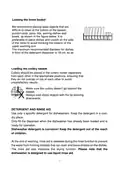
- Page 34: Loading the lower basket We recommend placing large objects that are difficult to clean at the bottom of the basket. It is preferable to place dishes and covers on the side of the racks to avoid blocking the rotation of the upper washing arm. Loading the cutlery basket Cutlery should be placed in the cutlery holder separately from each other, ensuring that they do not overlap on top of each other to avoid unsatisfactory results. Always load sharp objects with the tip pointing downwards. Detergent and rinse aid Use only a specific detergent for dishwashers. Keep the detergent in a cool, dry place. Dishwasher detergent is corrosive; keep it out of the reach of children. At the end of washing, rinse aid is released during the rinse function to prevent water droplets that can stain and leave streaks on the dishes. The rinse aid also improves the drying function.
- Page 35: Use only brand-name rinse aid for dishwashers. Never fill the rinse aid dispenser with any other substance. This would damage the appliance. The rinse aid dispenser should be refilled according to the frequency of dish washing. When the rinse is about to run out, the light will come on. Do not overfill the rinse aid dispenser. Open the cap by pulling it upwards. Add the rinse aid taking care not to spill it. Close the cover.
- Page 36: Rinse aid adjustment allows for better drying performance with minimal rinse aid. To adjust the quantity used for each washing cycle, open the door and switch the appliance on. Press the Program button for more than 5 seconds, then press the Delay button to access the set model. The rinse aid indication will flash with a frequency of 1Hz. Select the correct series according to your usage habits by pressing the Program button. The series changes in the sequence: D1 > D2 > D3 > D4 > D5 > D1. A higher number indicates a larger quantity of rinse aid used by the dishwasher. To exit configuration mode, press the power button or wait for 5 seconds. The Quick program light turns on for D2, the 90 min program light for D3, and the Eco program lamp for D4. The Eco and Quick program lights turn on for D5.
- Page 37: Fill the detergent tank. Choose between the following opening modes: Open the cap by sliding the release latch. Open the cap by pressing the release. Add the detergent in the largest part of the container for washing. For a better cleaning result, especially if you have very dirty objects, pour a small amount of detergent on the door.
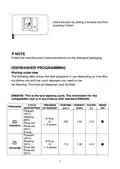
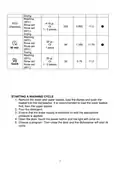
- Page 38: Close the door by sliding it forward and then pressing it down. Follow the manufacturer's recommendations on the detergent packaging. The following table shows the best programs to use depending on how dirty the dishes are and how much detergent you need to use. The rinse aid dispenser must be filled. EN60436: This is the test washing cycle. The information for the compatibility test is in accordance with standard EN60436. Washing cycles table. CYCLE PRE/MAIN DESCRIPTION DETERGENT RUNTIME ENERGY WATER RINSE. Intensive (65°C) Drying. Universal.
- Page 39: Drying Washing Rinse aid Starting a washing cycle Remove the lower and upper basket, load the dishes and push the basket into the dishwasher. Pour the detergent. Ensure that the water supply is switched on and the appropriate pressure is applied. Open the door, touch the power button and the light will come on. Choose a program. Then close the door and the dishwasher will start its cycle.
- Page 40: Change program during washing A washing cycle can only be changed if it has been run for a short time. The dishwasher must be reset and the detergent dispenser must be filled again. To reset the dishwasher, open the door slightly to stop the dishwasher. Press the > Program button for more than three seconds. You can change the washing cycle by selecting the desired program. Did you forget to add a dish? A forgotten dish can be added at any time before the detergent dispenser opens. Open the door slightly to stop the washing cycle. Never open the door mid-cycle as steam could cause burns or serious injury.
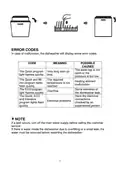
- Page 41: Error codes indicate malfunctions in the dishwasher. The water tap may not be open or the pressure could be too low. The Quick program light flashes quickly when there is a very long start-up time. The Quick and 90 min program lights flash quickly if the required temperature is not reached. A heating element malfunction may be indicated by the ECO program light flashing quickly. The Quick, ECO, and Intensive program lights flashing quickly suggest some elements of the dishwasher may be leaking. Electrical connections should be checked by an experienced person if there are overflow issues. In case of a spill, turn off the main water supply before contacting customer service. Water inside the dishwasher due to overfilling or a small leak must be removed before restarting the appliance.
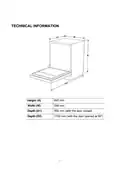
- Page 42: Height: 845 mm Width: 598 mm Depth (D1): 550 mm (with the door closed) Depth (D2): 1150 mm (with the door opened at 90°)
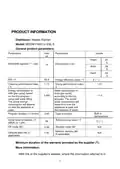
- Page 43: Product information Model: MKDW FI60514 E General product parameters: Height: 81.5 cm Width: 59.8 cm Depth: 55.0 cm Estimated capacity: 14 ps Energy efficiency class: A Energy consumption: 1.13 kWh per cycle Water consumption: 11.0 liters per cycle Program duration: 3:40 h:min Type of product: Built-in dishwashers
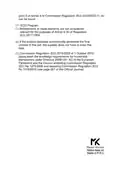
- Page 44: ECO Program. Amendments to these elements are not considered relevant for the purposes of Article 4 (4) of Regulation (EU) 2017/1369. If the product database automatically generates the final content of this cell, the supplier does not have to enter this data. Commission Regulation (EU) 2019/2022 of 1 October 2019 laying down the ecodesign requirements for household dishwashers under Directive 2009/125 / EC of the European Parliament and the Council amending Commission Regulation (EC) No 1275/2008 and repealing Commission Regulation (EU) No 1016/2010.

Cecotec Bolero Aguazero 6200 Dark D Dishwasher

BOSCH SMV2ITX48E Dishwasher

GE APPLIANCES GTW845 Dishwasher

Whirlpool WDF340PAMW 24-Inch Dishwasher

FISHER PAYKEL DD60DTX6HI1 Dishwasher

FISHER PAYKEL DD24DCTX9N Tall Dishwasher

TESLA WD461MX Dishwasher
GE PDP755SYV Profile UltraFresh System Dishwasher

BOSCH SMS6ZCW48E Dishwasher

Miele HGXX Built Under Dishwasher