
CMA H-1X Undercounter Dishwasher






Installation/Operation Manual
High Temperature
Undercounter Dishwasher
Model H-1X
High Temperature Wash and Drain
with built-in booster and Pumped
Final Rinse
Issue Date: Sept 23 2021
Manual P/N
For machines beginning with S/N W190688229 and above
Printed in the USA
CMA Dishmachines
12700 Knott Avenue
Garden Grove, CA 92841
Toll-free: 1 (800) 854-6417


| General | Details |
|---|---|
| Name | CMA H-1X Undercounter Dishwasher |
| Make | CMA |
| Language | English |
| Filetype | PDF (Download) |
| File size | 1.94 MB |
 (1 votes, average: 5.00 out of 5)
 Loading...

CMA UC65e M3 Undercounter Dishwasher

CMA-66 EST-66 Conveyor Dishwasher

CMA EST-FL1 EST Front Loader Water Dishwasher

CMA H-1X Undercounter Dishwasher Overview
Summary of Contents
- Page 1: Installation/Operation Manual High temperature undercounter dishwasher Model H-1X High temperature wash and drain with built-in booster and pumped final rinse Issue date: Sept 23 2021 For machines beginning with S/N W190688229 and above
- Page 2: Product registration is available online. Connect to the internet to register your machine. Enter the provided URL to complete the registration process.
- Page 3: For future reference, record your dishwasher information in the box below. The model no., serial no., voltage, Hz and phase are needed to identify your machine and to answer questions. The machine data plate is located on the lower front panel. Please have this information ready if you call for service assistance.
- Page 4: Specifications are subject to change based on continual product improvement. Released first edition.
- Page 5: Revision history Installation Receiving Placement Water connection Drain connection Electrical connection Machine start-up Normal wash mode Cleaning the wash tank
- Page 6: Installation The installation of the dishwasher must be performed by qualified service personnel familiar with food service equipment. Problems due to improper installation are not covered by the Limited Warranty. The installation must comply with all local electrical, plumbing, health and safety codes. Plumbing connections must be made before the electrical connections. Damage to water heaters will occur if the power is turned on without an adequate water supply. It is the installing plumber's responsibility to flush the incoming water line to remove debris before connecting to the machine. All models have a 6 ft. flexible hot water fill hose with a 3/4 female garden hose connector. A 1/2 or larger main incoming supply line must be installed to the dishwasher. A water hardness of 3 grains/gal (US) or less is recommended. The flowing incoming hot water supply must be between 25-95 psi.
- Page 7: Installation The dishwasher will not drain correctly if it is connected to a disposer. The drain hose is looped and clamped and must not be changed. Altering the drain hose routing may result in the machine’s inability to drain or may cause the machine to siphon the water out of the machine.
- Page 8: Installation Drain connection Failure to follow the drain connection instructions may void the warranty. The machine is equipped with a 6ft. [2m] 5/8 I.D. drain hose. The maximum drain height connection must not exceed 3ft. [1m] and must be vented to prevent wash tank siphoning. The drain hose is located at the rear of the machine and is secured by two clamps. A 3/4 hose barb fitting is strapped to the drain. The maximum drain flow is 15 US gpm/12.4 imp gpm/60 lpm. Do not remove the clamps holding the drain hose to the back of the machine. Do not connect the dishwasher to a disposer. Do not reduce the size of the drain hose connection or use a domestic drain fitting.
- Page 9: Installation Building drain connection must be properly vented. Install the drain hose to an 1-1/2 or larger WYE fitting. Connection to a TEE fitting will prevent the dishwasher from draining completely. Do connect the flexible drain hose to a vented WYE connection. Do not connect the flexible drain hose to a TEE fitting. A 1 (25.4mm) minimum air gap must be maintained between the outlet of the drain hose and the flood-level rim of the drain receptacle. Drain problems are often due to improper installation of the drain hose.
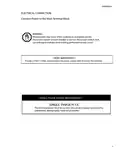
- Page 10: Installation Electrical connection The installation of the dishwasher must comply with all local electrical, plumbing, health and safety codes. In the absence of local codes, install in accordance with the National Electrical Code, Canadian Electrical Code, and the Standard for Ventilation Control and Fire Protection of Commercial Cooking Operations. The electrical power must be a 2-wire plus ground supply. Check the data plate on the front of the dishwasher for the phase of the machine. If the data plate says the machine is 1 Phase, connect a 1 PH power supply. Connect ground, then connect L1, L2 to 208-230 VAC. Do not connect power to L3.
- Page 11: Installation Electrical connection Connect power to the main terminal block Warning: Electrocution may occur when working on energized circuits. Disconnect power at main breaker or service disconnect switch; lock out and tag to indicate work is being performed on the circuit. Provide a 3 feet/1 meter service loop in the power supply cable to service the machine. Single phase power requirement The electrical power must be a 2-wire plus ground supply, hard wired to a dedicated, appropriately sized circuit breaker.
- Page 12: Installation Electrical connection Connect power to the main terminal block Remove the lower front dishwasher panel. Remove the retaining fastener from the main terminal block.
- Page 13: Installation Electrical connection Connect power to the main terminal block Provide a 3 foot/1 meter service loop in the machine power supply cable. Route the power cable from machine rear to terminal block ensuring it does not touch the booster tank. Connect the power cable to the terminal block bracket using a suitable strain relief connector. Connect the power wires according to the wiring diagram. A 30 / 76 cm service loop must be provided for servicing. Thread the power cable through the middle slot in the dishwasher rear panel. Secure the cable to the terminal box using the proper strain relief. Connect the incoming power as shown.
- Page 14: Installation Booster fill procedure Follow the instructions to fill the booster tank prior to washing dishes. Do not turn the dishwasher power switch on. Turn the main water supply to the machine on. Turn the main breaker or disconnect power switch on. Press and hold the dishwasher green start switch for three seconds to activate the fill solenoid. Continue to hold the start switch until water enters the wash tank. Release the green start button. Booster pre-fill is complete.
- Page 15: Initial start-up Contact a local chemical supplier for detergent and rinse-aid chemicals. The detergent should be a non-chlorinated liquid detergent. The chemical dispensing pumps are adjusted by the chemical supplier. The dishwasher is equipped with a built-in detergent dispensing pump and rinse-aid dispensing pump. The pumps are located on the lower panel behind the lower-front access panel. Each pump is equipped with 6 feet of pick-up supply tubing, a stiffener tube, and a strainer. A red label marked detergent is attached to the detergent pump inlet tubing. A blue label marked rinse-aid is attached to the rinse-aid pump inlet tubing. The detergent supply should be a non-chlorinated liquid detergent.
- Page 16: Installation Priming the chemical dispensing pumps is essential before operating the dishwasher and whenever the container is changed. The chemical dispensing pump supply lines must be primed for proper operation. Ensure the containers are full and the correct pick-up tubes are in their containers. Turn the dishwasher power switch ON to fill the machine with water. Push and hold the prime push button DOWN to the rinse-aid position for thirty seconds until detergent is observed entering the wash compartment. Release the push button after observing detergent flow. Open the dishwasher door and push and hold the prime push button UP to the detergent position until detergent is observed entering the wash compartment. Release the button after observing detergent flow. Inspect and replace the chemical dispensing pump squeeze tubes every six months.
- Page 17: Operation Normal wash mode Control panel In cycle LED light Start Push button Prime On/off - drain Power switch Close the door dishwasher front door. Push the power switch up to turn on power. The power switch will illuminate and the machine will fill with water. Wait until the wash temperature indicates a minimum of 150°F/66°C. Place an empty dish rack in machine and run first cycle empty to heat wash tank interior. Load the dish rack into the machine. Close the door and press the green start button for 1 second. The final rinse cycle begins at the end of the wash cycle. Rinse sentry mode will extend wash cycle time if the final rinse temperature has not reached 180-195°F/82-92°C. If the proper temperature is not reached within 5 minutes, the machine will leave the rinse sentry mode and complete the cycle.
- Page 18: Operation Loading dish racks Do not overload the dish rack. Load one dish rack into the machine at a time. Prescrap and rinse the wares before loading to remove large food particles. Load soiled wares into the dish rack. Place plates and glasses in a peg rack. Place cups and bowls in an optional flat bottom rack. Place utensils in a single layer in a flat-bottom rack. Slide one dish rack into the wash compartment making sure that wares do not interfere with the rotating spray arms.
- Page 19: Operation Loading dish racks Load pots and pans in a peg rack or optional flat-bottom rack. Load utensils in a single layer in a peg rack or an optional flat-bottom rack. Load cups and bowls in a peg rack or an optional flat-bottom rack. Never stack dish racks. Wash one dish rack at a time.
- Page 20: Operational display shows the machine's status throughout the cycle. When the power switch is turned ON, the system information screen will briefly show firmware version, parameter settings, and cycle counts. The machine is filling, and the wait light is illuminated. The progress bar shows fill time remaining. The red thermometer indicator shows the booster tank is heating, and the wait light remains illuminated. The wait light indicates the cycle is pending, and the progress bar shows remaining heat time. The booster heater has achieved temperature, and the blue thermometer bar shows the wash tank heat is active. The wait light is out, and READY indicates a cycle may begin. Ready indicates the machine will wash, and 155 °F indicates the wash tank temperature.
- Page 21: Operation Sump fill level should be 1/4” to 3/8” below level of sump flange. Wash cycle status indicator shows cycle progress. In-cycle light is illuminated. When the wash cycle is complete, the machine will drain all of the water and refill with fresh hot water. Display changes to red and indicates rinse temperature.
- Page 22: Operation Rinse Sentry Autoclean drain When the machine is turned off, the AutoClean screen with the status indicator is shown. This takes approximately 2-1/2 minutes. When complete, open the door to allow the machine interior to air dry.
- Page 23: Cleaning the wash tank is crucial for maintaining the dishwasher's performance. Drain and clean the dishwasher every 2 hours of continuous operation, after each meal period, and at the end of the day. Remove the upper and lower spray arms and flush clean with water. Remove the scrap screen, ensuring food soils do not fall into the tank. Flush and back flush with clean water. Check the sump and the pump intake strainer. Do not scrub the interior with a metal pad. Check the heating element for lime buildup and remove it without using a metal pad. Wipe the exterior of the machine with a soft cloth and mild detergent. Leave the door open to aid in overnight drying.
- Page 24: Cleaning the spray arms involves several steps. Unscrew the retaining screw from the upper and lower interchangeable spray arms. Flush the spray arms clean in a sink, ensuring to flush the spray arm bearings. Use grooves to loosen the hub for cleaning. Use a paper clip to clean nozzles. Use a coin or flat head driver to flush the spray arm.
- Page 25: Cleaning the scrap screen and sump strainer involves several steps. Lift the scrap screen straight up and out of the machine to prevent food particles from falling into the tank sump. Flush the scrap screen in a remote sink, ensuring to back-flush both sides of the screen. Wipe the tank sump of water and debris. Carefully inspect the pump intake strainer, which is not removable but must be thoroughly cleaned before reinstalling the scrap screen. A clogged or restricted sump strainer will prevent the proper washing, rinsing, and draining of the machine. Wipe the exterior of the machine with a soft cloth and mild detergent. Do not spray the exterior with water or bleach. Leave the door open to aid in overnight drying.
- Page 26: Deliming Warning: Death or serious injury may result when deliming solution is mixed with sodium hypochlorite. Deliming solutions can cause severe irritation and possible chemical burns. Always wear protective clothing and goggles when handling chemicals. Follow the steps below to delime the dishwasher. Open the dishwasher door and remove the dish rack. Carefully add the deliming chemical to the wash tank in accordance with your chemical supplier's instructions. Press and hold the Start button for one second to initiate an automatic cycle. When the cycle has ended, open the door and check the deliming results. Run 4 empty cycles to ensure all deliming chemicals are flushed from the machine. Deliming is complete.
- Page 27: Maintenance schedules outline daily, weekly, semi-annual, and yearly tasks. Daily maintenance includes checking wash arm and rinse arm spray jets, scrap screen, and sump strainer. Ensure the water supply is on and the drain is not clogged. Check the temperature display for proper operation. Inspect dish racks for good condition and refill chemical containers as needed. Follow established cleaning procedures. Weekly maintenance involves performing daily tasks and inspecting water lines for leaks. Check for leaks underneath the dishwasher and ensure floor drains are unobstructed. Inspect the machine interior for lime build-up and consult chemical suppliers for deliming. Yearly maintenance requires contacting an authorized service agent for a preventive inspection.
- Page 28: Rinse aid
- Page 29: Parameter setting instructions Caution: Parameter changes must be made by qualified personnel only. Locate control board shown below. Wash temperature adjustment in cycle. The following parameters may be changed depending on model: 1. Detergent concentration 2. Rinse temp 3. Wash temp 4. Rinse aid 5. Fill time 6. Units (F-C) 7. Language (English - French) To change parameters: Push and hold the “Menu” button.
- Page 30: Page 30
- Page 31: Page 31

BOSCH SPV4EKX20E Dishwasher

BOSCH SPS2IKW01G Dishwasher

Haier QRG_AU_61613 Dishwasher

TOSHIBA DWS-22AMY(K) Dishwasher

BAUKNECHT B2I HD526 A Dishwasher

AUDIBAX Haze 1500 Pro Dishwasher

BOSCH SMS4HKI07E Dishwasher

esatto EBTDWW Benchtop Dishwasher

BOSCH SPV4EMX25G Dishwasher

maxima 09240080 Pass Through Dishwasher