
AEG FSE64637P Dishwasher


























ENGLISH
49
•
To prevent limescale buildup inside
the appliance:
9.3 What to do if you want to
stop using multi-tablets
Before you start using separately
detergent, salt and rinse aid, complete
the following steps:
–
–
–
Refill the salt container whenever
necessary.
Use the recommended dosage of
the detergent and rinse aid.
Make sure that the current level of
the water softener agrees with the
hardness of the water supply.
Follow the instructions in the
chapter "Care and cleaning".
1. Set the highest level of the water
softener.
2. Make sure that the salt and rinse aid
containers are full.
–
3. Start the Quick programme. Do not
add detergent and do not put dishes
in the baskets.
9.2 Using salt, rinse aid and
detergent
•
4. When the programme is completed,
adjust the water softener according
to the water hardness in your area.
5. Adjust the released quantity of rinse
aid.
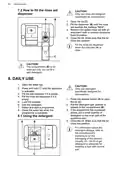
Only use salt, rinse aid and detergent
designed for dishwasher. Other
products can cause damage to the
appliance.
In areas with hard and very hard
water, we recommend to use basic
dishwasher detergent (powder, gel,
tablets containing no additional
agents), rinse aid and salt separately
for optimal cleaning and drying
results.
Detergent tablets do not fully dissolve
with short programmes. To prevent
detergent residues on the tableware,
we recommend that you use tablets
with long programmes.
Always use the correct quantity of
detergent. Insufficient dosage of
detergent can result in poor cleaning
results and hard-water filming or
spotting on the items. Using too much
detergent with soft or softened water
results in detergent residues on the
dishes. Adjust the amount of
detergent based on the water
hardness. Refer to the instructions on
the detergent packaging.
Always use the correct quantity of
rinse aid. Insufficient dosage of rinse
aid decreases the drying results.
Using too much rinse aid results in
bluish layers on the items.
•
9.4 Before starting a
programme
Before you start the selected
programme, make sure that:
•
The filters are clean and correctly
installed.
•
•
•
•
•
The cap of the salt container is tight.
The spray arms are not clogged.
There is enough salt and rinse aid
(unless you use multi-tablets).
The arrangement of the items in the
baskets is correct.
•
•
•
The programme is suitable to the type
of load and the degree of soil.
The correct quantity of detergent is
used.
9.5 Loading the baskets
•
•
•
Always use the whole space of the
baskets.
Use the appliance to wash
dishwasher-safe items only.
Do not wash in the appliance items
made of wood, horn, aluminium,
pewter and copper as they could
crack, warp, get discoloured or pitted.
Do not wash in the appliance items
that can absorb water (sponges,
household cloths).
Put hollow items (cups, glasses and
pans) with the opening facing
downwards.
Make sure that glass items do not
touch each other.
•
•
Make sure that the water softener
level is correct. If the level is too high,
the increased quantity of salt in the
water might result in rust on cutlery.
•
•
•

50
•
Put light items in the upper basket.
2. First remove items from the lower
basket, then from the upper basket.
Make sure that the items do not move
freely.
After the programme is
completed, water can still
remain on the inside
•
•
Put cutlery and small items in the
cutlery basket.
Move the upper basket upwards to
accommodate large items in the lower
basket.
surfaces of the appliance.
•
Make sure that the spray arms can
move freely before you start a
programme.
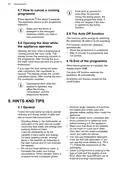
9.6 Unloading the baskets
1. Let the tableware cool down before
you remove it from the appliance. Hot
items can be easily damaged.
10. CARE AND CLEANING
dishwashers. Follow the instructions
on the packaging. Do not put dishes
in the baskets.
WARNING!
Before any maintenance
other than running the
programme Machine Care,
deactivate the appliance and
disconnect the mains plug
from the main socket.
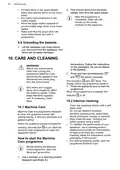
2. Press and hold simultaneously
and
The indicators
for about 3 seconds.
and flash. The
display shows the programme duration.
3. Close the appliance door to start the
programme.
Dirty filters and clogged
spray arms negatively affect
the washing results. Check
these elements regularly
and, if necessary, clean
them.
When the programme is complete, the
indicator
is off.
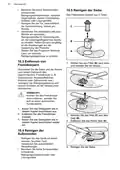
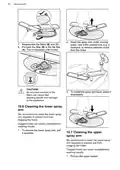
10.2 Internal cleaning
•
Clean the appliance interior with a soft
10.1 Machine Care
d
a
m
p
c
l
o
t
h
.
•
Do not use abrasive products,
abrasive cleaning pads, sharp tools,
strong chemicals, scourer or solvents.
Wipe clean the door, including the
rubber gasket, once a week.
Machine Care is a programme designed
to clean the appliance interior with
optimal results. It removes limescale and
grease buildup.
•
•
When the appliance senses the need for
To maintain the performance of your
appliance, use a cleaning product
designed specifically for dishwashers
at least once every two months.
Carefully follow the instructions on the
packaging of the product.
cleaning, the indicator
Machine Care programme to clean the
appliance interior.
is on. Start the
How to start the Machine
Care programme
•
For optimal cleaning results, start the
programme Machine Care.
Before starting the Machine
Care programme, clean the
filters and spray arms.
1. Use a descaler or a cleaning product
designed specifically for

| General | Details |
|---|---|
| Name | AEG FSE64637P Dishwasher |
| Make | AEG |
| Language | English |
| Filetype | PDF (Download) |
| File size | 1.72 MB |
 (1 votes, average: 5.00 out of 5)
 Loading...

AEG FSK76748P Dishwasher

AEG FSK53617Za Dishwasher

AEG FSK74747P Dishwasher

AEG FSE73507P Dishwasher

AEG GS60AIM Dishwasher

AEG FSB73427Z Dishwasher

AEG FSE74737P Quickselect Dishwasher

AEG FFB73727PM Dishwasher

AEG F8642FI Tall Tub Dishwasher

AEG FFE83800PM Dishwasher


FRIGIDAIRE FDPC4314AS Dishwasher

beko BDIN38650C Dishwasher

FISHER and PAYKEL DD60D4NB9 Dish Drawer Dishwasher

BOSCH SMI46CS01E-29 Semi- Dishwasher

Westinghouse WSF6606 Dishwasher

BOSCH SMV4ECX10E Dishwasher

FISHER PAYKEL DD24DTX6HI1 Sanitize Integrated Dishwasher

FISHER PAYKEL DD60DI9 DishDrawer Dishwasher

Miele PTD 901 Through Feed Dishwasher

Miele PFD 100 SmartBiz Free-Standing Dishwasher