
Bauknecht AUTBFC3C26 Dishwasher


DAILY USE
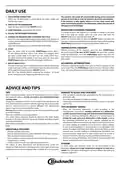
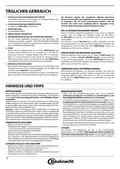
1. CHECK WATER CONNECTION
The machine will switch off automatically during certain extended
Check that the dishwasher is connected to the water supply and periods of inactivity, in order to minimise electricity consumption.
that the tap is open.
If the crockery is only lightly soiled or if it has been rinsed with
water before being placed in the dishwasher, reduce the amount of
detergent used accordingly.
2. SWITCH ON THE DISHWASHER
Open the door and press the ON/OFF button.
3. LOAD THE RACKS (see LOADING THE RACKS).
MODIFYING A RUNNING PROGRAM
If a wrong program was selected, it is possible to change it, provided
that it has only just begun: open the door, press and hold the
ON/OFF button, the machine will switch off.
Switch the machine back on using the ON/OFF button and select the
new wash cycle and any desired options; Start the wash cycle by pressing
START/Pause button (led is lit) and closing the door within 4 sec.
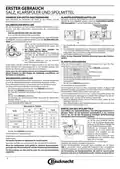
4. FILLING THE DETERGENT DISPENSER
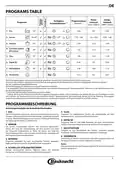
5. CHOOSE THE PROGRAM AND CUSTOMISE THE CYCLE
Select the most appropriate program in accordance with the type of
crockery and its soiling level (see PROGRAMS DESCRIPTION) by press-
ing the P button.
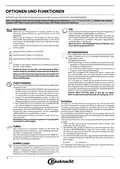
Select the desired options (see OPTIONS AND FUNCTIONS).
ADDING EXTRA CROCKERY
6. START
Without switching off the machine, open the door (START/Pause
led starts blinking) (be ware of HOT steam!) and place the crockery
inside the dishwasher. Press the START/Pause button and close the
door within 4 sec., the cycle will resume from the point at which it was
interrupted.
Start the wash cycle by pressing START/Pause button (led is
lit) and closing the door within 4 sec. When the program starts
you hear a single beep. If the door was not closed within 4sec.,
the alarm sound will be played. In this case, open the door, press
START/Pause button and close the door again within 4 sec.
7. END OF WASH CYCLE
ACCIDENTAL INTERRUPTIONS
The end of the wash cycle is indicated by beeps and by the flashing If the door is opened during the wash cycle, or if there is a power cut, the
of the wash cycle number on the display. Open the door and switch cycle stops. Press the START/Pause button and close the door within
off the appliance by pressing the ON/OFF button.
4 sec., the cycle will resume from the point at which it was interrupted.
Wait for a few minutes before removing the crockery - to avoid
burns. Unload the racks, beginning with the lower one.
ADVICE AND TIPS
TIPS
DAMAGE TO GLASS AND CROCKERY
Before loading the baskets, remove all food residues from the crockery • Only use glasses and porcelain guaranteed by the manufacturer as
and empty the glasses. You do not need to rinse beforehand under
dishwasher safe.
running water.
• Use a delicate detergent suitable for crockery
Arrange the crockery so that it is held in place firmly and does not tip • Collect glasses and cutlery from the dishwasher as soon as the wash
over; and arrange the containers with the openings facing downwards
and the concave/convex parts placed obliquely, thus allowing the
water to reach every surface and flow freely.
Warning: lids, handles, trays and frying pans do not prevent the sprayer
arms from rotating.
cycle is over.
TIPS ON ENERGY SAVING
• When the household dishwasher is used according to the
manufacturer’s instructions, washing tableware in a dishwasher
usually consumes less energy and water than hand dishwashing.
• In order to maximize dishwasher efficiency it is recommended to
initiate the wash cycle once dishwasher is fully loaded. Loading
the household dishwasher up to the capacity indicated by the
manufacturerwillcontributetoenergyandwatersavings.Information
on correct loading of tableware can be found in Loading chapter.
In case of partial loading it is recommended to use dedicated wash
options if available (Half load/ Zone Wash, Multizone), fiilling up only
selected racks. Incorrect loading or overloading the dishwasher may
increase resources usage (such as water, energy and time, as well as
increase noise level), reducing cleaning and drying performance.
• Manual pre-rinsing of tableware items leads to increased water and
energy consumption and is not recommended.
Place any small items in the cutlery basket.
Very soiled dishes and pans should be placed in the lower basket
because in this sector the water sprays are stronger and allow a higher
washing performance.
After loading the appliance, make sure that the sprayer arms can rotate
freely.
UNSUITABLE CROCKERY
• Wooden crockery and cutlery.
• Delicate decorated glasses, artistic handicraft and antique crockery.
Their decorations are not resistant.
•
Parts in synthetic material which do not withstand high temperatures.
• Copper and tin crockery.
• Crockery soiled with ash, wax, lubricating grease or ink.
The colours of glass decorations and aluminium/silver pieces can
change and fade during the washing process. Some types of glass (e.g.
crystal objects) can become opaque after a number of wash cycles too.
HYGIENE
To avoid odour and sediment which can be accumulated in the
dishwasher please run a high temperature program at least one a
month. Use a tea spoon of detergent and run it without the loading to
clean your appliance.
6

| General | Details |
|---|---|
| Name | Bauknecht AUTBFC3C26 Dishwasher |
| Make | Bauknecht |
| Language | English |
| Filetype | PDF (Download) |
| File size | 9.36 MB |
 (1 votes, average: 5.00 out of 5)
 Loading...

Bauknecht B7I HF60 Dishwasher

Bauknecht BK6UC11BS7A0X Dishwasher

BAUKNECHT 295f471f27d55b Dishwasher

Bauknecht Dishwasher

Bauknecht 3O35 PF Dishwasher

BAUKNECHT B2I HD526 A Dishwasher

Bauknecht BFP 5O41 PLT X Dishwasher

BOSCH SHX78B75UC 24 Bar Handle Dishwasher

FISHER AND PAYKEL DW24UT4I2 Dishwasher

FISHER AND PAYKEL DD60SHTI9 Dishwasher

FISHER AND PAYKEL DD24DTX6I Dishdra Wertm Dishwasher

FISHER and PAYKEL DD24DAX9 N Contemporary Dishwasher

GAGGENAU 8001221619 C Dishwasher

Haier HDW15F3B1 Steam Dishwasher

BOSCH SMV8ZDX86M Dishwasher

BOSCH SMS4HCI19E Free Standing Dishwasher

FISHER AND PAYKEL DD24SCTX9 N Tall Dishwasher