
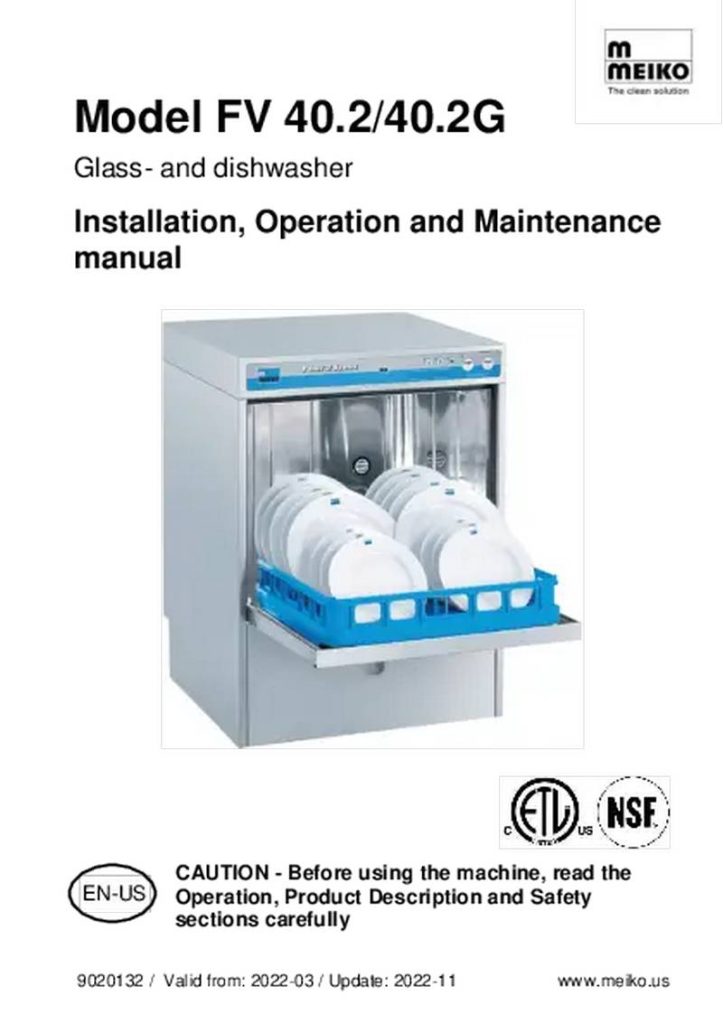
Meiko FV 40.2 Glass and Dishwasher



7.3
Requirements for the fresh water connection
Fresh water connections and their components must be made in
accordance with local regulations. From a biological perspective, the
fresh water must be of drinking water quality. This also applies to treated
water.
Installation components and materials must be suitable and permitted in
accordance with local regulations. A solenoid valve is integrated into the
dishwasher's fresh water pipe. This, together with the leakage detector in the
base drip tray in the subframe, ensures that the fresh water supply is shut off in
the event of a leak in the machine.
Recommended water hardness:
•
1–3 grains per U.S. gallon (gpg) (6 gpg, maximum)
Recommended water temperature:
•
140°F (60°C)
Colder water will result in a longer preheat time during startup and will
extend the wash cycle time. The required temperatures will still be
reached.
Pressure range of the fresh water supply flow pressure upstream of the
solenoid valve:
•
8.7–72.5 psi (0.6–5 bar)
Measures to ensure correct water pressure:
•
•
If the minimum flow pressure is too low, increase the pressure using a
pressure booster pump (not supplied as standard).
If the maximum pressure is exceeded, limit the pressure using a pressure
regulator (not supplied as standard).
Other measures:
•
Make sure that no foreign iron particles can enter the machine via the
fresh water connection. The same also applies to contamination by other
metal particles (e.g. copper shavings).
•
•
A dirt trap must be fitted in the fresh water supply to protect the solenoid
valve. An additional dirt trap is not required.
The feed hose must be sufficiently long so that the machine can be
moved for servicing purposes.
22 / 64
9020132

Model
F
V
40.2/40.2G
7.4
Requirements for the electrical connection
IMPORTANT
The wiring diagram is under the upper cover of the dishwasher. It must
remain in the dishwasher. The rating plate with the electrical connected
values is on the inside of the front panel and on the outside on the right
side panel.
Requirements for the operating company:
•
•
The correct voltage and current type must be available.
Safeguard the power supply in accordance with the regulations and provide
it with an all-pole main switch in the permanently installed electrical
installation.
•
•
Connect the dishwasher to an equipotential bonding system.
Do not connect any additional consumers to the fuse protecting the
dishwasher.
•
Electricity supply without a neutral conductor (N): When connecting to three-
phase current, use a 4-pole terminal strip (L1, L2, L3, PE) or a 3-pole
terminal strip (L1, L2, PE).
The products are intended for permanent connection to the locally available
power supply and have been tested for the market accordingly. Any other type
of electrical connection must be made by specially trained personnel.
Install the dishwasher in accordance with local regulations. In the absence of
any such regulations, install the machine in accordance with the applicable
requirements in the National Electrical Code, NFPA 70, Canadian Electrical
Code (CEC), Part 1, CSA C22.1 and the Standard for Ventilation Control and
Fire Protection of Commercial Cooking Operations, NFPA 96.
9020132
23 / 64

| General | Details |
|---|---|
| Name | Meiko FV 40.2 Glass and Dishwasher |
| Make | MEIKO |
| Language | English |
| Filetype | PDF (Download) |
| File size | 2.59 MB |
 (1 votes, average: 5.00 out of 5)
 Loading...

MEIKO UPster U 400 M2 Glass and Dishwasher

FISHER AND PAYKEL HDW13V1W1 Dishwasher

Miele PFD 101 U Built Under Dishwasher

Fisher and Paykel DW60UD6X Built-Under Dishwasher

FISHER and PAYKEL DD60DTX6HI1 Dishwasher

FISHER PAYKEL DW60UD6B Built-under Dishwasher

FISHER PAYKEL DW60FC1X1 Dishwasher

BOSCH SGV4HCX40G Dishwasher

FISHER PAYKEL DD24SCTB9_N Single DishDrawer Dishwasher

HEINNER HG-150SS Free Standing Dishwasher

BOSCH SPH4HKX10E 45 cm Dishwasher