
ASKO DFI544D Dishwasher


USER MANUAL
Dishwasher
EN
DFI544D


| General | Details |
|---|---|
| Name | ASKO DFI544D Dishwasher |
| Make | ASKO |
| Language | English |
| Filetype | PDF (Download) |
| File size | 2.13 MB |
 (1 votes, average: 5.00 out of 5)
 Loading...

ASKO DSD5444D Dishwasher

ASKO DFI8557MMXXL Dishwasher

ASKO DBI565IXXLS Logic Series 24 Dishwasher

ASKO DFI766UXXL.AU Dishwasher

ASKO DFI5558MKXXL Dishwasher

ASKO DFI777UXXL Dishwasher

ASKO D5636XXL Dishwasher

ASKO DFI7602MMXXL Dishwasher

ASKO DBI343ID.W.AU Dishwasher

ASKO D5233 Dishwasher

ASKO DFI544D Dishwasher Overview
Summary of Contents
- Page 1: User manual for the dishwasher DFI544D.
- Page 2: Your dishwasher Safety instructions Child lock Installation Overflow guard function Winter storage/Transport Disposal Before washing for the first time Water hardness Basic settings
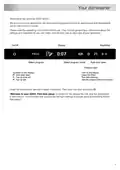
- Page 3: Your dishwasher Welcome to our growing ASKO family! Please read the operating instructions before use. They include general tips, information about the settings and adjustments you can make, and the best way to take care of your appliance. Install the dishwasher, see the chapter Installation. Welcome to your ASKO. First time setup. is shown on the display the first time the dishwasher is switched on. It is important that you choose the right settings to ensure good dishwashing results.
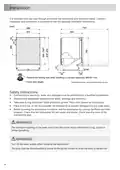
- Page 4: Safety instructions Read the operating instructions and keep them in a safe place. Number of standard place settings: 14. Never use the dishwasher for any purpose other than that specified in these operating instructions. Do not load the dishwasher door or dishwasher baskets with anything other than dishes. Never leave the dishwasher door open as someone may trip on it. Use only dishwasher detergent. This machine can be used by children aged 8 and upwards, and by people with reduced physical capacity, mental ability, memory loss or lacking experience and knowledge. Damaged supply cord must only be replaced by the manufacturer's service centre or someone similarly professionally qualified. Only use the dishwasher in household-type environments for dishwashing household dishes. Knives and other pointed items must be placed with the points down in the cutlery basket or horizontally in other baskets.
- Page 5: Safety instructions Children must be supervised – dishwasher detergent is corrosive. You can activate the automatic child lock setting to prevent children from starting the dishwasher. The overflow guard starts pumping out the machine and turns off the water supply if the water level exceeds the normal level. If the overflow guard is triggered, F54 (Overfilling water) appears on the display. Store the dishwasher above freezing and avoid long transport distances in very cold weather. Before transporting a used dishwasher, water must first be removed from the machine. The outer packaging protects the product during transport and is recyclable. Separate the different packaging materials to help reduce raw material use and waste. The dishwasher is manufactured and labelled for recycling. Contact your local authority for information about where and how your dishwasher should be correctly recycled.
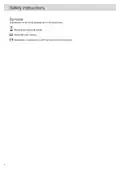
- Page 6: Safety instructions Explanation of symbols appearing on the appliance. Recycle as electrical waste. Read the user manual. Approved in accordance with the relevant EU directives.
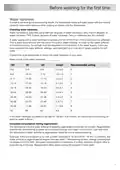
- Page 7: Before washing for the first time Water hardness is essential for achieving good dishwashing results. Hard water leaves a white coating on dishes and the dishwasher. Water hardness is specified using various degrees such as German degrees (°dH), French degrees (°fH), English degrees (°eH), or millimoles per litre (mmol/l). A water supply with a hardness exceeding 5°dH must be softened. The built-in water softener automatically softens the water, but its settings must be adjusted to the local water hardness. Once the water softener settings are adjusted, add detergent and rinse aid suitable for soft water. Contact local waterworks to check the water hardness in your area. If water hardness exceeds 50°dH, connecting an external water softener is recommended. The dishwasher's built-in water softener undergoes regular regeneration to maintain its function, which increases energy and water consumption. Regeneration frequency depends on the selected setting and water hardness. During regeneration, energy and water consumption increase, and the program time is extended.
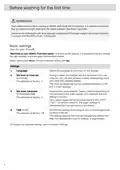
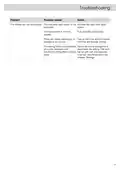
- Page 8: Before washing for the first time, it is important to select the right setting for the water softener to avoid hard water issues. Never run the dishwasher with an empty salt compartment if the water supply has a water hardness in excess of 5°dH. Welcome to your ASKO. First time setup. It is important to choose the right settings to ensure good dishwashing results. Select the language to be shown on the display. Set the level of rinse aid for better drying and dishwashing results. The rinse aid dispenser can be adjusted between 0 (Off) and 5 (High dosage). Adjust the water softener setting depending on the hardness of the water supply. For a water supply with a hardness below 6°dH, select 0 to deactivate the water softener. Activate the On/Off setting when using an all-in-one detergent that contains rinse aid. This setting reduces the rinse aid dosage and affects how often the dishwasher's built-in softener is regenerated.
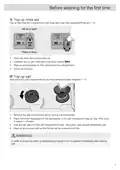
- Page 9: Before washing for the first time Top up rinse aid Top up the rinse aid compartment with rinse aid if you have selected Rinse aid 1 - 5. Open the rinse aid compartment lid. Carefully top up with rinse aid to the level marked MAX. Wipe up any splashes of rinse aid around the compartment. Close the lid firmly. Top up salt Add salt to the salt compartment if you have selected Water hardness 1 - 9. Use special dishwasher salt. In order to avoid rust stains a dishwashing program must be started immediately after adding salt.
- Page 10: Greener dishwashing Save energy and water When using a dishwasher in a residential setting, less energy and water are generally used compared to washing the dishes by hand. Do not rinse under running water Do not rinse the dishes under running water as this will lead to increased energy and water consumption. Choose a green detergent Read the environmental declaration on the packaging. Run a fully loaded dishwasher Save energy and water by waiting until the dishwasher is full before running a program. Run programs at a lower temperature If the dishes are only slightly dirty, you can select a program with a low temperature. Select dishwashing program – Eco This program is suitable for washing normally soiled dishes and is the most effective program in terms of combined energy and water consumption. Select option – Auto door open Better drying results are achieved if you use the Auto door open option. Connect to cold water Connect the dishwasher to the cold water supply if the building is heated using oil, electricity or gas. Connection to hot water supply Connect the dishwasher to the hot water supply (max. 70 °C) if the building is heated using an energy-efficient means.
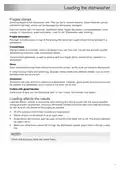
- Page 11: Loading the dishwasher Some cookware is not dishwasher safe due to high heat or damage from detergent. Exercise caution with handmade items, fragile decoration, crystal/glassware, silver, copper, tin, aluminium, wood, and plastic. Porcelain with decoration on top of the glazing should not be washed in a dishwasher. Drying is faster and better with rinse aid for crystal/glass. Hand-painted glassware and antique items should not be washed in a dishwasher. Silver and stainless steel should not come into contact to avoid discoloration. Separate dishes made from different metals to prevent marks and tarnishing. Aluminium can lose its shine in a dishwasher, but good quality pans can be washed. Some types of glue on cutlery handles are not dishwasher safe. Load dishes carefully to ensure the best washing and drying results.
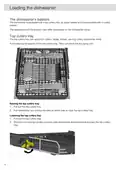
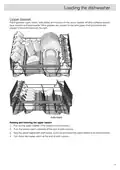
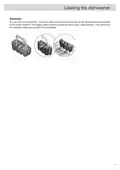
- Page 12: Loading the dishwasher The dishwasher is equipped with a top cutlery tray, an upper basket and a lower basket with a cutlery basket. The appearance of the baskets may differ depending on the dishwasher setup. The top cutlery tray has space for cutlery, ladles, whisks, serving cutlery and similar items. Avoid placing tall objects in the top cutlery tray. They can block the top spray arm. Pull out the top cutlery tray to raise or lower it. Pull forward the two locking handles on either side to raise the top cutlery tray. Slide the two locking handles on either side downwards and backwards to lower the top cutlery tray.
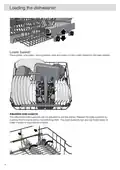
- Page 13: Loading the dishwasher involves placing glasses, cups, bowls, side plates, and saucers in the upper basket with all dirty surfaces facing inwards and downwards. Wine glasses should be placed on the wine glass shelf, and knives in the knife stand on the right. To raise and lower the upper basket, first pull out the upper basket while ensuring it is empty. Then, turn the basket catch outwards at the end of both runners. Grip the upper basket with both hands, pull it out, and move it to the desired position. Finally, turn back the basket catch at the end of both runners.
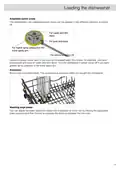
- Page 14: Loading the dishwasher involves placing plates, side plates, serving dishes, pots, and cutlery in the lower basket. The adjustable plate supports can be modified to accommodate different dish sizes. To adjust the plate supports, push them inwards before repositioning. The plate supports can also be folded down for easier loading of pots and bowls.
- Page 15: Loading the dishwasher The dishwasher's two adaptable power zones can be opened in two different positions or turned off. Leave the power zones open for increased water flow for pots and pans or vases and slim items. Turn the dishwasher’s power zones off for greater spray pressure in the lower spray arm. Buy a vase and bottle holder as an accessory available where you bought the dishwasher. You can adjust the lower basket for plates with a diameter of 25-31 cm by moving the adjustable plate supports.
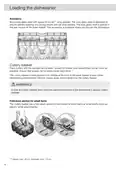
- Page 16: Loading the dishwasher Buy a wine glass shelf with space for six tall wine glasses. The wine glass shelf is designed to ensure optimal washing and drying results with tall wine glasses. The cutlery basket is best placed in the middle at the front of the lower basket to best utilise dishwashing performance from the unique spray zone intended for the cutlery basket. Knives and other pointed items must be placed horizontally in the dishwasher's special cutlery baskets. The cutlery basket has a fold-down section in the middle for small items or small shafts.
- Page 17: Loading the dishwasher. Buy an extra cutlery basket. The extra cutlery basket is flexible and can be dismantled and attached to the lower basket or the large cutlery basket to make an extra large cutlery basket. This accessory is available where you bought the dishwasher.
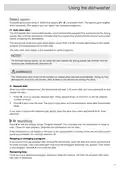
- Page 18: Using the dishwasher Add detergent Follow the instructions on the detergent packaging. This dishwasher is fitted with a water softener, so use detergent and rinse aid doses suitable for soft water. Too much detergent can result in less effective dishwashing and also entails greater environmental impact. The detergent compartment must be dry when adding detergent. Use only dishwasher detergent! Washing up liquid must not be used as the foam that forms prevents the dishwasher from operating effectively. There are many types of all-in-one detergents on the market. Read through the directions for these products carefully. Activate the TAB setting when using an all-in-one detergent that contains rinse aid. Dishwasher tablets are not recommended for short programs (less than 75 minutes). Use powder or liquid dishwasher detergent instead. Optimal washing and drying results are achieved by using normal detergent together with separately dispensed rinse aid and salt.
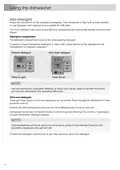
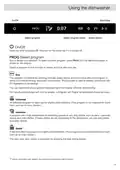
- Page 19: Using the dishwasher Open the door and press the On/Off button. Also turn on the water tap if it is turned off. Eco is always pre-selected. To select another program, press the button shown on the display until the desired program is selected. Select a program to suit the type of dishes and how dirty they are. Eco program is suitable for washing normally soiled dishes and is the most effective program in terms of combined energy and water consumption. For heavily soiled dishes with a lot of grease, a program with higher temperatures should be used. Universal is an effective program for daily use for slightly dried leftovers. Intensive is a program with a high temperature for dissolving grease on very dirty dishes. Quick is a fast and effective program for slightly dried leftovers. The Auto door open option is important for ensuring the best drying results. When combined with Speed, the program is shortened to 60 minutes.
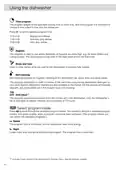
- Page 20: Using the dishwasher Time program adapts to the specified running time or finish time. Choose a time suited to how dirty the dishes are. Hygiene program is ideal for high demands on hygiene, such as for baby bottles and cutting boards. Rinse and hold is used to rinse dishes while waiting for the dishwasher to become fully loaded. Self-cleaning program is for hygienic cleaning of the dishwasher tub, spray arms, and spray pipes. Anti-odour program prevents bad odours from dirty dishes left in the dishwasher. Select program mode to scroll through the available program modes. Speed program shortens the time but uses more energy. Night program lowers noise level during the dishwashing program and extends the program time.
- Page 21: Using the dishwasher Select option Available options are dimly lit. The options glow brighter when activated. Auto door open The dishwasher door opens automatically, which shortens the program time and improves the drying results. Wait until the dishwasher indicates that the program has ended and the dishes have cooled before unloading. The drying time of the Auto door open option varies depending on the model, program, and temperature of the final rinse. For the best drying results, do not close the door before the drying phase has finished. The dishwasher door must not be blocked or closed when opened automatically. Delayed start When you select Delayed start, the dishwasher will start 1-24 hours after you have pressed Start/Stop. If you want to cancel the Delayed start option, open the door then press and hold for three seconds. Stopping or changing a program If you want to change the program after starting the dishwasher, open the door then press and hold for three seconds. Remaining time Once you have selected a program, the time the program took when last used is displayed.
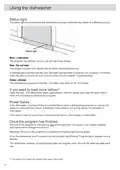
- Page 22: Using the dishwasher The status light at the bottom on the dishwasher provides information by means of 3 different colours. Blue - Load more: The program has started, but you can still load more dishes. Red - Do not load: You should not load more dishes (risk of poor washing result). A flashing light indicates that the door has been opened while a program is in progress. Green - Unload: The dishwashing program is finished. The status light stays on for 15 minutes. If you want to load more dishes, open the door. The dishwasher stops automatically. If the dishwasher is turned off due to a power failure when a dishwashing program is running, the program continues when power is restored. The end of the program is indicated by one short signal from the buzzer. Once the dishwasher door is opened and the program has finished, Program done appears on the display.
- Page 23: Using the dishwasher The best drying results Fully load the dishwasher. Angle dishes with hollows, such as cups, so that the rinse water will run off. Top up with rinse aid or increase the rinse aid dosage setting. Activate the Auto door open option. Allow the dishes to cool before unloading the dishwasher. Unloading the dishwasher Hot porcelain is more fragile. Leave the dishes to cool in the dishwasher before unloading them. Unload the lower basket first to avoid any water drops from the upper basket falling onto the dishes in the lower basket.
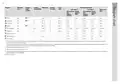
- Page 24: Program modes and options include Eco, Universal, Intensive, Quick, Time program, Hygiene, Rinse and hold, Self-cleaning, and Anti-odour. Consumption values vary depending on the temperature of the incoming water, room temperature, load size, selected additional functions, and more. The values for the Eco program are accurate, while others are indicative only. The dishwasher's built-in water softener is regularly regenerated to maintain its function. Regeneration extends the dishwashing program and increases energy and water consumption. Connection to cold water is approximately 15 °C. Connection to hot water is approximately 60 °C. The Eco program is suitable for washing normally soiled dishes and is the most effective in terms of combined energy and water consumption. This program is used to assess compliance with EU legislation on ecodesign. Auto door open feature is included.
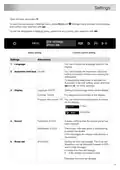
- Page 25: Open the dishwasher's Settings menu by pressing the appropriate button and confirming your selection until the Settings menu is displayed. To exit the Settings menu, select Exit and confirm your selection. You can choose the language used for the display. The Automatic child lock setting can be activated to prevent children from starting the dishwasher. To temporarily deactivate or activate the Automatic child lock, press and hold the designated buttons for three seconds. You can adjust the display settings, including hiding the logotype and adjusting the contrast. A beep confirms that the control panel has been pressed, and a buzzer indicates when a dishwashing program has ended. Error messages are always indicated by a loud buzzer. The rinse aid dosage can be adjusted between 0 (Off) and 5 (High dosage). Increase the rinse aid dosage if the dishes have water marks.
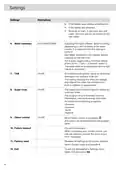
- Page 26: Settings for the dishwasher include options for water hardness and rinse aid. Adjust the water softener based on the hardness of the water supply. For water hardness below 6°dH, select setting 0 to deactivate the water softener. Activate the TAB setting when using an all-in-one detergent that contains rinse aid. The Super rinse function rinses dishes an extra two times, using more energy and water. Odour control can be activated to manage smells during washing. Error messages can be read out for troubleshooting purposes. Factory reset restores all settings to the original defaults. To exit the settings menu, select Exit.
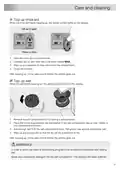
- Page 27: Care and cleaning Top up rinse aid When the rinse aid needs topping up, the above symbol lights on the display. Open the rinse aid compartment lid. Carefully top up with rinse aid to the level marked MAX. Wipe up any splashes of rinse aid around the compartment. Close the lid firmly. Top up salt When the salt needs topping up, the above symbol lights on the display. Remove the salt compartment lid by turning it anticlockwise. Add enough salt to fill the salt compartment (max. 750 gram). Use special dishwasher salt. WARNING! In order to avoid rust stains a dishwashing program must be started immediately after adding salt.
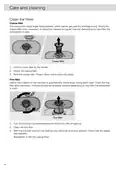
- Page 28: Care and cleaning Clean the filters Coarse filter traps larger food particles, which cannot get past the drainage pump. Empty the coarse filter when necessary. Coarse filter cleaning steps include lifting the coarse filter by the handle, emptying it, and refitting it until it clicks into place. Fine filter debris is automatically rinsed away during each wash. Clean the fine filter when necessary. Fine filter cleaning steps include turning the locking ring anticlockwise, lifting the fine filter straight up, cleaning it, and refitting it while ensuring the edges seal properly. Remember to refit the coarse filter.
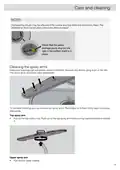
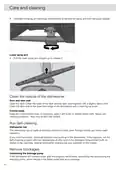
- Page 29: Care and cleaning Dishwashing results may be affected if the coarse and fine filters are incorrectly fitted. The dishwasher must not be used without the filters in place. Check that the yellow drainage pump stop is in place. Cleaning the spray arms Holes and bearings can sometimes become blocked. Remove any debris using a pin or the like. To facilitate cleaning, you can remove the spray arms. Remember to fit them firmly back into place afterwards. Pull out the top cutlery tray to release the top spray arm. Pull out the upper basket to access the upper spray arm.
- Page 30: Care and cleaning Unscrew the spray arm bearings anticlockwise to remove the spray arm from the upper basket. Pull the lower spray arm straight up to release it. Clean the outside of the dishwasher. Open the door. Clean the sides of the door and the door seal regularly with a slightly damp cloth. Keep the control panel clean. If necessary, wipe it with a dry or slightly damp cloth. The dishwasher tub is made of stainless steel and is kept clean through normal use. If you have hard water, limescale deposits may build up in the dishwasher. Run the Self-cleaning program with two tablespoons of citric acid in the detergent compartment. If the dishwasher still contains water after the program has finished, something may be blocking the drainage pump.
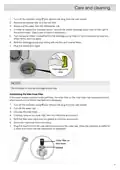
- Page 31: Care and cleaning Turn off the machine and remove the plug from the wall socket. Remove the coarse filter and the fine filter. Scoop out the water from the dishwasher tub. Inspect the drainage pump by removing the yellow drainage pump stop. Turn the pump wheel by hand and carefully remove any sharp items. Refit the drainage pump stop along with the fine and coarse filters. Unblocking the inlet hose filter is necessary if the water supply contains small particles. Turn off the water tap and unscrew the inlet hose. Remove the outer filter from the inlet hose and clean it. Check that the connection is watertight after refitting the filter and hose.
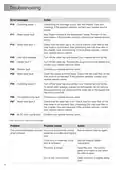
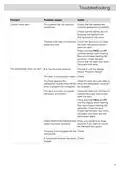
- Page 32: Troubleshooting Error messages F10 - Overfilling water 1: Unblocking the drainage pump. If the problem persists, contact your nearest service centre. F11 - Water outlet fault: See Water remains in the dishwasher under Problem in the table below. If the problem persists, contact your nearest service centre. F12 - Water inlet fault 1: Check that the water tap is on and that the outer filter on the inlet hose is not blocked. If the problem persists, contact your nearest service centre. F40 - Inlet valve leakage: Turn off the water tap and contact your nearest service centre. F41 - Heater fault 1: Turn off the water tap, remove the plug from the wall socket, and contact your nearest service centre. F45 - Diverter fault: Contact your nearest service centre. F52 - Water level fault: Clean the coarse and fine filters. If the problem persists, contact your nearest service centre. F54 - Overfilling water 2: Turn off the water tap and contact your nearest service centre. F56 - Circulation pump fault: Contact your nearest service centre. F67 - Water inlet fault 2: Check that the water tap is on and that the outer filter on the inlet hose is not blocked. If the problem persists, contact your nearest service centre.
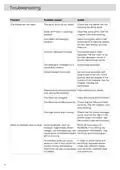
- Page 33: Troubleshooting Cannot close door. Check that the baskets are correctly positioned horizontally. Check that the dishes are not blocking the baskets from sliding properly into place. The door lock does not click into place and lock. Check the door lock. If it does not click into place and lock, open the door. The dishwasher does not start. Press until the display shows Program started. Check that the door is not properly closed. You have opened the dishwasher to add more dishes while a program is in progress. Close the door and wait. After a while, the dishwasher continues the program. Check whether the Delayed start option has been selected. Press and hold for three seconds if you want to cancel the Delayed start option. The plug is not plugged into the wall socket. Check. A fuse/circuit breaker has been tripped. Check.
- Page 34: Troubleshooting The dishes are not clean. The spray arms do not rotate. Check that the dishes are not blocking the spray arms. Clean the spray arms. Select a program with a high temperature to dissolve grease on very dirty dishes. Dose detergent according to water hardness. Old detergent can affect cleaning results. Dishes loaded incorrectly can lead to poor cleaning. The filters are clogged. Check that the filters are fitted correctly. Rinse off certain foodstuffs if not starting the dishwasher immediately.
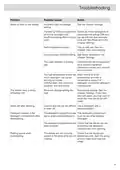
- Page 35: Troubleshooting Spots or films on the dishes may be caused by incorrect rinse aid dosage setting or insufficient drying effect. Top up with salt if the salt compartment is empty. Check the water softener setting if there are issues with the water softener. Ensure the salt compartment lid is properly tightened to prevent leaking. Too high temperature and/or too much detergent can cause etching on crystal. The dishes may have a sticky white/blue film due to high rinse aid dosage. Spots left after washing could be due to difficult-to-wash substances like lipstick and tea. Detergent residue in the detergent compartment may occur if it was damp when adding detergent. Ensure the detergent compartment is not blocked and can open properly. A rattling sound during dishwashing may indicate that dishes are not correctly placed or spray arms are obstructed.
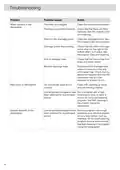
- Page 36: Troubleshooting Water remains in the dishwasher. The filters are clogged. Clean the coarse and fine filters. The filters are not fitted correctly. Check that the filters are fitted correctly. Debris in the drainage pump. Clean the drainage pump. Drainage pump stop missing. Check that the yellow drainage pump stop is in place. Kink in drainage hose. Check that the hose is free from kinks and sharp bends. Bad odour in dishwasher. Clean with washing-up brush and low foaming cleaner. Low temperature programs have been selected for a prolonged period. Run a program with a high temperature once or twice a month. Grease deposits in the dishwasher. Select a program with a high temperature to dissolve grease on very dirty dishes.
- Page 37: Troubleshooting The dishes are not dry enough. Possible causes include the Auto door open option not being activated, the dishwasher not being fully loaded, or the rinse aid needing topping up or dosage being set too low. Activate the Auto door open option. Fully load the dishwasher. Top up with rinse aid or increase the rinse aid dosage setting. Switch all-in-one detergents or deactivate the setting TAB and top up with salt and separate rinse aid.
- Page 38: Installation instructions should be followed carefully. Connections to electricity, water, and drainage must be performed by a qualified professional. Always follow applicable regulations for water, drainage, and electricity. Wear protective gloves during installation. There must always be two people present during installation. Place a drip tray beneath the dishwasher to prevent damage from leaks. Test the dishwasher by running the Rinse and hold program before securing it in place. Ensure the ventilation opening in the lower part of the door is not blocked. Turn off the water supply when installing the dishwasher. Disconnect the plug or turn off power to the socket during installation.
- Page 39: Installation The recess and connection dimensions are included in the separate installation instructions. Check that all dimensions are correct before starting the installation. Make sure the area on which the dishwasher is to be installed is firm. Adjust the adjustable feet so that the dishwasher is level. If the dishwasher is built-in, the surrounding furnishings must be resistant to any condensation. Mount the protective film beneath the worktop and up around the edge. Check that the machine is installed such that the door opens freely. This dishwasher is suitable for installing in a raised recess. Use only the inlet hose supplied with the dishwasher. Connect the dishwasher to the cold water supply if the building is heated using oil, electricity or gas.
- Page 40: Installation Do not exceed the permitted water supply temperature. Certain materials used in some cookware cannot withstand high heat. Information about the electrical connection can be found on the serial number plate. This specification must match the electricity supply. The dishwasher must be connected to an earthed socket. The electric wall socket must be placed outside of the installation area to be easily accessible after installing the dishwasher. Do not use an extension cord!
- Page 41: Service information about your product is available through a QR code on the serial number plate. Read the chapter on troubleshooting before contacting the service centre. If you encounter a problem that you cannot resolve, contact your nearest service centre for professional help. Provide the details on the serial number plate when making contact, including the article number and the serial number. Non-professional repairs may risk user safety and affect the warranty. Press and hold specific buttons for 3 seconds to show the number of cycles on the display.
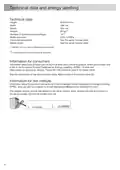
- Page 42: Technical data and energy labelling Height: 819-872 mm Width: 596 mm Depth: 554 mm Weight: 50 kg Number of standard place settings: 14 Water pressure: 0.03-1.0 MPa Electrical connection: See the serial number plate Rated power: See the serial number plate Information for consumers Information for test institute
- Page 43: Page 43
ASKO DFI777UXXL Dishwasher

KitchenAid KDFE104K Dishwasher

MAYTAG MDB Series Dishwasher

VALBERG SAD929C Dishwasher

Gaggenau 9001923384 B Dishwasher

IKEA SBE6496E0G PROFFSIG Integrated Dishwasher

Whirlpool WFC 3C26 X UK Dishwasher

BOSCH SPS4HMW49E Dishwasher

BOSCH SHE53CE5SS Recessed Handle Dishwasher

SIEMENS SN61HX04AE Dishwasher